Post by : Saif Nasser
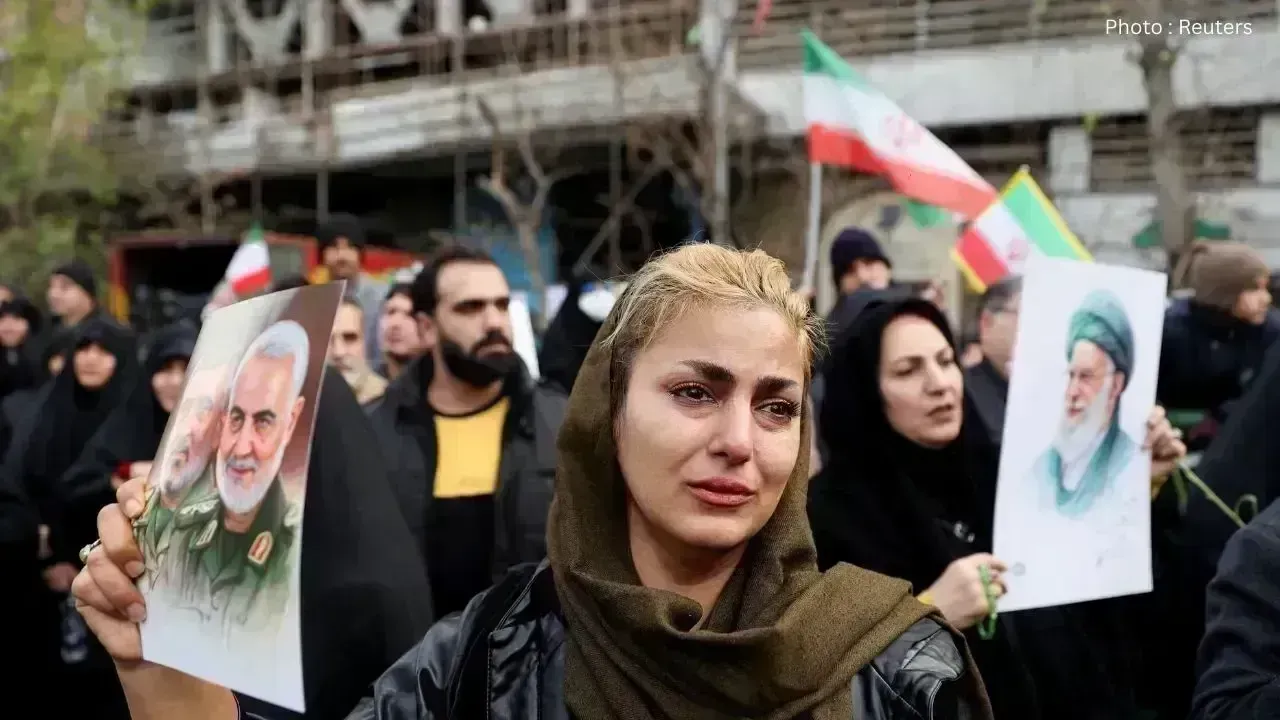
The Middle East faces growing tension as Iran warns that it will retaliate if the United States strikes its territory. In response, the U.S. has withdrawn some personnel from key bases in the region as a precautionary measure. The warnings and troop movements come amid the worst unrest in Iran in decades.
Iran’s leadership is struggling to control widespread protests that have erupted across the country. Demonstrators are expressing anger over dire economic conditions and the harsh crackdown by security forces. The unrest has led to the deaths of thousands, making it the deadliest wave of protests in Iran since the 1979 Islamic Revolution. Rights groups report over 2,600 deaths, while Iranian officials claim around 2,000.
The situation has prompted the United States to prepare for potential intervention. A senior Western military official told Reuters that all signals indicate a U.S. strike could be imminent, though the exact timing and scope remain unclear. President Donald Trump, however, has indicated a cautious approach. He said he believes the killings are decreasing and that the U.S. is “watching the process” before deciding on any military action.
Iranian Foreign Minister Abbas Araqchi also sought to calm tensions, stating in an interview that “hanging is out of the question,” in reference to the anti-government protesters. Despite this, Iran has warned neighboring countries that U.S. bases in the region would be targeted if Washington launches attacks. The warning extends to U.S. allies such as Saudi Arabia, the United Arab Emirates, and Turkey.
In Qatar, the U.S. has withdrawn some personnel from its Al Udeid air base, the largest American base in the Middle East. Some British personnel have also been removed from bases in the region. Officials said these drawdowns are precautionary measures amid heightened regional tensions.
The protests, which began two weeks ago, started as demonstrations against the rapid collapse of Iran’s currency and poor economic conditions. The unrest has quickly turned violent, with security forces cracking down on protesters. The Iranian government blames foreign powers, particularly the U.S. and Israel, for fueling the unrest. French Foreign Minister Jean-Noel Barrot described the crackdown as “the most violent repression in Iran’s contemporary history.”
Despite the protests and U.S. threats, Iran’s security apparatus remains firmly in control. The government has displayed public support through large funeral processions and rallies showing loyalty to Supreme Leader Ayatollah Ali Khamenei. Officials are trying to project stability while managing both domestic unrest and international pressure.
The United Nations Security Council is set to meet to discuss the crisis in Iran. Meanwhile, the U.S. continues to monitor the situation closely. The combination of internal unrest, regional warnings, and U.S. military readiness has created a tense environment, with the possibility of escalation high.
Iran’s people continue to face uncertainty, with internet blackouts and heavy security presence limiting access to information. As the world watches, the actions of both Washington and Tehran will determine whether the crisis escalates or moves toward a fragile stability.








The Impact of Consistent Small Investments on Wealth Building
Discover how investing small amounts regularly can positively transform your financial future over t

7.5 Magnitude Earthquake Strikes Japan, Tsunami Alerts Issued
Japan experiences a hefty 7.5 quake, prompting tsunami alerts and safety measures. Stay updated on a

Reopening of the Strait of Hormuz: New Regulations to Impact Global Trade
Iran reopens the strategic Strait of Hormuz with new regulations affecting oil transport and global

Top 10 Must-See Attractions in NYC for First-Time Explorers
Discover essential experiences for first-time visitors to NYC, including attractions, culture, and i

Starbucks Engages Boyu Capital for Major Chinese Expansion
Starbucks teams up with Boyu Capital, selling a majority stake to boost growth and adapt to the Chin

Three Individuals Charged in Massive Meth Trafficking Case in Malaysia
In Malaysia, a married couple and another suspect are charged with trafficking 510kg of meth, facing