Post by : Saif Nasser
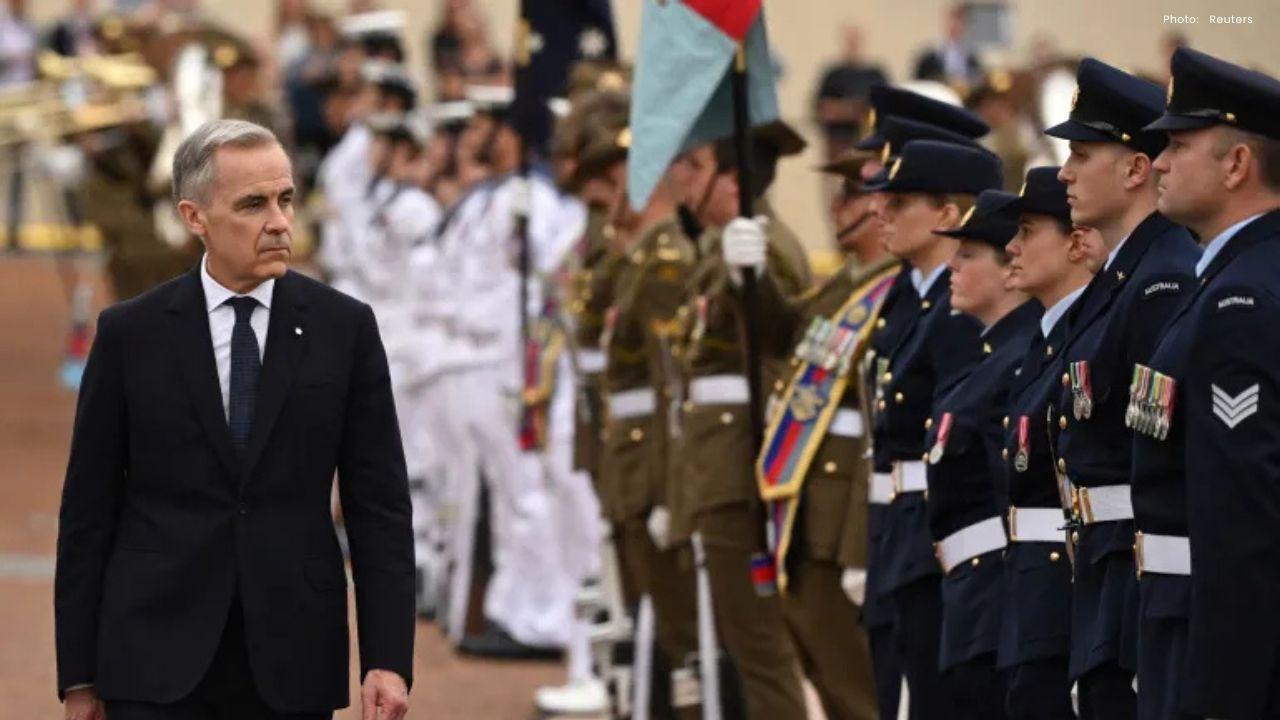
Canada’s Prime Minister Mark Carney has said that his country cannot completely rule out a military role in the ongoing conflict involving Iran. His comments come as tensions in the Middle East continue to rise following attacks by the United States and Israel on Iranian targets and Iran’s retaliatory actions across the region. The conflict has quickly become one of the most serious international crises in recent years, raising fears that more countries could become involved.
Carney made the statement while speaking to reporters during a visit to Australia, where he met with Australian Prime Minister Anthony Albanese. When asked whether Canada might join the war in some form, Carney said that such a possibility could not be completely ruled out. He described the question as hypothetical but emphasized that Canada would always stand with its allies and defend its citizens if necessary.
At the same time, the Canadian leader stressed that Canada was not informed in advance about the military strikes carried out by the United States and Israel against Iran. According to Carney, Canada was neither consulted nor asked to participate in the initial attack that triggered the current conflict. His remarks showed that some Western allies were surprised by the sudden escalation.
The current crisis began after large-scale military strikes targeted several Iranian locations. These attacks have led to heavy damage and casualties and have triggered strong retaliation from Iran. The conflict has spread across different parts of the Middle East, with missile and drone attacks reported in multiple areas and military activity increasing throughout the region.
Carney also raised legal concerns about the strikes. He said that, at first glance, the attacks appeared to be inconsistent with international law. However, he noted that the final judgment on legality would depend on legal experts and international institutions. Even while expressing concern, he acknowledged that the world is now facing a difficult and rapidly changing security situation.
Despite his criticism of the military action, Carney said Canada remains committed to its alliances. Canada is a member of NATO and has long maintained strong military partnerships with the United States and other Western countries. In times of international crisis, these alliances often play an important role in determining how countries respond.
The prime minister’s comments reflect the complicated position Canada currently faces. On one hand, the government has called for calm and urged all sides to respect international rules and avoid further escalation. On the other hand, Canada must also consider its security commitments and the expectations of its allies.
Carney has repeatedly called for de-escalation and diplomatic efforts to reduce tensions. He warned that the current conflict shows serious weaknesses in the international system that is meant to prevent wars and maintain global stability. According to him, the crisis demonstrates how fragile the global order has become.
The Canadian leader also stressed the importance of cooperation between “middle powers” such as Canada and Australia. These countries may not have the same global influence as major powers like the United States or China, but they can still work together to promote stability, diplomacy, and international cooperation.
During his visit to Australia, Carney and Albanese both emphasized the need to prevent the conflict from spreading further. The leaders agreed that Iran should not be allowed to develop nuclear weapons, but they also stressed that diplomatic solutions should be explored to avoid a wider war.
Across the world, governments are closely watching the situation. Several countries are already preparing evacuation plans for their citizens in the Middle East. Airlines have cancelled flights, energy markets have reacted with rising prices, and global trade routes are facing disruptions because of the growing instability.
Analysts warn that if the conflict continues to escalate, more nations could become involved either directly or indirectly. Military alliances, regional security concerns, and economic interests could all influence how different countries respond.
For Canada, any decision about military involvement would require careful political and legal consideration. The government would need to evaluate the situation, consult with allies, and possibly seek approval from parliament before sending troops or military resources into the conflict.
At this stage, Carney’s statement does not mean that Canada will definitely join the war. Instead, it signals that the government is keeping its options open while monitoring developments closely. His remarks highlight how uncertain the global situation has become as the conflict continues to unfold.
For now, Canada is urging restraint while preparing for different possible outcomes. The coming weeks will likely determine whether the crisis moves toward diplomacy and negotiation or expands into a wider international confrontation.







DAE Achieves Remarkable Growth in Q1 2026 With Record Revenue
Dubai Aerospace Enterprise announces impressive financial results for Q1 2026, reflecting a surge in

Price Increase for Sony PS5 in Southeast Asia Effective May 1
Sony announces a price increase for the PS5 across Southeast Asia starting May 1, 2026, impacting ga

Potential ‘Super El Niño’ in 2026: Understanding the Climate Risks
Could a Super El Niño emerge in 2026? Discover its implications and potential global climate impacts

Global Energy Crisis Intensifies: Markets React to Oil Supply Challenges
Markets are on edge as oil disruptions escalate, influencing prices and economic stability. Explore

Must-See Tourist Spots in London You Can't Overlook
Explore London's essential attractions, from royal landmarks to vibrant markets, ensuring an unforge

Ultimate Guide to Snagging Cheap Flights in 2026
Unlock the secrets to booking affordable flights in 2026 with insightful tips and strategies tailore




