Post by : Saif Nasser
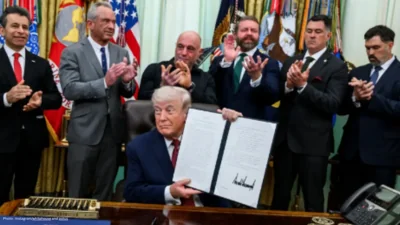
The United States has announced a major change in how it will sell weapons to other countries. President Donald Trump has signed a new executive order that gives priority to nations that spend more on their own defense and hold strong strategic positions in their regions. This new approach is called the “America First Arms Transfer Strategy.”
For many years, U.S. foreign military sales mostly worked on a first-come, first-served basis. Countries that placed orders earlier usually received their weapons earlier, unless special exceptions were made. Now, that system is being reshaped. Under the new rule, countries that invest heavily in their military and play a key role in regional security will move ahead in the line.
This is not just a small technical update. It is a policy shift that could affect global defense ties, military readiness of allies, and the U.S. defense industry itself.
The White House says the goal is simple: make sure U.S.-made weapons go first to partners who are serious about their own defense and who matter most to regional stability. Officials say this will help strengthen alliances and make sure limited production capacity is used in the most effective way.
Another goal is to support American industry. Large foreign weapons orders help keep U.S. factories running and workers employed. The administration says that when trusted partners place big orders, it allows companies to expand production lines. That can also help the U.S. military get its own equipment faster and sometimes at lower cost because of higher total output.
In recent years, demand for American weapons has grown quickly. Wars, regional tensions, and security fears have pushed many countries to upgrade their forces. This has created production backlogs and delivery delays. Some buyers have had to wait years for advanced systems. The White House argues that the older system did not always match orders with real manufacturing capacity.
The new order directs the Departments of Defense, State, and Commerce to prepare a priority list of weapons platforms and systems for export. They are also asked to find deals that support both U.S. national security and industrial growth. At the same time, the order calls for faster approval processes and clearer monitoring rules to reduce paperwork delays and improve transparency.
Supporters of the move say it rewards responsibility. Their argument is that countries that spend more on defense show commitment to their own security and to shared alliances. Giving them priority access to weapons could strengthen deterrence and reduce the risk of conflict. They also note that some alliances, such as NATO, have already pushed members to raise defense spending. In 2025, NATO leaders backed a higher defense spending target equal to 5% of GDP.
However, critics see risks in this approach. One concern is fairness. Smaller or poorer partner countries may need defensive weapons but cannot afford very high military budgets. If they are pushed down the priority list, their security could suffer. That might create new weak spots in already fragile regions.
There is also concern about the global arms race. When weapons become easier and faster to obtain for top-spending countries, neighbors may feel pressure to match that power. This can increase tension instead of reducing it. Arms sales are not just business deals — they also shape regional military balance.
Another question is how “strategic importance” will be defined. The executive order does not name specific countries. That gives the U.S. government flexibility, but it also creates uncertainty. Decisions could change with politics and world events. Countries may lobby hard to be seen as strategically vital.
Arms exports have always been a mix of security policy, diplomacy, and economics. This new strategy makes that mix more direct and more selective. It ties access to American weapons more closely to defense spending levels and regional value.
In the end, the success of this policy will depend on how it is carried out. If it strengthens reliable partners while keeping careful controls, it could improve coordination among allies. If applied too narrowly, it could create gaps and resentment.
Weapons policy is never only about hardware. It is about trust, balance, and long-term stability. Changing the order of who gets what — and when — can reshape relationships across the world. That is why this new rule deserves close attention in the months ahead.




Reopening of the Strait of Hormuz: New Regulations to Impact Global Trade
Iran reopens the strategic Strait of Hormuz with new regulations affecting oil transport and global

Top 10 Must-See Attractions in NYC for First-Time Explorers
Discover essential experiences for first-time visitors to NYC, including attractions, culture, and i

Starbucks Engages Boyu Capital for Major Chinese Expansion
Starbucks teams up with Boyu Capital, selling a majority stake to boost growth and adapt to the Chin

Three Individuals Charged in Massive Meth Trafficking Case in Malaysia
In Malaysia, a married couple and another suspect are charged with trafficking 510kg of meth, facing

Singapore Police Revisit Geylang Murder Scene with Suspect
In Geylang, police return a murder suspect to the scene of a crime involving the fatal stabbing of a