Post by : Saif Nasser
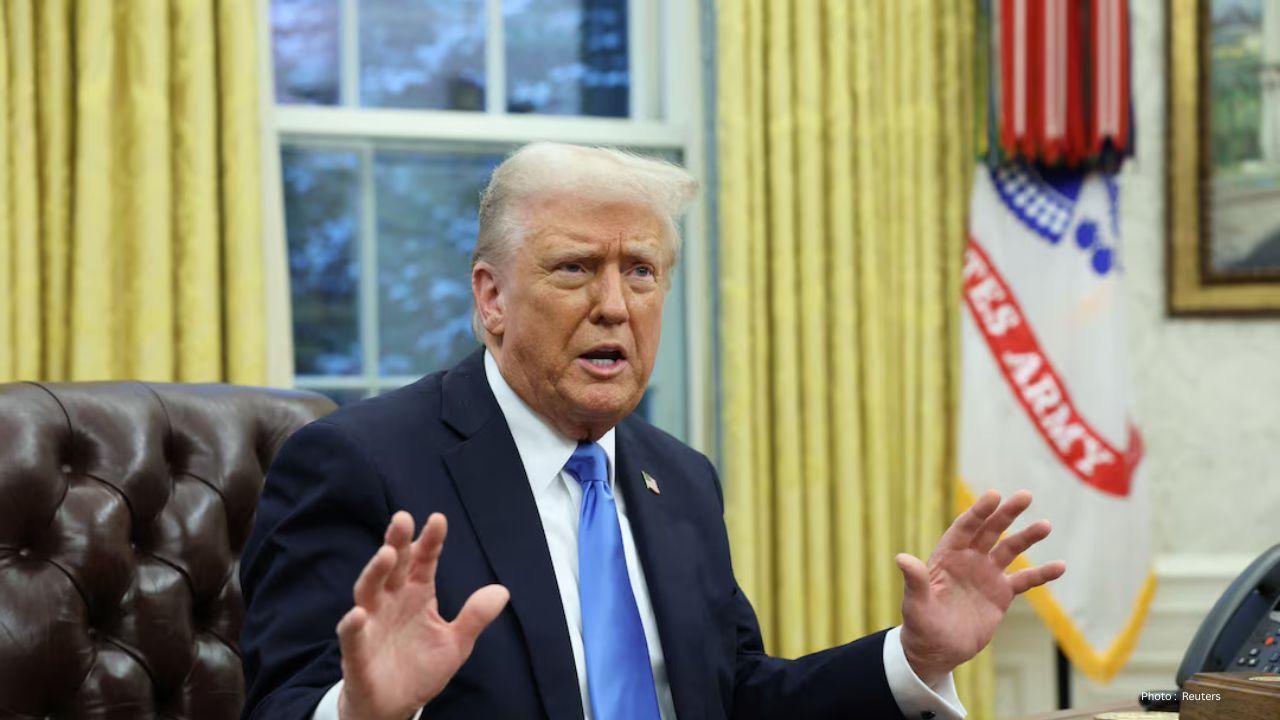
U.S. President Donald Trump has confirmed that he has allowed the Central Intelligence Agency (CIA) to begin secret operations in Venezuela. This move marks a serious rise in U.S. pressure on Venezuelan President Nicolás Maduro and his government.
The decision gives the CIA power to conduct lethal operations, gather intelligence, and carry out missions across Venezuela and parts of the Caribbean. Many experts say this could increase political tension in the region and may even lead to a new conflict.
Why Did Trump Approve CIA Operations?
President Trump told reporters in Washington that he authorized the operations mainly for two reasons — illegal migration and drug trafficking.
“I authorized for two reasons really,” Trump said in the Oval Office. “They have emptied their prisons into the United States, and they are sending drugs. We now have the sea under control, and we are looking at land.”
Trump claimed that Venezuela had released former prisoners who then crossed into the U.S. through the southern border. However, he has not provided any public evidence to support this claim.
The U.S. government has already offered a $50 million reward for any information leading to Maduro’s arrest or conviction on drug trafficking charges.
What the Authorization Means
The classified order, first reported by The New York Times, gives the CIA a much stronger hand in Venezuela. According to reports, the CIA can now carry out covert missions — including operations that may involve force.
Historically, the CIA’s role in Latin America has ranged from gathering information to direct involvement in wars and political crises. During the Cold War, the CIA helped to influence governments across Central and South America and fought against drug cartels in the late 20th century.
The new authorization could allow the CIA to operate more freely in the Caribbean region, especially as the U.S. increases its military presence there.
U.S. Military Build-Up in the Caribbean
Alongside the CIA’s new powers, Trump has ordered a large U.S. military buildup in the southern Caribbean. In recent months, U.S. forces have carried out several strikes on ships accused of smuggling drugs.
However, Trump’s government has not provided evidence to confirm that these vessels were linked to drug trafficking.
Some members of Congress, including both Democrats and Republicans, have raised questions about these military actions. They say the White House has shared little information about what exactly the U.S. military and the CIA are doing in the region.
Senator Jeanne Shaheen, a senior Democrat on the Senate Foreign Relations Committee, warned that the administration may be putting American soldiers at risk. “The American people deserve to know if the administration is leading the U.S. into another conflict,” she said.
Venezuela’s Response
The Venezuelan government reacted strongly to Trump’s announcement. It accused the United States of violating international law and trying to force regime change in Caracas.
Venezuela’s Foreign Minister Yvan Gil said in a public statement that the U.S. is using claims of drug trafficking as an excuse to overthrow President Maduro and seize Venezuela’s oil resources.
“Our mission to the United Nations will bring this issue before the Security Council and the Secretary-General, demanding accountability from the U.S. government,” Gil said on his Telegram account.
For years, Venezuela has accused Washington of supporting opposition groups and plotting to remove Maduro, who has ruled the country since 2013.
Trump Says Venezuela Is “Feeling the Heat”
When asked if the CIA now has the power to capture or even kill President Maduro, Trump avoided giving a direct answer. He simply said, “I think Venezuela is feeling heat.”
Trump also repeated his claim that Venezuela has become a major source of the deadly drug fentanyl, although U.S. records show that most fentanyl entering America comes from Mexico, not Venezuela.
When a reporter asked why he didn’t rely more on the U.S. Coast Guard to stop drug boats, Trump said such efforts were “politically correct” and claimed they had not worked well in the past.
A Risk of New Conflict
Trump’s decision comes at a time when the United States has already declared what the Pentagon called a “non-international armed conflict” with drug cartels. This means the U.S. now treats certain criminal networks as if they were enemy forces in a war.
Experts say that combining this policy with CIA covert operations could lead to serious consequences. Any U.S. military or intelligence activity inside Venezuela — without its government’s approval — could be seen as a violation of sovereignty and a step toward war.
It would also repeat a long and controversial history of U.S. intervention in Latin America, including past efforts to remove leaders who opposed Washington’s policies.
The Bigger Picture
Since taking office, Trump has repeatedly accused Maduro’s government of corruption, election fraud, and involvement in drug trafficking. The U.S. has placed economic sanctions on Venezuelan oil, frozen assets, and supported opposition leader María Corina Machado, though her team has not yet commented on Trump’s latest move.
Analysts say that Trump’s decision to authorize the CIA reflects his hardline approach to both immigration and national security. However, it could also isolate the United States diplomatically and create new instability in Latin America.
The move also raises questions about how far Trump is willing to go in his campaign to pressure Venezuela — and whether this could lead to direct conflict in the region.
Venezuela’s Struggle and Global Impact
Venezuela has faced years of economic crisis, hyperinflation, and mass migration. Millions of Venezuelans have left the country seeking better lives abroad, with many ending up in the United States.
At the same time, Maduro has stayed in power with support from allies such as Russia, China, and Iran — countries that oppose U.S. influence in the region.
If the CIA becomes more active in Venezuela, it could draw these nations further into the dispute, turning it into a larger international confrontation.
A Dangerous Gamble
Trump’s latest order may mark a turning point in U.S. foreign policy toward Venezuela. While he says his goal is to stop drug trafficking and illegal migration, critics argue that it could instead bring violence and chaos.
The move has already deepened distrust between Washington and Caracas and raised fears of covert actions that could spiral out of control.
In the end, the biggest question remains — is this about stopping drugs and protecting borders, or is it about removing a government that the United States no longer wants in power?

The Impact of Consistent Small Investments on Wealth Building
Discover how investing small amounts regularly can positively transform your financial future over t

7.5 Magnitude Earthquake Strikes Japan, Tsunami Alerts Issued
Japan experiences a hefty 7.5 quake, prompting tsunami alerts and safety measures. Stay updated on a
Reopening of the Strait of Hormuz: New Regulations to Impact Global Trade
Iran reopens the strategic Strait of Hormuz with new regulations affecting oil transport and global

Top 10 Must-See Attractions in NYC for First-Time Explorers
Discover essential experiences for first-time visitors to NYC, including attractions, culture, and i
Starbucks Engages Boyu Capital for Major Chinese Expansion
Starbucks teams up with Boyu Capital, selling a majority stake to boost growth and adapt to the Chin
Three Individuals Charged in Massive Meth Trafficking Case in Malaysia
In Malaysia, a married couple and another suspect are charged with trafficking 510kg of meth, facing