Post by : Saif Nasser
A major political meeting in North Korea is expected to reshape the country’s military and weapons development plans. Officials say the upcoming Workers’ Party Congress will set new arms goals after reviews showed that several targets from the 2021 plan were only partly completed. The meeting is important because it guides long-term defense policy and shows where the country will spend its money and effort in the coming years.
Leader Kim Jong Un has placed strong focus on military strength since the last party congress. Nuclear weapons and long-range missiles remain central to his strategy. But experts say the record is mixed when it comes to other systems such as drones, submarines, and military satellites. These tools are important because they improve surveillance, targeting, and strike coordination without always crossing the nuclear threshold.
The earlier 2021 plan called for a wide list of advanced weapons. These included hypersonic missiles, solid-fuel intercontinental ballistic missiles, reconnaissance satellites, unmanned attack systems, and even a nuclear-powered submarine. State media later showed progress in some areas, especially missile testing. However, other programs faced delays, technical failures, or unclear results.
One area where North Korea appears to have made steady progress is drones. State reports and outside analysts say the country has increased drone testing and production. Military displays have shown both surveillance and attack-style unmanned aircraft. Modern warfare around the world has shown how powerful drones can be for reconnaissance and precision strikes. Because drones are cheaper and faster to build than large weapons platforms, they are attractive for countries under heavy sanctions.
Security researchers have also raised concerns about possible cooperation between North Korea and Russia on drone production. Some reports suggest Russian designs or production support may be involved. If true, this would have wider security effects in Northeast Asia. Still, such claims are difficult to fully verify, and details remain limited.
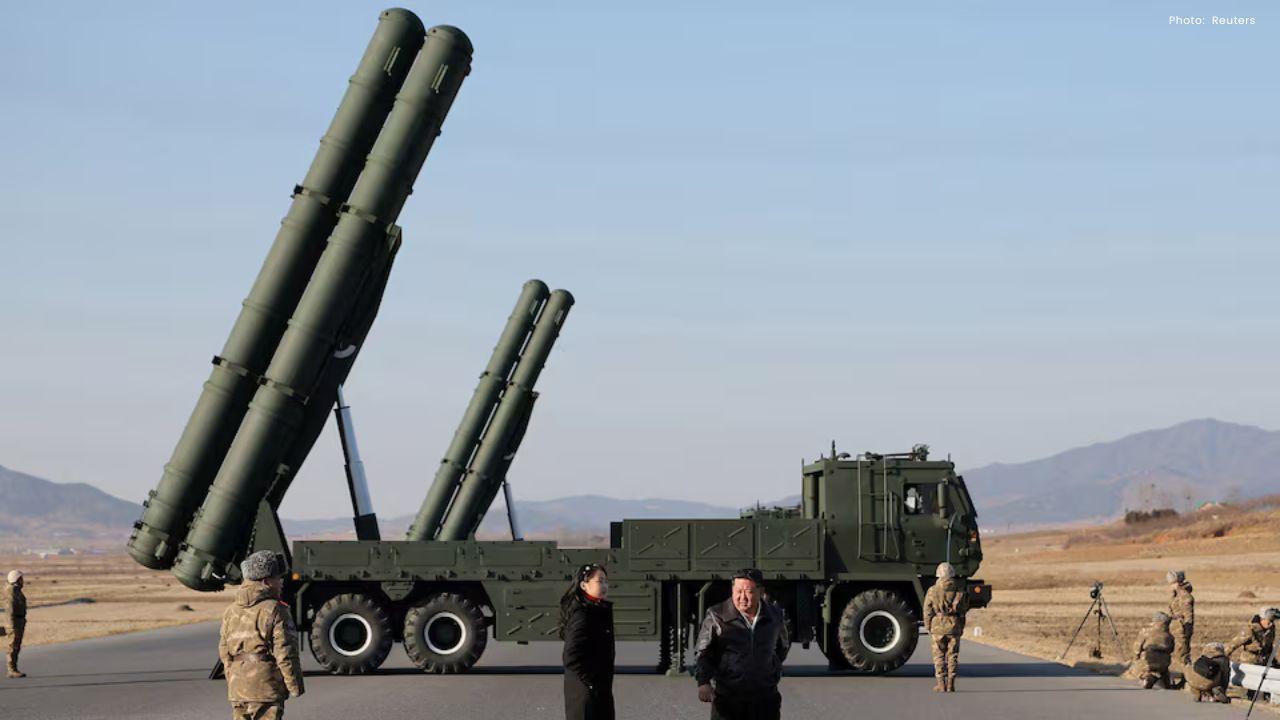
Another strong focus has been conventional artillery and rocket systems. North Korea has tested very large multiple rocket launchers and expanded long-range artillery drills. Analysts say this type of firepower gives the country a powerful non-nuclear strike option. Reports from regional defense officials also claim that North Korea has exported some conventional weapons systems abroad. Arms exports can bring in cash and also help clear out older stock, making room for newer equipment.
Submarine development, however, appears more troubled. North Korea introduced what it called a tactical nuclear attack submarine in recent years, but outside experts questioned whether it was fully operational. Later images showed construction of a larger submarine said to be nuclear-powered. Building such a vessel is extremely complex. It requires advanced reactor design, noise control, sensor systems, and trained crews. Analysts say these are major barriers for a heavily sanctioned and resource-limited country. So far, there is no public proof of a fully successful nuclear submarine program.
The space and satellite program has also seen mixed outcomes. North Korea succeeded in placing a military reconnaissance satellite into orbit in 2023. But later launch attempts failed. Military satellites are valuable because they allow a country to observe troop movement, bases, and ships from space. Without reliable satellite coverage, modern targeting and coordination become harder. Experts believe the program will continue, but future launches may be delayed until engineers are more confident of success.
The expected reset of goals at the new party congress suggests a practical adjustment. Instead of only announcing ambitious projects, leadership may now focus on what can be finished and deployed reliably. This kind of reset does not mean the country is slowing its military push. Instead, it may be choosing more reachable steps and clearer priorities.
From an editorial point of view, this development matters beyond one country. Military upgrades in North Korea affect the security balance across East Asia. Neighboring countries watch each test and announcement closely. When weapons programs grow, mistrust also grows. That often leads to more defense spending across the region, creating a cycle of tension.
At the same time, it is important to understand the difference between announcement and ability. Declaring a new weapon is easier than building a reliable one. True military strength depends on testing, maintenance, trained operators, and supply chains. Gaps between plans and results are common in complex defense projects everywhere.
The coming congress will likely present a revised roadmap. The world will be watching to see whether the focus shifts toward drones and artillery, continues toward missiles and nuclear systems, or pushes again into difficult areas like submarines and space assets. Each choice will send a signal about future direction.
Military policy decisions made now will shape regional stability for years. That is why this meeting, though internal, carries international weight.










Reopening of the Strait of Hormuz: New Regulations to Impact Global Trade
Iran reopens the strategic Strait of Hormuz with new regulations affecting oil transport and global

Top 10 Must-See Attractions in NYC for First-Time Explorers
Discover essential experiences for first-time visitors to NYC, including attractions, culture, and i

Starbucks Engages Boyu Capital for Major Chinese Expansion
Starbucks teams up with Boyu Capital, selling a majority stake to boost growth and adapt to the Chin

Three Individuals Charged in Massive Meth Trafficking Case in Malaysia
In Malaysia, a married couple and another suspect are charged with trafficking 510kg of meth, facing

Singapore Police Revisit Geylang Murder Scene with Suspect
In Geylang, police return a murder suspect to the scene of a crime involving the fatal stabbing of a