Post by : Saif Nasser
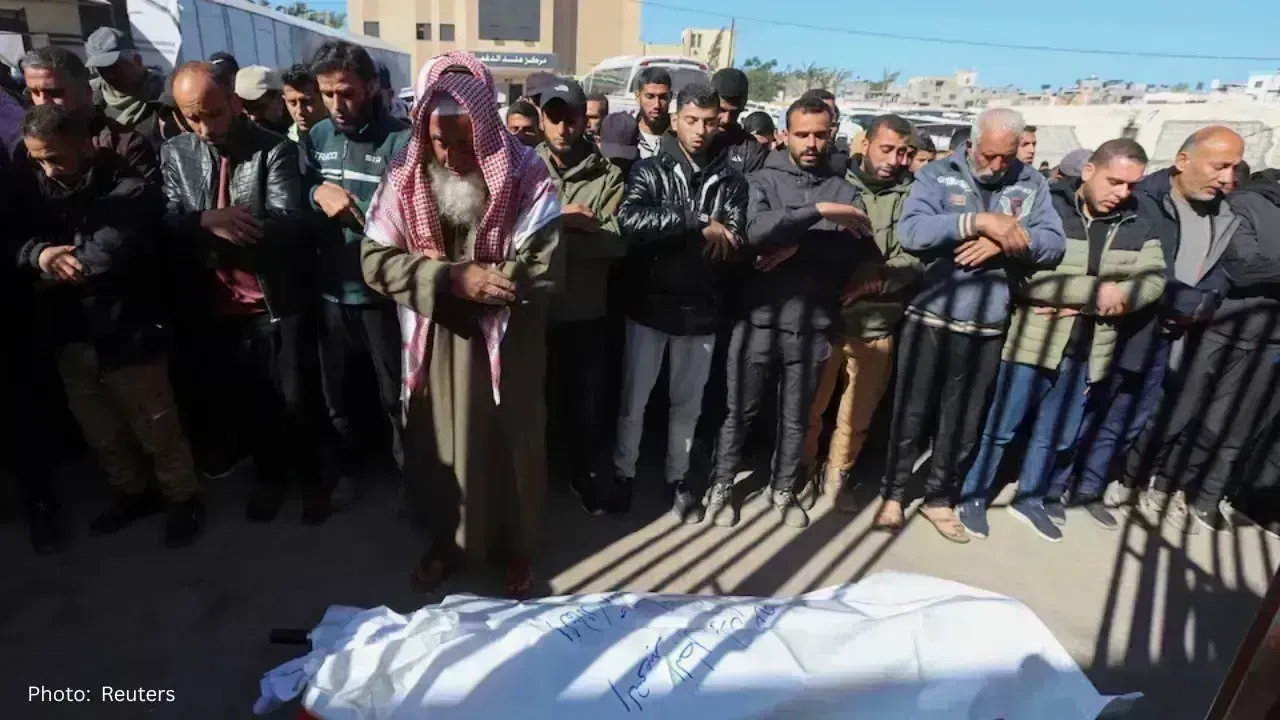
The killing of a senior Hamas police officer in southern Gaza has opened a new and troubling chapter in the already fragile situation inside the war-torn enclave. The incident highlights growing internal divisions, rising insecurity, and the risk of further violence even as a ceasefire remains in place.
On Monday, gunmen shot and killed Mahmoud Al-Astal, head of the criminal police unit in Khan Younis, according to Gaza’s Hamas-run interior ministry. The attackers fired from a passing car and escaped. Hamas described the gunmen as “Israeli collaborators,” accusing them of working against Palestinian interests.
Shortly after the attack, an armed Palestinian group opposed to Hamas claimed responsibility. Hussam Al-Astal, the leader of the group, posted a video on social media in which he openly threatened Hamas members. Wearing a military-style uniform and holding a rifle, he warned that anyone working with Hamas would be targeted next.
Reuters could not independently confirm the details of the killing. An Israeli military official said the army was not aware of any direct operation in the area at the time. Still, the event has drawn attention because it points to Israel’s quiet support for rival Palestinian groups inside Gaza.
These anti-Hamas groups are small and limited in reach, but their presence adds pressure on Hamas, which has ruled Gaza for years. Their actions could also complicate any future plans to stabilize or reunify the territory after nearly two years of devastating war.
Most Palestinians in Gaza do not support these armed rivals. Many see them as operating under Israeli protection, even though the groups deny taking direct orders from Israel. In the past, Hamas has responded harshly to suspected collaborators, including carrying out public executions to deter cooperation with Israel.
Under the ceasefire that began in October, Israel withdrew from nearly half of Gaza. However, Israeli forces still control large areas that have been almost completely destroyed by fighting. Nearly all of Gaza’s two million residents now live in Hamas-held zones, often in tents or damaged buildings, struggling with shortages of food, water, and medical care.
Despite heavy losses during the war, Hamas remains powerful. Several Hamas sources say the group still commands thousands of fighters and continues to enforce control in areas it governs. The killing of a senior police officer, however, challenges its ability to maintain order and security.
Israeli Prime Minister Benjamin Netanyahu has previously acknowledged that Israel has supported rival clans and groups inside Gaza, saying they were “activated” to weaken Hamas. Yet details of this strategy remain unclear, and its long-term impact is uncertain.
The broader ceasefire has reduced major fighting over the past three months, but violence has not stopped. Both sides accuse each other of repeated violations. Since the truce began, more than 440 Palestinians and three Israeli soldiers have been killed, according to available reports.
On Monday alone, Gaza health officials said Israeli drone fire killed at least three people near Khan Younis. The Israeli military said those killed were militants who approached troops in an area under Israeli control and were shot to remove a threat.
This latest killing shows that Gaza is far from stable. Beyond the conflict with Israel, internal Palestinian tensions are now becoming more visible and deadly. For civilians already exhausted by war, displacement, and loss, these developments deepen fear and uncertainty.
From an editorial perspective, the incident underlines a painful truth: even during a ceasefire, Gaza remains trapped in violence. Without a clear political path forward and real efforts to protect civilians, the risk of further chaos and bloodshed remains high.










The Impact of Consistent Small Investments on Wealth Building
Discover how investing small amounts regularly can positively transform your financial future over t

7.5 Magnitude Earthquake Strikes Japan, Tsunami Alerts Issued
Japan experiences a hefty 7.5 quake, prompting tsunami alerts and safety measures. Stay updated on a
Reopening of the Strait of Hormuz: New Regulations to Impact Global Trade
Iran reopens the strategic Strait of Hormuz with new regulations affecting oil transport and global

Top 10 Must-See Attractions in NYC for First-Time Explorers
Discover essential experiences for first-time visitors to NYC, including attractions, culture, and i

Starbucks Engages Boyu Capital for Major Chinese Expansion
Starbucks teams up with Boyu Capital, selling a majority stake to boost growth and adapt to the Chin

Three Individuals Charged in Massive Meth Trafficking Case in Malaysia
In Malaysia, a married couple and another suspect are charged with trafficking 510kg of meth, facing