Post by : Saif Nasser
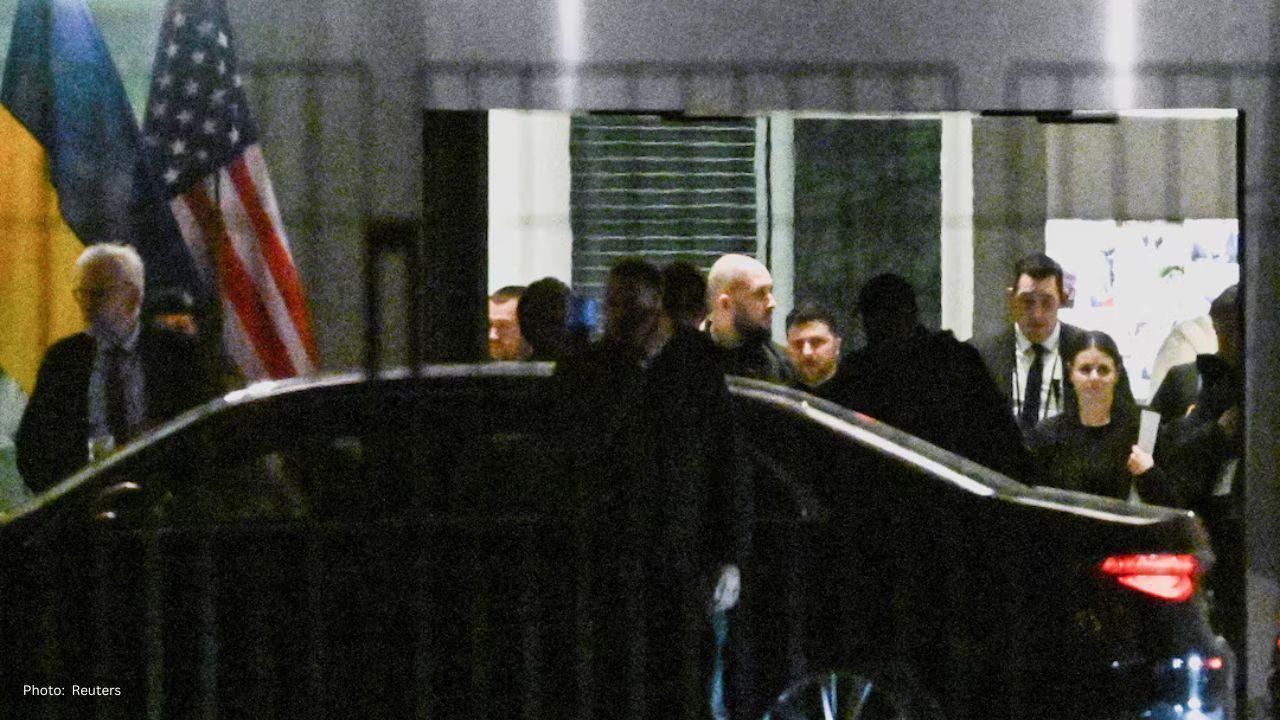
Ukrainian President Volodymyr Zelenskiy resumed peace talks in Berlin on Monday with U.S. envoys, marking the second day of high-level negotiations aimed at ending Europe’s deadliest conflict since World War Two.
The meetings involve U.S. envoy Steve Witkoff and President Donald Trump’s son-in-law Jared Kushner, along with European leaders who are holding discussions throughout the day. Ukrainian officials have indicated they may drop their long-standing goal of joining NATO in exchange for Western security guarantees.
However, the details of a possible ceasefire, the future of Ukrainian territory, and security commitments remain unclear. The Kremlin emphasized that Ukraine not joining NATO is a fundamental point in any peace settlement. Kremlin spokesman Dmitry Peskov said Russia expects updates from the U.S. following the Berlin talks.
The discussions come at a crucial time for Europe. An EU summit on Thursday is set to decide whether to approve a massive loan to Ukraine using frozen Russian central bank assets. EU foreign ministers are also meeting to plan new sanctions against Russia, even as last-minute negotiations on a trade deal with Latin America could complicate matters.
Danish Foreign Minister Lars Lokke Rasmussen stressed the urgency of financing Ukraine. "We must take a decision to ensure that Ukraine is in a position to continue its freedom fight and to show the rest of the world that Europe is a strong player," he said.
Finnish President Alexander Stubb, closely involved in the peace talks, described the moment as critical. "We are probably closer to a peace agreement than we have been at any time during these four years," he said. He added that the discussions focus on three main documents: a 20-point peace framework, security guarantees for Kyiv, and a reconstruction plan for Ukraine.
European Commission President Ursula von der Leyen and leaders from Britain, Italy, the Netherlands, Poland, and Sweden are also participating in the talks.
Russia has repeatedly demanded that Ukraine renounce NATO ambitions, withdraw troops from eastern Donbas, and remain neutral with no NATO forces stationed on its territory. Russian sources earlier indicated that President Vladimir Putin wants a formal promise from Western powers not to expand NATO further east.
EU foreign policy chief Kaja Kallas warned that conceding the Donbas region would not satisfy Russia. "If he gets Donbas, then the fortress is down and then they definitely move on to taking the whole of Ukraine," she said.
As negotiations continue, European leaders hope to show unity and support for Ukraine, while balancing pressure from the U.S. and the complex realities of diplomacy with Russia.



DAE Achieves Remarkable Growth in Q1 2026 With Record Revenue
Dubai Aerospace Enterprise announces impressive financial results for Q1 2026, reflecting a surge in

Price Increase for Sony PS5 in Southeast Asia Effective May 1
Sony announces a price increase for the PS5 across Southeast Asia starting May 1, 2026, impacting ga

Potential ‘Super El Niño’ in 2026: Understanding the Climate Risks
Could a Super El Niño emerge in 2026? Discover its implications and potential global climate impacts

Global Energy Crisis Intensifies: Markets React to Oil Supply Challenges
Markets are on edge as oil disruptions escalate, influencing prices and economic stability. Explore

Must-See Tourist Spots in London You Can't Overlook
Explore London's essential attractions, from royal landmarks to vibrant markets, ensuring an unforge

Ultimate Guide to Snagging Cheap Flights in 2026
Unlock the secrets to booking affordable flights in 2026 with insightful tips and strategies tailore




