Post by : Priya
Photo:AFP
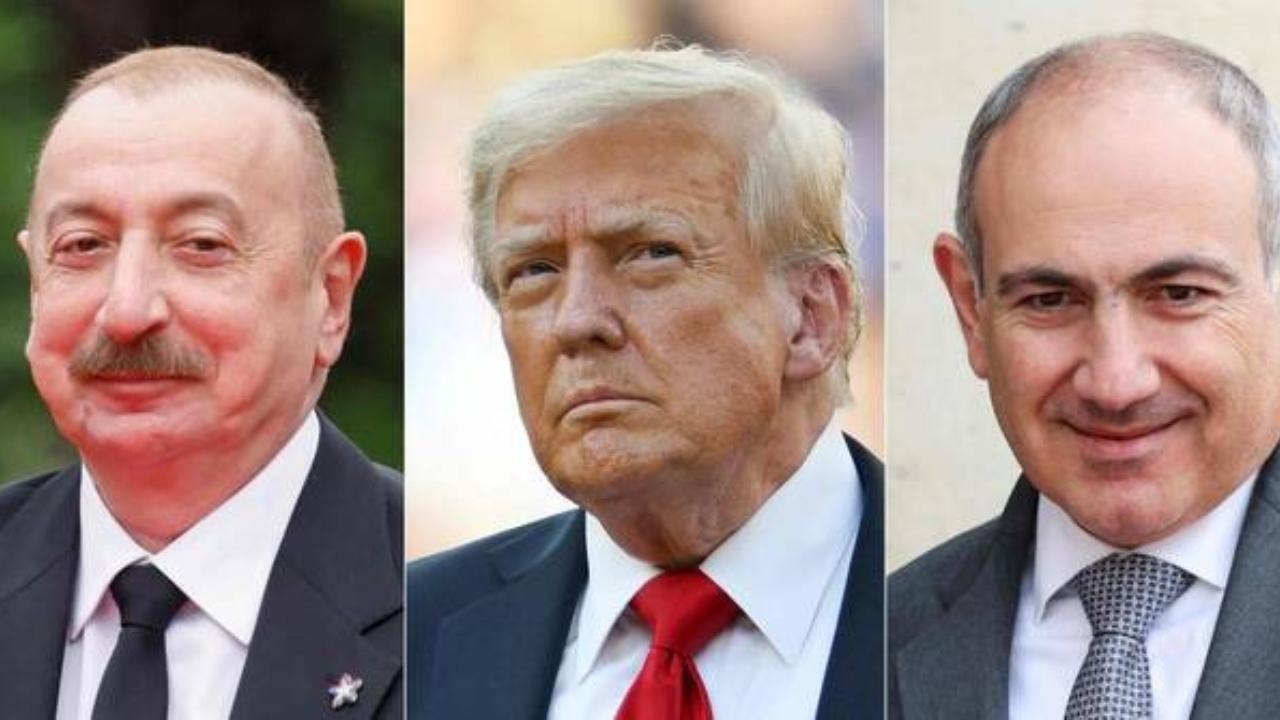
After decades marked by conflict, hardship, and disrupted lives, Armenia and Azerbaijan are poised to turn a new page in their turbulent history. On August 8, 2025, the leaders of these neighboring South Caucasus nations signed a peace agreement at the White House in Washington, D.C., under the auspices of former U.S. President Donald Trump. This event, hailed as historic by many observers, represents not only an end to years of hostility but also a hopeful beginning for regional cooperation, economic development, and stability.
Background: Longstanding Conflict Over Nagorno-Karabakh
The roots of this conflict stretch back to the late 20th century, emerging from ethnic and territorial disputes over Nagorno-Karabakh, a region internationally recognized as part of Azerbaijan but long controlled by Armenian forces. The dissolution of the Soviet Union in 1991 intensified these tensions, leading to a full-scale war that resulted in over 30,000 lives lost and widespread displacement.
Despite a fragile ceasefire in the mid-1990s, clashes continued intermittently for decades. The situation escalated in 2020 when Azerbaijan launched a military offensive and recaptured much of the contested territory, culminating in a Russia-brokered peace agreement. Yet despite this, deep mistrust and sporadic violence persisted.
Most recently, in September 2023, Azerbaijan established full sovereignty over Nagorno-Karabakh following the surrender of separatist forces, a move that significantly altered the regional balance and paved the way for renewed diplomatic efforts.
The Role of the United States and Donald Trump’s Mediation
The peace initiative championed by Donald Trump, who hosted the Armenian Prime Minister Nikol Pashinyan and Azerbaijani President Ilham Aliyev for the signing ceremony, reflects years of diplomatic efforts by the U.S. government to stabilize the volatile South Caucasus region.
Trump emphasized on his social media platform that many leaders had attempted to resolve the conflict without success, but the recent agreement marked a breakthrough facilitated under his administration's engagement with both sides. He expressed pride in the courage of the leaders, calling the occasion a “Historic Day” for the countries involved and for the global community.
Beyond peace, the United States also secured bilateral agreements with Armenia and Azerbaijan to jointly pursue economic development, unlocking the region’s untapped potential and opening pathways for trade and infrastructure projects.
Key Elements of the Peace Agreement
Ceasefire and Peace Treaty: The core of the deal is a formal peace treaty that ends hostilities definitively, promising to replace decades of mistrust with cooperation.
Trump Route for International Peace and Prosperity: A central feature of the agreement is a transit corridor, dubbed by officials as the "Trump Route," spanning 43 kilometers. This corridor connects Azerbaijan with its exclave Nakhchivan, separated by Armenian territory. It is envisioned as a multi-modal transport and energy route that includes roads, railways, pipelines, and fiber optic cables.
U.S. Development and Leasing Rights: Under the deal, the United States obtained leasing rights to develop and assist in constructing this transit corridor, which is expected to facilitate the free movement of goods and people and enhance regional connectivity. This development is planned to be financed by private sector entities rather than the U.S. government.
Economic Cooperation: The deal includes commitments to economic collaboration in sectors such as energy, infrastructure, and commerce, aiming to leverage the strategic location of the South Caucasus as a bridge between Europe and Asia.
Regional and Global Implications
For Armenia and Azerbaijan, the agreement offers a long-sought relief from conflict that has resulted in profound human suffering and economic hardship. It promises stability that could encourage investment, tourism, and improved living standards.
For the broader South Caucasus region, peace between Armenia and Azerbaijan can unlock regional integration, restore disrupted trade routes, and reduce the influence of external actors competing for regional dominance.
The United States, through its role as peace broker and infrastructure developer, signals continued strategic interest in this pivotal region, historically a crossroads of cultures, economies, and geopolitical ambitions.









Mattel Revives Masters of the Universe Action Figures Ahead of Film Launch
Mattel is reintroducing Masters of the Universe figures in line with its upcoming film, tapping into

China Executes 11 Members of Criminal Clan Linked to Myanmar Scam
China has executed 11 criminals associated with the Ming family, known for major scams and human tra

US Issues Alarm to Iran as Military Forces Deploy in Gulf Region
With a significant military presence in the Gulf, Trump urges Iran to negotiate a nuclear deal or fa

Copper Prices Reach Unprecedented Highs Amid Geopolitical Turmoil
Copper prices soar to all-time highs as geopolitical tensions and a weakening dollar boost investor

New Zealand Secures First Win Against India, Triumph by 50 Runs
New Zealand won the 4th T20I against India by 50 runs in Vizag. Despite Dube's impressive 65, India