Post by : Saif Nasser
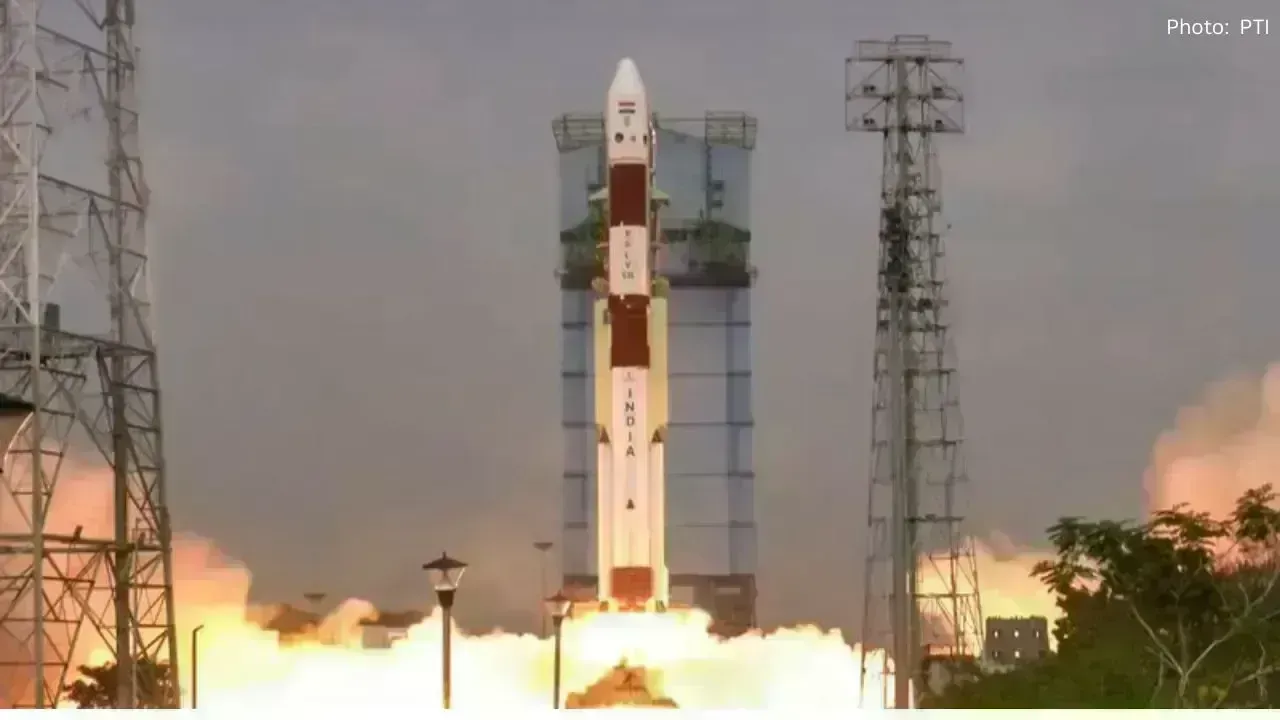
India’s trusted Polar Satellite Launch Vehicle (PSLV) faced a serious test on Monday when its 64th mission showed an unexpected deviation during flight. The rocket, known as PSLV-C62, lifted off from the Satish Dhawan Space Centre in Sriharikota at 10:18 am, carrying the EOS-N1 satellite along with 14 other co-passenger satellites. While the launch began smoothly, the Indian Space Research Organisation (ISRO) later confirmed that a deviation was noticed during the rocket’s third stage.
ISRO Chairman Dr. V. Narayanan said that engineers are carefully studying the flight data to understand what went wrong. He did not immediately call the mission a success or a failure, showing that the space agency is taking a cautious and scientific approach before making any final announcement. ISRO has assured that full details will be shared once the analysis is complete.
This mission was especially important because it came after a PSLV failure in 2025. The PSLV has long been considered one of India’s most reliable launch vehicles, with a strong record of successful missions. Any issue with such a trusted rocket naturally draws attention, not just in India but around the world. Even so, experts say that temporary setbacks are part of space exploration and often lead to better systems in the future.
PSLV-C62 carried a total of 15 satellites. The main payload, EOS-N1, was meant to strengthen India’s Earth observation capabilities. Along with it were several smaller satellites, including Anvesha, a surveillance satellite developed by the Defence Research and Development Organisation (DRDO). Anvesha is designed to provide advanced imaging, helping India monitor and map sensitive and strategic areas with high accuracy. Another satellite, the Kestrel Initial Demonstrator, was planned for a controlled re-entry mission.
The launch also marked an important moment for India’s private space industry. For the first time, a single Indian private company, Hyderabad-based Dhruva Space, contributed seven satellites to a PSLV mission. This highlights how private companies are playing a growing role alongside ISRO in building India’s space future.
While the deviation has raised questions, ISRO’s calm response reflects its experience and confidence. Space missions are complex, and even a small change in flight behavior can lead to detailed investigations. Such reviews often help engineers improve designs and avoid similar issues in future launches.
For now, the nation waits for ISRO’s final report. Regardless of the outcome, this mission underlines both the challenges and the strength of India’s space program. Transparency, careful analysis, and continuous improvement have always been key parts of ISRO’s work. As the data review continues, the focus remains on learning from the event and moving forward with stronger and safer missions ahead.










The Impact of Consistent Small Investments on Wealth Building
Discover how investing small amounts regularly can positively transform your financial future over t

7.5 Magnitude Earthquake Strikes Japan, Tsunami Alerts Issued
Japan experiences a hefty 7.5 quake, prompting tsunami alerts and safety measures. Stay updated on a

Reopening of the Strait of Hormuz: New Regulations to Impact Global Trade
Iran reopens the strategic Strait of Hormuz with new regulations affecting oil transport and global

Top 10 Must-See Attractions in NYC for First-Time Explorers
Discover essential experiences for first-time visitors to NYC, including attractions, culture, and i

Starbucks Engages Boyu Capital for Major Chinese Expansion
Starbucks teams up with Boyu Capital, selling a majority stake to boost growth and adapt to the Chin

Three Individuals Charged in Massive Meth Trafficking Case in Malaysia
In Malaysia, a married couple and another suspect are charged with trafficking 510kg of meth, facing