Post by : Saif Nasser
For thousands of years, the land between the Tigris and Euphrates rivers has fed civilizations. Today, that same land is struggling to grow enough wheat, as Iraq faces one of the worst water crises in its modern history. Long-held hopes of becoming self-sufficient in wheat are now fading as drought, climate change, and shrinking rivers hit farmers hard.
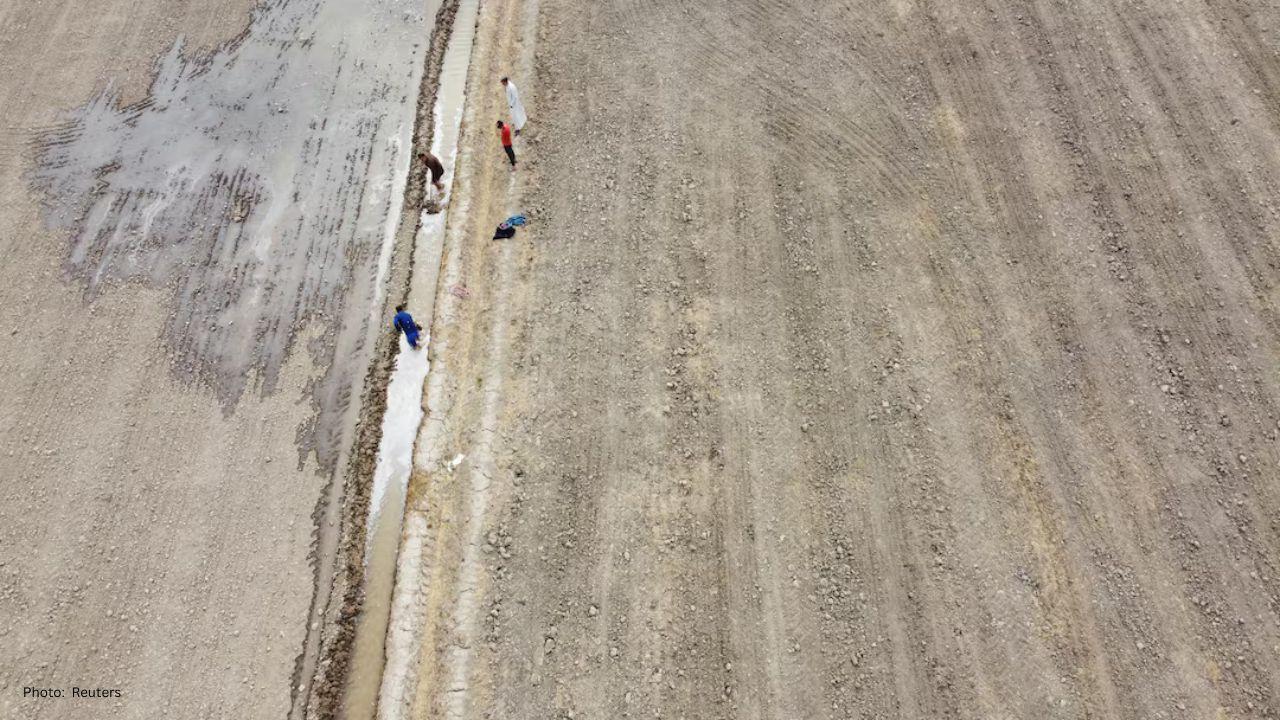
Near the holy city of Najaf, wheat farmer Ma’an al-Fatlawi stands beside dry canals and cracked soil. For decades, his fields depended on water from the Euphrates River. This year, that water barely arrived. Drilling wells has not helped, as underground water in his area is too salty to grow crops. With little choice, he has reduced his wheat planting to just a fraction of what it once was and laid off most of his workers.
Iraq had made strong progress in recent years. Once one of the Middle East’s biggest wheat importers, the country recorded three straight years of surplus production. Government support played a key role. Farmers were given high-yield seeds, modern tools, and generous subsidies. The state even paid more than double the global price for wheat to encourage local production. At one point, grain reserves were so large they filled Iraq’s storage facilities.
That progress is now under serious threat. This year is the driest Iraq has seen in decades. Water levels in the Tigris and Euphrates have fallen to record lows. The United Nations Food and Agriculture Organization says wheat production could drop by 30% to 50% this season. Iraq’s total water reserves have collapsed from about 60 billion cubic metres in 2020 to less than 4 billion today.
Climate change is a major cause. Iraq is one of the world’s most climate-vulnerable countries. Temperatures are rising faster than the global average, rainfall is falling, and heatwaves are becoming more common. But nature is not the only factor. About 70% of Iraq’s water comes from outside its borders. Upstream dams built by Turkey and Iran have sharply reduced the flow of water reaching Iraqi farms.
The impact goes far beyond crops. With less water available, Baghdad has introduced rationing. The government has capped river-irrigated wheat planting at half of last season’s level and banned rice farming nationwide because it uses too much water. Farmers are now required to use modern irrigation methods like drip and sprinkler systems instead of traditional flood irrigation, which wastes water. Desert farming using groundwater has expanded, but this too depends on costly equipment and careful management.
Experts warn that relying too much on wells could create new problems. Producing one ton of wheat needs more than a thousand cubic metres of water. Uncontrolled pumping risks draining underground reserves. In southern Iraq, groundwater levels have already fallen by several metres. For many rural families, the cost of new irrigation systems is simply too high.
As local production falls, wheat imports are expected to rise again. The FAO predicts Iraq may need to import about 2.4 million tons of wheat in the coming season. While global wheat prices are currently low, reliance on imports leaves Iraq exposed to sudden price spikes and budget pressure. Analysts warn that water and food shortages can also lead to social unrest and security risks.
The human cost is already visible. Around 170,000 people have been displaced from rural areas due to water scarcity. For families who depend on farming, the crisis is not only about food, but about survival and dignity.
Iraq’s struggle shows how water scarcity can undo years of progress in food security. Without urgent regional cooperation on water sharing, stronger climate adaptation, and support for farmers, the country’s ancient role as a breadbasket may continue to slip away.









Anticipated Dates for UAE Eid Al Adha 2026 Unveiled by Astronomical Experts
Experts predict Eid Al Adha 2026 in the UAE to start on May 27, prompting early holiday planning amo

DAE Achieves Remarkable Growth in Q1 2026 With Record Revenue
Dubai Aerospace Enterprise announces impressive financial results for Q1 2026, reflecting a surge in

Price Increase for Sony PS5 in Southeast Asia Effective May 1
Sony announces a price increase for the PS5 across Southeast Asia starting May 1, 2026, impacting ga

Potential ‘Super El Niño’ in 2026: Understanding the Climate Risks
Could a Super El Niño emerge in 2026? Discover its implications and potential global climate impacts

Global Energy Crisis Intensifies: Markets React to Oil Supply Challenges
Markets are on edge as oil disruptions escalate, influencing prices and economic stability. Explore

Must-See Tourist Spots in London You Can't Overlook
Explore London's essential attractions, from royal landmarks to vibrant markets, ensuring an unforge




