Post by : Saif Nasser
Iranian President Masoud Pezeshkian has accused the United States, Israel, and several European countries of increasing tensions during recent protests across Iran. Speaking on state television, he said foreign leaders took advantage of Iran’s economic troubles and encouraged unrest in order to divide the country.
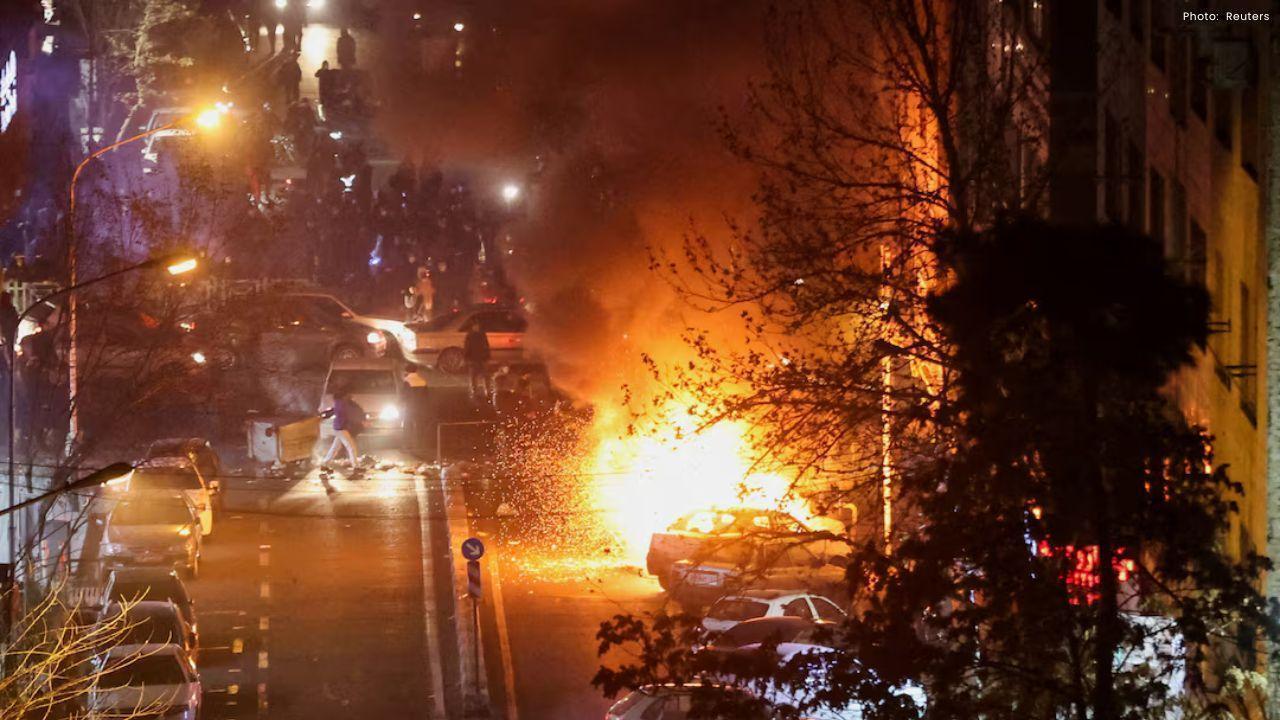
The protests began in late December and lasted for nearly two weeks. They were triggered by a deep economic crisis, marked by rising prices, high inflation, and a sharp fall in the value of Iran’s currency. Many Iranians took to the streets to express anger over the high cost of living and lack of economic relief.
President Pezeshkian claimed that what started as social protests were later influenced by outside forces. He said foreign leaders used Iran’s problems to provoke people and provide support that pushed demonstrations toward violence. According to him, these actions were aimed at creating division and weakening the country from within.
The protests have now largely ended after a strong crackdown by Iran’s security forces. Human rights groups outside Iran report a very high death toll, with thousands of protesters and security personnel killed. Iranian officials have given lower figures but still acknowledge heavy losses on both sides.
During his speech, Pezeshkian directly named U.S. President Donald Trump, Israeli Prime Minister Benjamin Netanyahu, and European leaders. He said they “rode on Iran’s problems” and tried to turn public anger into chaos. He added that their goal was not reform but to tear Iranian society apart.
The United States has openly supported the protesters. President Trump has warned Iran against using force and said Washington was considering its options if violence continued. U.S. officials have confirmed that no final decision has been made on possible military action, but the warnings have increased tensions in the region.
Reports of a U.S. Navy destroyer docking at an Israeli port have also raised concerns about possible escalation. At the same time, countries such as Turkey, Saudi Arabia, and the United Arab Emirates have stepped in diplomatically, urging calm and trying to prevent a wider conflict between Iran and the United States.
Iran’s foreign minister, Abbas Araqchi, said Iran is open to talks but will not negotiate its missile program, which the U.S. has demanded as a condition for renewed discussions. He stated clearly that Iran is prepared for either dialogue or conflict, depending on how other nations act.
Araqchi also dismissed any idea of regime change, saying Iran’s political system is stable and deeply rooted. According to him, outside pressure will not change the country’s leadership or direction.
The situation highlights the fragile balance in the Middle East, where economic hardship, public anger, and global politics often collide. While the protests have slowed, the underlying economic problems remain. Without relief for ordinary people, tensions could rise again, making stability harder to achieve.




Reopening of the Strait of Hormuz: New Regulations to Impact Global Trade
Iran reopens the strategic Strait of Hormuz with new regulations affecting oil transport and global

Top 10 Must-See Attractions in NYC for First-Time Explorers
Discover essential experiences for first-time visitors to NYC, including attractions, culture, and i

Starbucks Engages Boyu Capital for Major Chinese Expansion
Starbucks teams up with Boyu Capital, selling a majority stake to boost growth and adapt to the Chin

Three Individuals Charged in Massive Meth Trafficking Case in Malaysia
In Malaysia, a married couple and another suspect are charged with trafficking 510kg of meth, facing
Singapore Police Revisit Geylang Murder Scene with Suspect
In Geylang, police return a murder suspect to the scene of a crime involving the fatal stabbing of a