Post by : Saif Nasser
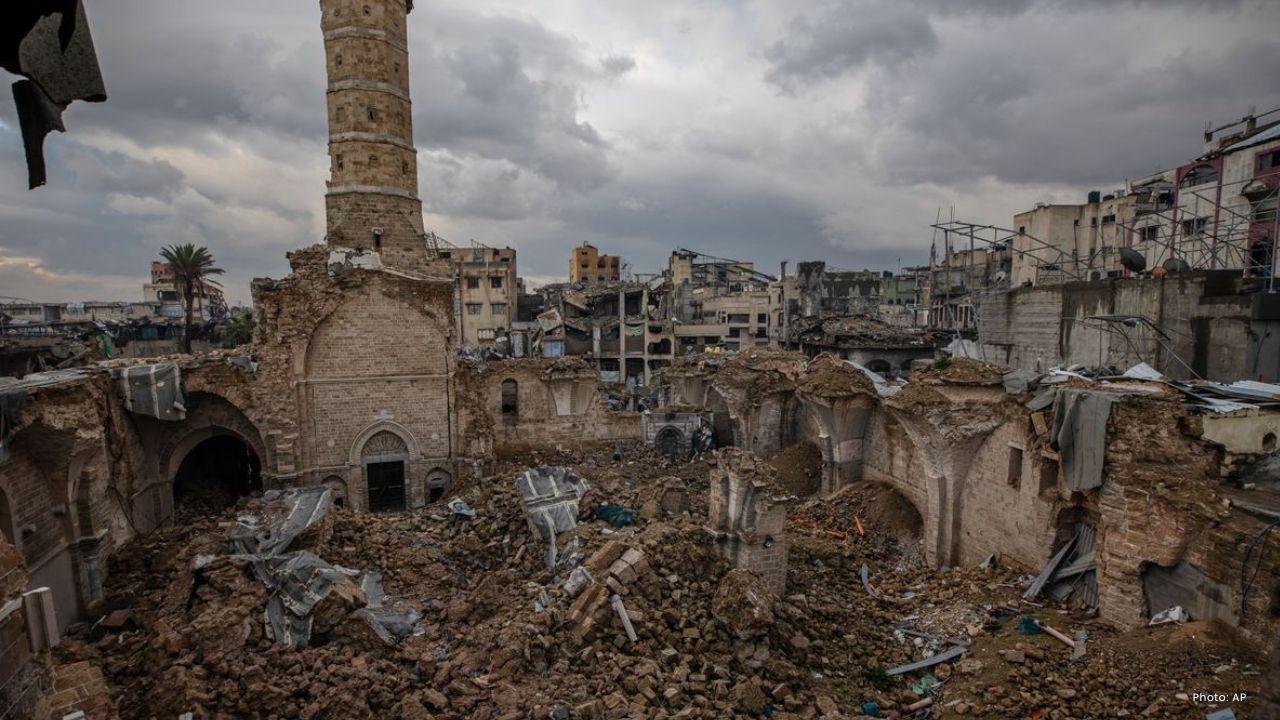
After two years of heavy fighting, much of Gaza is in ruins. Homes, schools, markets, and hospitals have been damaged or destroyed. But beyond the human suffering, another loss is becoming clearer — the damage to Gaza’s long and rich history.
Across the territory, old religious buildings, museums, bathhouses, and archaeological sites have been hit. These places were not only made of stone and wood. They carried memory, identity, and community meaning. Now many of them stand broken.
One of the most painful examples is the Great Omari Mosque in Gaza City. For centuries, it was one of the most important religious and cultural landmarks in the area. Families prayed there. Children studied there. Visitors walked through the nearby markets and courtyards. Today, large parts of it are damaged, with fallen columns and collapsed roofs.
For local residents, the loss is personal. Many older people say they grew up visiting these places with their parents and grandparents. These were not just buildings. They were part of daily life.
The war between Israel and Hamas has caused destruction across the Gaza Strip. According to local health officials, tens of thousands of people have been killed. Entire neighborhoods have been flattened. With a fragile ceasefire now in place, people are finally able to look around and measure the cultural damage more clearly.
International cultural agencies using satellite images say that more than 150 heritage and cultural sites show signs of damage. These include religious buildings, historic houses, monuments, and archaeological areas. Some were partly damaged. Others were almost completely destroyed.
Important sites affected include the Pasha Palace, which once displayed rare artifacts from different historical periods. Workers now say many items are missing or buried under debris. Recovery teams are trying to find and protect whatever remains. Each recovered object is treated like a rescued piece of memory.
Another site, Hamam al-Sumara, one of Gaza’s oldest bathhouses, also suffered heavy damage. Before the war, it was a rare example of traditional public bath culture still in use. It connected modern residents to centuries-old customs.
The Israeli military has said it targeted militant infrastructure and claims that armed groups operated near or under some of these sites. Palestinian officials and local heritage groups deny this in several cases. International bodies say they assess damage but do not assign blame. Independent investigators have questioned whether some strikes were justified even if military targets were claimed nearby.
Under international law, cultural and religious sites should be protected during war. They should not be used for military purposes, and they should not be attacked unless there is a very strong and direct military reason. Even then, the level of force must be limited. When ancient sites are destroyed, the loss is not only local — it is global.
ccc history goes back thousands of years. It has been a crossroads of trade, religion, and empire. Egyptians, Greeks, Romans, Byzantines, early Muslims, Crusaders, and Ottomans all left marks on the land. Each period added layers to its culture. Buildings like the Omari Mosque show these layers in their stones and design.
Heritage experts say culture gives people a sense of belonging. It tells them who they are and where they come from. When cultural landmarks disappear, communities can feel uprooted. Recovery is not only about clearing rubble. It is also about protecting identity.
Restoration, however, will be very difficult. Rebuilding historic sites needs skilled workers, special materials, careful study, and stable conditions. Gaza faces shortages of cement, tools, and funding. Border restrictions and political disputes make large rebuilding projects uncertain.
There is also a lesson here for the wider world. War does not only take lives in the present. It also erases links to the past. When a historic mosque, church, palace, or archive is destroyed, future generations lose something they can never fully rebuild.
Even so, local teams continue their careful work. They collect broken stones, document damage, and store fragments. They hope that one day proper restoration can begin. Their effort sends a message: culture matters, even after disaster.
Saving heritage will not heal every wound from the war. But it can help people feel rooted again. It can give children something solid to inherit — proof that their story did not begin with destruction and will not end with it.









Reopening of the Strait of Hormuz: New Regulations to Impact Global Trade
Iran reopens the strategic Strait of Hormuz with new regulations affecting oil transport and global

Top 10 Must-See Attractions in NYC for First-Time Explorers
Discover essential experiences for first-time visitors to NYC, including attractions, culture, and i

Starbucks Engages Boyu Capital for Major Chinese Expansion
Starbucks teams up with Boyu Capital, selling a majority stake to boost growth and adapt to the Chin

Three Individuals Charged in Massive Meth Trafficking Case in Malaysia
In Malaysia, a married couple and another suspect are charged with trafficking 510kg of meth, facing

Singapore Police Revisit Geylang Murder Scene with Suspect
In Geylang, police return a murder suspect to the scene of a crime involving the fatal stabbing of a