Post by : Saif Nasser
China’s large-scale consumer subsidy program, designed to boost household spending, is losing momentum as the year comes to an end. Experts warn that while the subsidies have helped China’s economy this year, the short-term effects are fading and the country may need new policies to sustain growth.
The program, worth 300 billion yuan (about $42 billion), supports purchases of home appliances, electronics, and electric vehicles. It is equivalent to roughly 0.2% of China’s GDP but has had a larger impact than its size suggests, helping policymakers target around 5% economic growth in 2025.
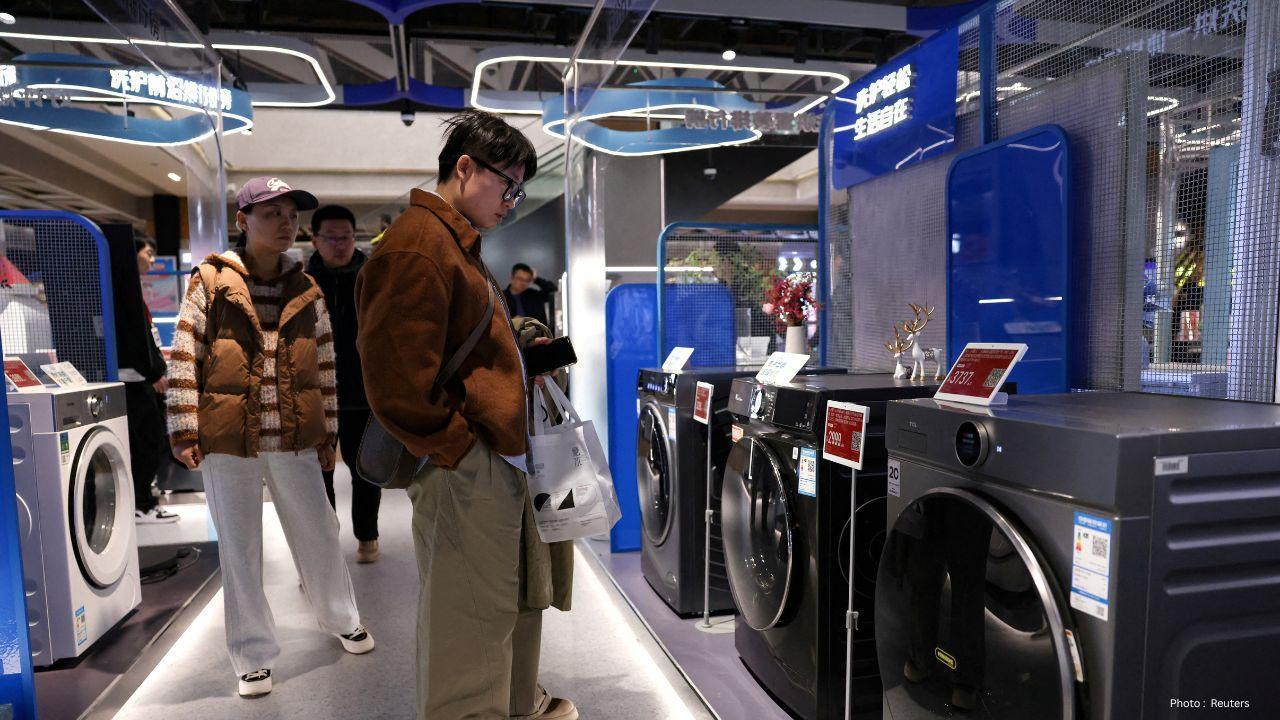
Many Chinese consumers, like doctor Lisa Zhu, have already taken full advantage of the subsidies. Zhu bought three air conditioners and a washing machine this year. “I no longer need to buy home appliances for several years,” she said, highlighting a challenge of the program. Once people buy these durable goods, their demand drops sharply, reducing future sales.
Sales data shows strong initial results. In the first nine months of 2025, refrigerator sales rose 48.3%, electric vehicles 34.9%, and audio-visual gadgets 26.8% compared to 2024, according to state media. Analysts estimate the subsidies contributed about 0.5 percentage points to GDP growth.
However, this front-loaded spending creates a “payback effect.” Nomura predicts that home appliance sales may drop around 20% in the fourth quarter, and auto sales could fall 2%, as consumers no longer need new goods. Retailers are already feeling the slowdown. Shi Xiaolan, a salesperson in Anhui province, said her store’s sales fell from 13 million yuan in June to 3 million in July and have not recovered.
Economists suggest that China should rethink its approach to consumer spending. Rather than focusing on durable goods, they recommend subsidies for services such as dining out, cinemas, travel, and spa visits. Robin Xing, chief China economist at Morgan Stanley, said subsidising services could be more effective in creating jobs and generating long-term economic benefits.
China also faces a deeper structural challenge. Household consumption currently lags global averages by about 20 percentage points of GDP, while investment, especially in infrastructure and manufacturing, is high. This imbalance makes the economy too reliant on exports, leaving domestic demand weak and contributing to deflationary pressures.
Xing proposes reforms to increase social welfare for farmers and rural workers. He estimates that boosting monthly welfare accounts from 143 yuan to 1,000 yuan could raise consumption to 45% of GDP in five years, up from the current 40%, supporting long-term economic growth.
Meanwhile, small business owners are feeling the effects of the fading subsidies. Cheng Sha, an air conditioner shop owner in Jingzhou, said two-thirds of local appliance merchants face declining sales. “As the subsidies lose effect in 2026, many of us may struggle to keep our shops open,” he said.
Experts warn that without a shift to service-based incentives and social welfare reforms, China’s consumer subsidy program will remain a short-term, cyclical measure. While it has helped stimulate spending in the short run, it is unlikely to create lasting growth unless policymakers introduce deeper, structural changes.
In conclusion, China’s current subsidy scheme has temporarily boosted household purchases and GDP growth, but its effects are fading. The country now faces pressure to focus on sustainable policies that encourage ongoing consumption, improve social welfare, and strengthen domestic demand to maintain long-term economic stability.








Mattel Revives Masters of the Universe Action Figures Ahead of Film Launch
Mattel is reintroducing Masters of the Universe figures in line with its upcoming film, tapping into

China Executes 11 Members of Criminal Clan Linked to Myanmar Scam
China has executed 11 criminals associated with the Ming family, known for major scams and human tra

US Issues Alarm to Iran as Military Forces Deploy in Gulf Region
With a significant military presence in the Gulf, Trump urges Iran to negotiate a nuclear deal or fa
Copper Prices Reach Unprecedented Highs Amid Geopolitical Turmoil
Copper prices soar to all-time highs as geopolitical tensions and a weakening dollar boost investor

New Zealand Secures First Win Against India, Triumph by 50 Runs
New Zealand won the 4th T20I against India by 50 runs in Vizag. Despite Dube's impressive 65, India