Post by : Naveen Mittal
For decades, discovering a new drug was like searching for a needle in a biochemical haystack — an expensive, slow, and uncertain process. But now, artificial intelligence is turning that chaos into clarity.
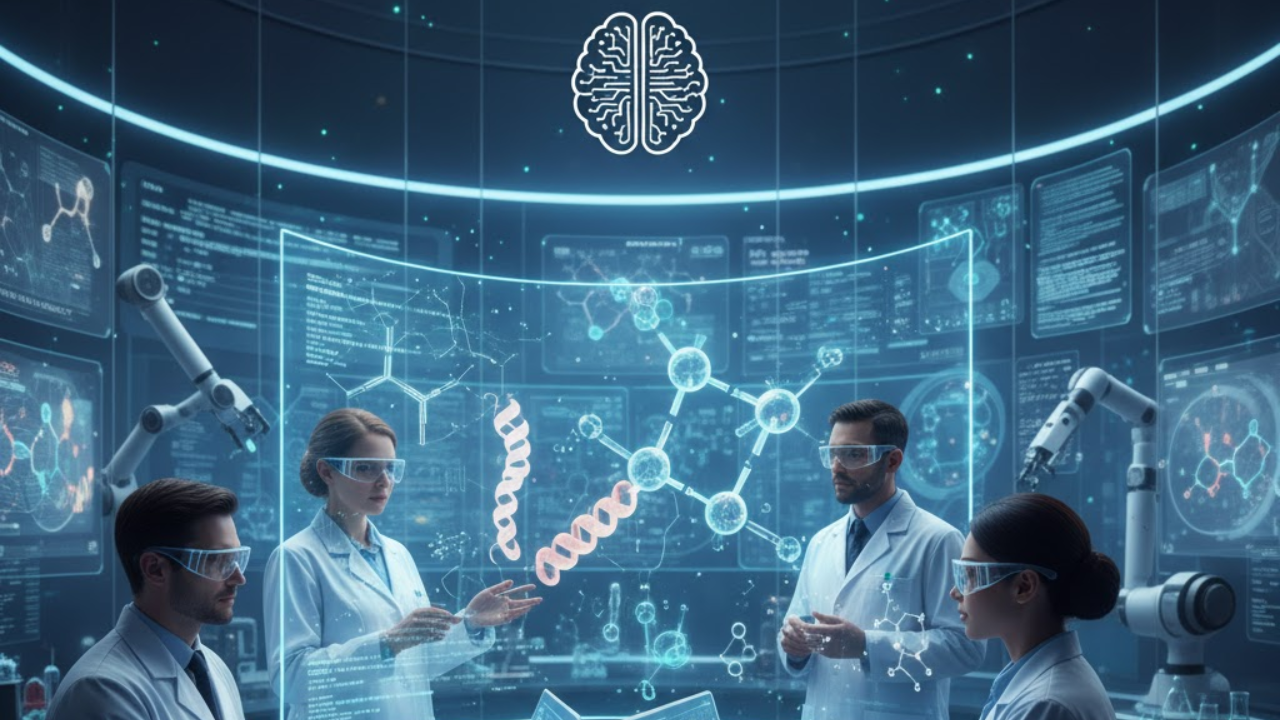
In 2025, the pharmaceutical industry stands on the verge of a revolution powered by AI-driven drug discovery, where algorithms predict molecular behavior, simulate experiments, and accelerate timelines that once took years — all at a fraction of the cost.
Traditionally, developing a new drug could take 10–15 years and cost over $2 billion. Researchers had to manually test thousands of compounds in labs, relying on trial-and-error methods.
Today, machine learning models can analyze enormous datasets — from molecular structures and genomic sequences to clinical outcomes — to predict which compounds are most likely to work before they ever reach a test tube.
These AI systems identify promising drug candidates, simulate interactions with human proteins, and even suggest molecular modifications to improve safety or effectiveness.
It’s not just speeding up the process — it’s rewriting the rules of modern pharmacology.
AI drug discovery relies on three core technologies:
Neural networks learn from millions of known chemical reactions and molecular structures to predict how new compounds might behave. Models like AlphaFold, developed by DeepMind, revolutionized this space by accurately predicting 3D protein folding, a task once considered nearly impossible.
Generative AI systems such as Insilico Medicine’s Chemistry42 and BenevolentAI’s Genesis platform use the same principles as text- and image-generating models — but instead of words or pictures, they generate new molecular structures.
This allows scientists to design potential drugs that have never existed before, customized for specific diseases.
AI doesn’t stop at chemistry. Machine learning is now being used to predict how drugs will perform in human trials by analyzing biological data, patient demographics, and previous test results.
This helps pharmaceutical companies eliminate weak candidates early, saving millions in failed trials.
Major pharmaceutical giants are now investing heavily in AI-powered pipelines.
Pfizer uses machine learning to identify biomarkers and speed up vaccine research.
AstraZeneca and Sanofi have partnered with AI firms like BenevolentAI and Exscientia to discover novel cancer and cardiovascular drugs.
Insilico Medicine became the first company to bring an AI-discovered molecule (INS018_055) into Phase II clinical trials in 2024, a milestone that shocked the global pharma community.
Roche, Novartis, and Johnson & Johnson are also building in-house AI labs focused on accelerating drug pipelines.
The message is clear: AI is no longer a supporting tool — it’s a strategic asset.
AI-driven drug discovery is already reshaping the economics of the pharmaceutical world.
Speed: Processes that once took years can now be completed in months.
Cost Reduction: AI can lower development costs by up to 60%, according to McKinsey.
Precision: Algorithms help design drugs tailored to genetic variations, paving the way for personalized medicine.
Data Utilization: AI systems can analyze billions of molecular possibilities, something impossible for humans alone.
These advancements could drastically increase the number of treatable diseases and bring hope to conditions previously considered incurable.
With breakthroughs in computational biology, quantum computing, and cloud infrastructure, AI is finally ready for large-scale integration in pharma.
Governments and health regulators are also catching up. The FDA and EMA have launched frameworks to evaluate AI-designed drugs, ensuring safety while encouraging innovation.
At the same time, venture capital funding in AI biotech startups reached record levels in 2025 — crossing $5.6 billion globally, according to PitchBook data.
The intersection of AI and biotechnology is now the hottest field in life sciences — and it’s moving faster than any innovation before it.
The next evolution of AI drug discovery involves quantum computing and nanotechnology.
Quantum computers can simulate complex molecular interactions in seconds — processes that would take traditional systems years. Meanwhile, AI algorithms use this data to design nano-level drug delivery systems that target disease at the cellular level.
This integration promises smarter therapies for cancer, Alzheimer’s, and genetic disorders — with minimal side effects and maximum precision.
As with any emerging technology, AI in pharmacology raises ethical questions:
How transparent are the algorithms behind molecule design?
Who owns an AI-generated patent?
Can machine-predicted drugs guarantee safety in humans?
Regulators and scientists are now calling for explainable AI frameworks to ensure that automation doesn’t come at the cost of accountability.
Still, the consensus is clear — AI’s potential far outweighs its risks when guided by proper oversight and collaboration between humans and machines.
For the first time, machines are not just assisting researchers — they’re becoming co-creators of life-saving drugs.
AI is transforming pharmacology from a reactive science into a predictive and precision-driven discipline, capable of designing molecules that nature itself never imagined.
As we enter this new era of biotechnology, the question is no longer whether AI will change drug discovery — but how quickly it will reshape the entire healthcare ecosystem.
The lab of the future won’t be filled with microscopes and petri dishes, but with algorithms, quantum processors, and intelligent systems — tirelessly decoding the chemistry of life.









Starbucks Engages Boyu Capital for Major Chinese Expansion
Starbucks teams up with Boyu Capital, selling a majority stake to boost growth and adapt to the Chin

Three Individuals Charged in Massive Meth Trafficking Case in Malaysia
In Malaysia, a married couple and another suspect are charged with trafficking 510kg of meth, facing

Singapore Police Revisit Geylang Murder Scene with Suspect
In Geylang, police return a murder suspect to the scene of a crime involving the fatal stabbing of a

Mattel Revives Masters of the Universe Action Figures Ahead of Film Launch
Mattel is reintroducing Masters of the Universe figures in line with its upcoming film, tapping into

China Executes 11 Members of Criminal Clan Linked to Myanmar Scam
China has executed 11 criminals associated with the Ming family, known for major scams and human tra