Post by : Monika
Photo: Reuters
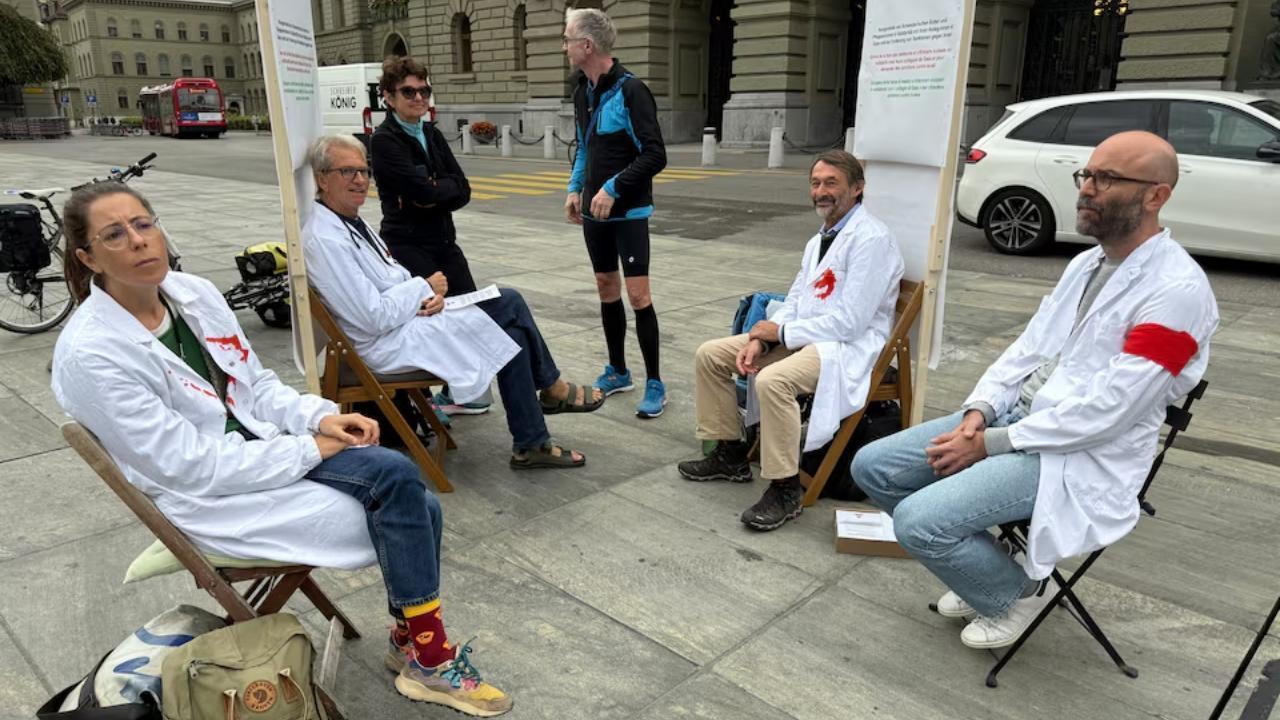
On September 8, 2025, a group of Swiss healthcare professionals began a hunger strike outside the Swiss Parliament in Bern to protest the ongoing crisis in Gaza. This protest was organized by a group called Swiss Healthcare Workers Against Genocide, which includes doctors, nurses, surgeons, and other medical staff. The demonstrators are urging the Swiss government to take stronger action, including implementing targeted sanctions against Israel and officially recognizing Palestine as an independent state.
The hunger strike marks a significant moment in global activism, demonstrating how healthcare professionals are using their platform to advocate for human rights and draw attention to humanitarian crises worldwide.
Background: The Gaza Crisis
Gaza has been facing severe challenges due to years of conflict. Civilian casualties, destruction of infrastructure, and shortages of food, water, and medical supplies have made daily life extremely difficult. Hospitals, schools, and residential areas have been damaged during repeated military strikes. The humanitarian situation in Gaza has caused widespread concern among international organizations, human rights groups, and governments.
Despite condemning certain actions in Gaza, such as attacks on medical facilities, the Swiss government has not taken direct punitive measures against Israel. Switzerland has also not officially recognized Palestine as a state, which some activists believe undermines international efforts to protect civilians and ensure justice.
The Hunger Strike
The hunger strike involves medics wearing traditional medical uniforms, some stained with fake blood, to symbolize the suffering of people in Gaza. Protesters are fasting in shifts, with each participant maintaining a 24-hour fast during the parliamentary session. The protest aims to attract attention from Swiss lawmakers, the public, and international media to highlight the urgent humanitarian crisis in Gaza.
The medics hope their protest will encourage Switzerland to take a stronger and more principled stand on the issue. They emphasize that healthcare workers, whose mission is to save lives, have a moral responsibility to speak out when innocent civilians are being harmed.
Statements from Protest Leaders
Professor Pietro Majno-Hurst, a surgeon participating in the hunger strike, expressed his frustration with the current situation. He said:
"A white tunic used to protect you. Today, if you want to save your life, you take it off, and that's intolerable."
This statement reflects the ethical and emotional distress healthcare professionals feel when they see people suffering and dying due to violence while governments hesitate to take action.
Professor Karl Blanchet, Director of the Geneva Centre of Humanitarian Studies, criticized the Swiss government for being "silent, inactive, and lacking in courage." He emphasized that neutrality should not prevent Switzerland from supporting international humanitarian standards and human rights. Professor Blanchet urged the government to recognize the urgency of the crisis and take concrete measures to protect civilians in Gaza.
Swiss Government's Response
A spokesperson for the Swiss Federal Council, Nicolas Bideau, acknowledged Switzerland's concern over the humanitarian situation in Gaza. He called for a ceasefire and stressed the importance of respecting international humanitarian law. However, he explained that Switzerland does not have the legal authority to impose independent sanctions and must follow United Nations regulations or align with major trading partners.
This explanation has drawn criticism from the protestors and other observers. Critics argue that Switzerland's neutrality is sometimes used as an excuse to avoid taking moral and political responsibility. They point out that Switzerland has imposed independent sanctions in other contexts, such as aligning with the European Union’s measures against Russia over the Ukraine conflict.
Ethical and Humanitarian Significance
The hunger strike highlights the ethical responsibility of healthcare professionals to advocate for human rights. Medics are often among the first witnesses to the suffering caused by conflict, and their professional ethics compel them to speak out when civilians are at risk.
By engaging in a hunger strike, the medics are putting their own health at risk to draw attention to the plight of Palestinians in Gaza. The symbolic use of medical attire and fake blood emphasizes the urgency of the humanitarian situation and visually conveys the suffering experienced by innocent civilians.
International Reactions
The hunger strike has received attention from international media and human rights organizations. It has sparked discussions about the role of neutral countries like Switzerland in responding to global crises. The protest emphasizes that neutrality does not mean inaction and that nations can use their influence to advocate for justice and protection of human life.
Other activists and organizations around the world have expressed solidarity with the Swiss medics. The protest is being seen as part of a broader movement to hold governments accountable for their actions or inactions in response to humanitarian crises.
Symbolism and Media Impact
The visual aspects of the protest—medics in blood-stained uniforms, fasting in front of the Swiss Parliament—have been widely covered in media outlets. These images are powerful symbols that communicate the severity of the situation in Gaza in a way that words alone may not.
By using media effectively, the protestors aim to educate the public about the humanitarian crisis and put pressure on Swiss lawmakers to take action. The media coverage also amplifies the voices of the victims in Gaza, making their suffering visible to a global audience.
Broader Implications for Switzerland
Switzerland has long been known for its neutral stance in international conflicts. However, the hunger strike raises questions about whether neutrality should prevent moral and political action in the face of clear humanitarian violations.
The medics’ protest challenges the idea that neutrality means staying silent in the face of injustice. They argue that neutrality should not be used to justify inaction when civilians are suffering. The protest may encourage Switzerland and other neutral nations to reconsider their approach to humanitarian crises.
Potential Impact on Policy
Historical Context of Hunger Strikes
Hunger strikes have been used throughout history as a method of peaceful protest. They rely on personal sacrifice to draw attention to injustice. In this case, Swiss healthcare professionals are using their own well-being to highlight the suffering of people in Gaza.
The strategy is intended to create moral pressure on decision-makers. It emphasizes the urgency and severity of the crisis, encouraging lawmakers and citizens to consider the ethical dimensions of political decisions.
Voices from the Medical Community
Many medical professionals around the world have expressed support for the Swiss medics. They view the hunger strike as an important demonstration of ethical responsibility. Healthcare workers believe that their role extends beyond hospitals and clinics—they also have a duty to advocate for policies that protect human life.
The protest has also sparked discussions within the medical community about how healthcare professionals can engage in activism while maintaining their ethical obligations to patients.
Public Engagement
The protest has attracted attention from the public in Switzerland and beyond. Citizens have joined the medics to show solidarity, and discussions on social media have amplified the message. The public response demonstrates that people are paying attention to both the humanitarian crisis in Gaza and the ethical questions surrounding Switzerland’s policies.
The hunger strike by Swiss healthcare professionals outside the Swiss Parliament is a powerful example of activism in the modern world. By risking their own health, these medics aim to draw attention to the humanitarian crisis in Gaza and challenge Switzerland’s approach to international conflicts.
The protest highlights the ethical responsibility of medical professionals to advocate for human rights, even when it requires personal sacrifice. It also raises important questions about neutrality, government action, and international accountability.
As the hunger strike continues, it remains to be seen whether the Swiss government will respond with new measures or whether the protest will inspire similar actions elsewhere. Regardless, it has already succeeded in focusing international attention on the humanitarian crisis in Gaza and demonstrating the power of moral courage in action.








Mattel Revives Masters of the Universe Action Figures Ahead of Film Launch
Mattel is reintroducing Masters of the Universe figures in line with its upcoming film, tapping into

China Executes 11 Members of Criminal Clan Linked to Myanmar Scam
China has executed 11 criminals associated with the Ming family, known for major scams and human tra

US Issues Alarm to Iran as Military Forces Deploy in Gulf Region
With a significant military presence in the Gulf, Trump urges Iran to negotiate a nuclear deal or fa

Copper Prices Reach Unprecedented Highs Amid Geopolitical Turmoil
Copper prices soar to all-time highs as geopolitical tensions and a weakening dollar boost investor

New Zealand Secures First Win Against India, Triumph by 50 Runs
New Zealand won the 4th T20I against India by 50 runs in Vizag. Despite Dube's impressive 65, India