Post by : Anees Nasser
The Shaksgam Valley dispute has resurfaced in early 2026 as China publicly reinforced its claims over the territory, prompting strong objections from India. The exchange has drawn international attention due to its connection with longstanding border disagreements and its implications for regional security and strategic infrastructure projects. China’s recent statements defending infrastructure activity in the region have reignited diplomatic friction, bringing the complex three-way dynamics involving India, China, and Pakistan to the forefront once again.
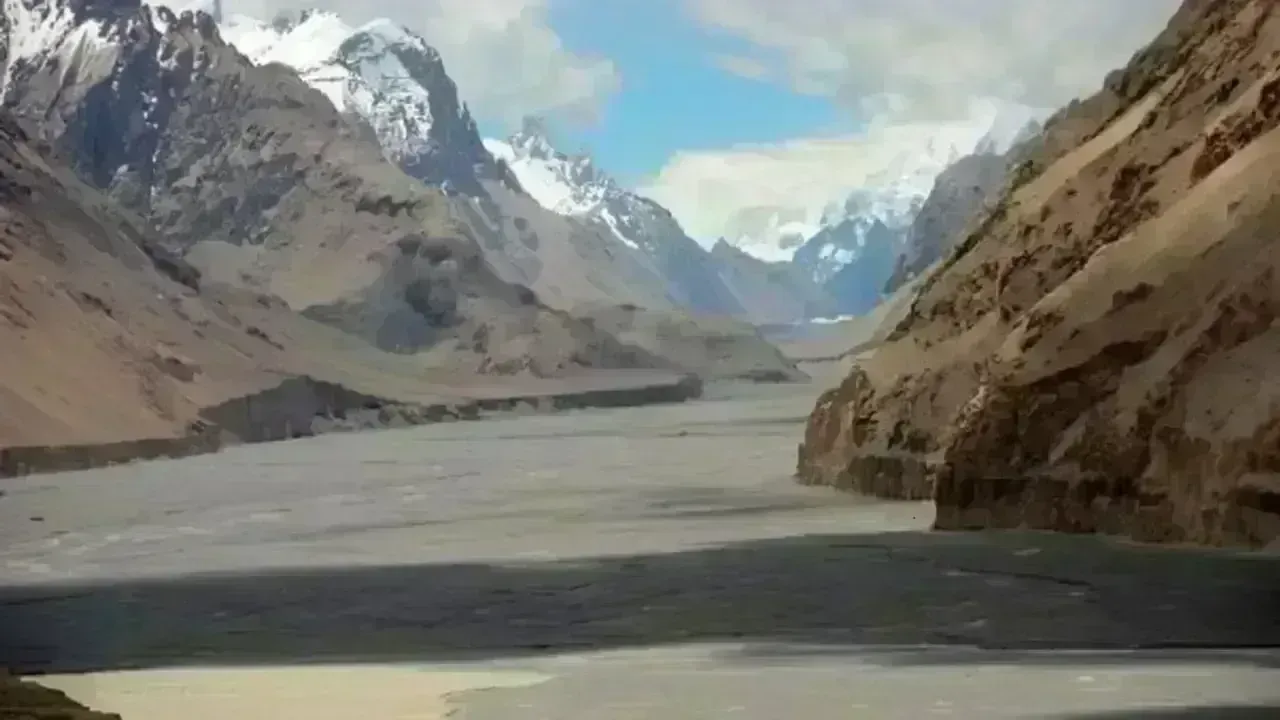
Shaksgam Valley, also referred to as the Trans-Karakoram Tract, lies in a remote, high-altitude area north of the Siachen Glacier in the Karakoram mountain range. Although currently administered by China, India maintains that it is an integral part of its territory — a claim rooted in history and legal arguments about territorial sovereignty and past treaties. This article delves into the origins of the dispute, why it matters strategically, the positions of the involved countries, and the broader geopolitical consequences.
The Shaksgam Valley is located at the northern edge of what India considers its territory in the broader region of Jammu and Kashmir and Ladakh. The valley stretches along the upper reaches of the Shaksgam River — a tributary of the Yarkand River — and lies between formidable mountain ranges such as the Karakoram and Kunlun. This remote landscape, characterised by rugged terrain, towering peaks, and sparse population, has historically limited extensive habitation but not strategic interest.
Its position adjacent to the Siachen Glacier — one of the world’s highest and most contested battlegrounds — and its proximity to strategic passes and international corridors give it outsized geopolitical value despite its harsh environment. The valley also lies along routes associated with the China‑Pakistan Economic Corridor (CPEC), which aims to connect China’s Xinjiang region with Pakistan’s Gwadar Port. Control of these routes offers tactical leverage for movement and oversight in a region where geography defines military and economic potential.
Before the partition of British India in 1947, the Shaksgam Valley formed part of the princely state of Jammu and Kashmir. Following the partition and subsequent conflicts between India and Pakistan, sections of the region — including what would become known as Pakistan-occupied Kashmir — came under Pakistani control. These developments set the stage for subsequent territorial negotiations and disagreements among the three nations.
The heart of the contemporary dispute lies in the 1963 boundary agreement between China and Pakistan. In this agreement, Pakistan agreed to cede control of the Shaksgam Valley to China, contingent upon a final settlement of the Kashmir dispute. Pakistan, which had control over parts of the region at the time, agreed to delimit the boundary along most of the tract in exchange for territorial adjustments elsewhere.
India has consistently rejected this agreement as illegitimate, arguing that Pakistan lacked legal sovereignty to transfer territory that India considers part of its own internationally recognised domain. Indian officials and legal scholars maintain that because the princely state of Jammu and Kashmir acceded to India in 1947, any subsequent action by Pakistan in dealing with the area was unlawful. This position forms the core of India’s longstanding objections to China’s presence and activities in the valley.
In early 2026, Chinese authorities reiterated their claim over the Shaksgam Valley, describing the territory as legitimately under Chinese sovereignty and defending infrastructure construction in the region as “fully justified” and “beyond reproach.” These remarks came in response to Indian diplomatic protests about ongoing Chinese activities — including road building and development linked to broader connectivity initiatives.
China’s position emphasises the bilateral nature of the 1963 agreement with Pakistan and rejects India’s objections as irrelevant to its sovereign rights. Chinese officials have also framed the infrastructure development as part of efforts to improve local socio-economic conditions and strengthen connectivity, pointing to initiatives such as CPEC that span regions beyond the immediate territorial contention.
India, on the other hand, has firmly opposed the Chinese stance, reiterating its claim that Shaksgam Valley is Indian territory. Indian government spokespeople have emphasised that New Delhi never recognised the 1963 boundary agreement and continues to regard any transfer of territory without its consent as illegal and invalid. The Indian Ministry of External Affairs has maintained that the entire union territories of Jammu and Kashmir and Ladakh — which extend to the Shaksgam region under Indian claims — are “integral and inalienable parts” of India.
Indian Army leadership has echoed this legal position in military and strategic discussions, highlighting the need for constant vigilance along the Line of Actual Control (LAC) and reiterating that the situation in the northern border regions with China remains stable but sensitive. These statements underscore India’s focus on both diplomatic resistance and military preparedness in the face of renewed tensions.
Often positioned between the rival positions of India and China, Pakistan’s role in the Shaksgam Valley dispute is complex. The 1963 boundary agreement — which India deems illegal — was part of Pakistan’s broader effort in the 1960s to strengthen ties with China, particularly after the 1962 Sino-Indian War. Pakistan’s decision to cede territory to China was motivated by strategic and diplomatic considerations, including hopes of enhanced military and economic cooperation.
In the decades since, Pakistan has supported China’s claims and development activities in the valley. Islamabad views strategic coordination with Beijing as a counterbalance to its own rivalry with India. As a consequence, Pakistan’s stance — often aligned with China — has contributed to the enduring difficulty in resolving territorial disputes in the broader Kashmir region, including Shaksgam.
The Shaksgam Valley’s strategic importance extends beyond mere cartographic claims. Its proximity to the Siachen Glacier — where India maintains a significant military presence — and its position relative to the Karakoram Pass give it considerable relevance for defence planning and regional security. Oversight of the region affects supply routes, troop movements, and visibility across adjacent territories.
Control or influence over the valley also impacts India’s ability to monitor broader Chinese military deployments and infrastructure enhancements in the greater border area. With China’s investments in infrastructure — including roads linking key strategic points — the terrain could facilitate rapid troop repositioning, logistics improvements, and enhanced connectivity with Xinjiang province. These developments have raised concerns in Indian strategic circles about shifts in the balance of mobility and observation in high-altitude theatres.
The Shaksgam Valley dispute reflects deeper undercurrents in India-China relations. Despite efforts in recent years to reduce tensions along the broader Himalayan border — including agreements in 2024 aimed at lowering military tensions following clashes in 2020 — territorial disagreements remain unresolved. This ongoing friction underscores the challenge of converting diplomatic frameworks into durable peace on complex and contested frontiers.
Territorial assertions over areas like Shaksgam also intersect with other disputed zones, including Arunachal Pradesh (referred to as South Tibet by China) and the broader concept of the LAC itself, which remains a notional demarcation rather than a mutually agreed boundary. These overlapping claims complicate negotiations and create flashpoints in diplomatic and military engagements.
The dispute over Shaksgam Valley is part of a broader triangular dynamic involving India, China, and Pakistan. Each country has distinct motivations — India’s focus on territorial integrity and legal sovereignty, China’s emphasis on strategic expansion and infrastructure, and Pakistan’s alignment with China for geopolitical leverage. These intersecting interests contribute to a regional environment where dialogue is necessary but difficult.
The involvement of initiatives like CPEC also places the dispute within a web of global economic and security interests. For China, connectivity projects lift strategic pressures and expand influence across South Asia. For India, opposition to such projects reflects concern over sovereignty, economic encroachment, and the legitimacy of infrastructure that traverses disputed territories. These factors elevate the Shaksgam Valley issue beyond a bilateral field and into a broader contest over regional order.
The Shaksgam Valley dispute is a reminder that historical agreements, geography, and geopolitical strategy can converge to sustain long-running international disagreements. China’s recent reaffirmation of its territorial claim and India’s resolute objections exemplify the enduring complexity of this issue. While diplomacy and agreements aimed at broader detente remain important, unresolved territorial claims continue to shape perceptions of security, sovereignty, and national interest for all parties involved.
In essence, the Shaksgam Valley serves as both a symbol and a practical focal point of India-China and India-Pakistani relations — a territory where history, strategy, and law intersect with contemporary geopolitical realities.
Disclaimer:
This article synthesises publicly available information for explanatory purposes only. It does not represent official positions of any government.








Price Increase for Sony PS5 in Southeast Asia Effective May 1
Sony announces a price increase for the PS5 across Southeast Asia starting May 1, 2026, impacting ga

Potential ‘Super El Niño’ in 2026: Understanding the Climate Risks
Could a Super El Niño emerge in 2026? Discover its implications and potential global climate impacts

Global Energy Crisis Intensifies: Markets React to Oil Supply Challenges
Markets are on edge as oil disruptions escalate, influencing prices and economic stability. Explore

Must-See Tourist Spots in London You Can't Overlook
Explore London's essential attractions, from royal landmarks to vibrant markets, ensuring an unforge

Ultimate Guide to Snagging Cheap Flights in 2026
Unlock the secrets to booking affordable flights in 2026 with insightful tips and strategies tailore

The Impact of Consistent Small Investments on Wealth Building
Discover how investing small amounts regularly can positively transform your financial future over t