Post by : Bianca Suleiman
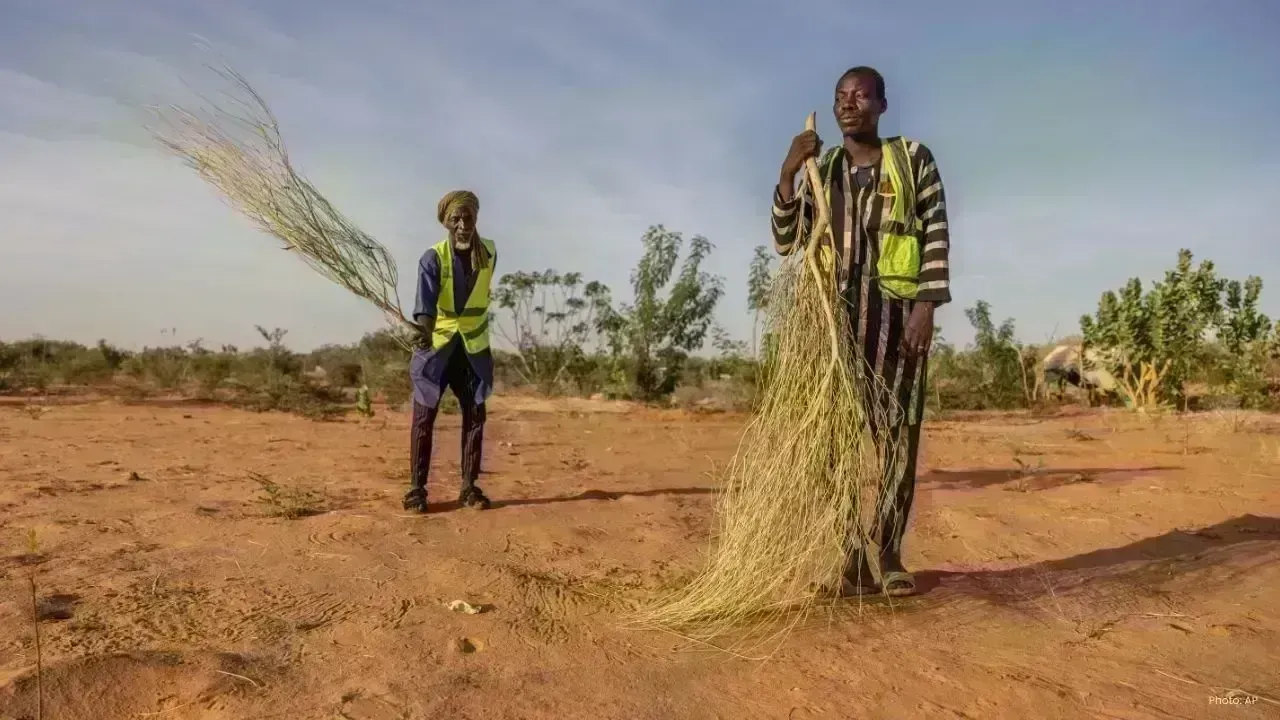
As twilight descends on the arid expanses of Mauritania, a dedicated group of individuals assembles. They rhythmically strike the earth with thin branches, their actions creating a sharp crackle that permeates the stillness. While there's no fire at this moment, these volunteers remain vigilant, aware that bushfires can ignite unexpectedly.
These courageous men, refugees from Mali, are backed by the United Nations refugee agency (UNHCR). Collaborating with their Mauritanian neighbors, they undertake the critical task of safeguarding the land that sustains them all. Their objective is both straightforward and perilous: prevent fires from ravaging homes, livestock, and crops.
Fires in a Treacherous Landscape
In West Africa, Mauritania's landscape is predominantly enveloped by the Sahara Desert, making it a dry haven with sparse vegetation. Bushfires can emerge in mere moments, lasting for days and obliterating the limited flora that both people and livestock rely upon for sustenance.
Currently, over 250,000 refugees from Mali reside in Mauritania, sharing the fragile ecosystem with local herders. The dependence on scarce grazing lands means that a single bushfire poses a significant threat to countless animals, exacerbating food shortages and potential conflicts.
Heritage of Service
Hantam Ag Ahmedou, a young volunteer who arrived in Mauritania at the age of 11, recalls fleeing violence in Mali with his family, eventually settling in the Mbera camp near the border. He remembers the terrifying speed at which bushfires can engulf the land and the sense of helplessness that envelops the community during such events.
Motivated by gratitude for the warmth extended by Mauritanians, his father initiated a volunteer firefighting team comprised of refugees. While local residents brought experience to the table, the Malians introduced a distinctive technique—extinguishing flames using branches rather than water.
Ag Ahmedou stresses that water sources are often too far away when fires erupt; thus, they rely on branches from acacia trees to smother the flames.
An Expanding Brigade
With the UN refugee agency's official backing since 2018, and funded training from the European Union, this group has grown to include over 360 refugees. They collaborate closely with local authorities, jumping into trucks whenever a fire breaks out. A 20-member team engages the fire directly while others remain poised to relieve fatigued volunteers.
Ag Ahmedou's journey began at 13 when he aided in transporting supplies. At 18, he faced his first fire. Now, he has confronted countless flames. Aware of the dangers, he insists that their efforts are crucial for the community.
If they falter, the fire could threaten the refugee camps and nearby villages, endangering lives and disrupting the economy.
Climate Change Intensifies Risks
Rising temperatures, prolonged droughts, and increasing desertification caused by climate change in Mauritania have accelerated the spread and duration of bushfires.
Officials from UNHCR caution that local Mauritanian herders are also struggling to feed their livestock. As resources dwindle, tensions may rise between refugees and locals vying for essential resources.
More than 150,000 refugees reside in the Mbera camp, and another 150,000 are scattered across surrounding villages. In certain regions, the refugee population exceeds the local population by a significant margin. Given the limited resources, collaboration is essential to mitigate conflict.
Reforestation Efforts
These refugee firefighters contribute to environmental recovery while battling fires. Volunteers like Abderrahmane Maiga plant acacia trees, resilient to the heat, and have begun introducing lemon and mango trees.
Tree planting helps combat desertification by providing shade and enriching the soil. Maiga emphasizes the importance of this initiative, stating that the community has supported their survival, and it is now their turn to give back.
He recalls the devastating fire of 2014, when dozens fought relentless flames for nearly two days. Many collapsed from exhaustion, yet they succeeded in safeguarding homes and livestock.
Persistent Despite Adversity
Given the ongoing violence in Mali, returning home remains a distant dream for most refugees. They have established lives amidst the challenges of Mauritania's desert. Ag Ahmedou reflects on his upbringing in a landscape defined by sand and scarcity. Resilience, he believes, is the key to protecting their newfound home.
Rather than dreaming of migrating to Europe, he recognizes that survival hinges on strength, collaboration, and hope.
"We must fight," he asserts. "We have to defend our home and the kind-hearted people who welcomed us."
The refugee firefighting initiative in Mauritania serves as a testament to bravery and collective strength. They risk everything to combat flames, safeguard livestock, and foster harmony. With assistance from the UN and the European Union, they train and rebuild the environment they rely on.
Their actions illustrate how refugees can evolve from victims of circumstances into guardians of their adopted homeland. In an era marked by climate challenges and scarcity, their vital contributions shine through.
They fight not only to preserve flora but to maintain peace, uphold dignity, and construct a promising future in one of the most inhospitable regions on the planet.








Mattel Revives Masters of the Universe Action Figures Ahead of Film Launch
Mattel is reintroducing Masters of the Universe figures in line with its upcoming film, tapping into

China Executes 11 Members of Criminal Clan Linked to Myanmar Scam
China has executed 11 criminals associated with the Ming family, known for major scams and human tra

US Issues Alarm to Iran as Military Forces Deploy in Gulf Region
With a significant military presence in the Gulf, Trump urges Iran to negotiate a nuclear deal or fa

Copper Prices Reach Unprecedented Highs Amid Geopolitical Turmoil
Copper prices soar to all-time highs as geopolitical tensions and a weakening dollar boost investor

New Zealand Secures First Win Against India, Triumph by 50 Runs
New Zealand won the 4th T20I against India by 50 runs in Vizag. Despite Dube's impressive 65, India