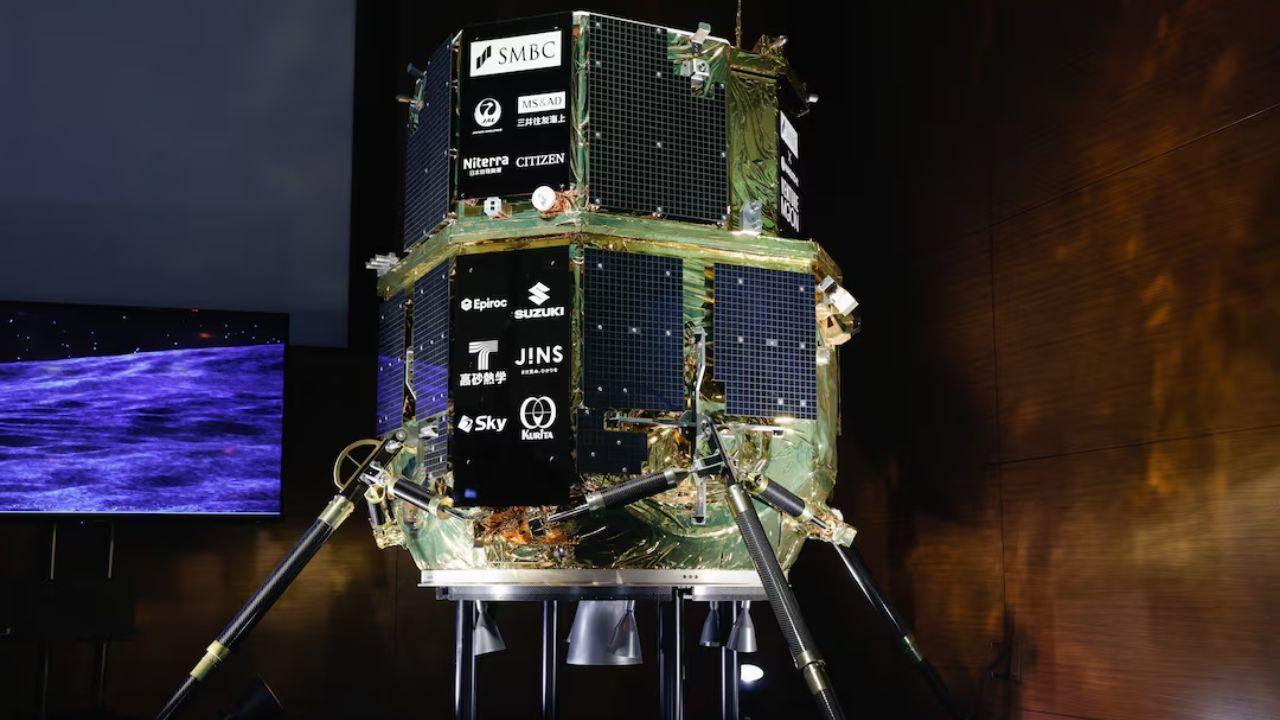
Post by : Bianca Suleiman
Photo: AP
A Japanese space company named ispace has confirmed that its spacecraft called RESILIENCE crashed while trying to land on the Moon. The attempt took place early in the morning on June 6, 2025, in a region of the Moon called Mare Frigoris, also known as the Sea of Cold, which lies in the Moon’s northern hemisphere. The goal of the mission was to make a smooth and soft landing on the Moon’s surface, but sadly, that did not happen.
The lander started its landing sequence after engineers at ispace’s Mission Control Center in Nihonbashi, Tokyo, sent commands at 3:13 a.m. Japanese time. The lander began to descend from about 100 kilometers above the Moon down to about 20 kilometers. Its main engine fired correctly to slow it down, just as planned. However, less than two minutes before the scheduled landing, the mission team lost all communication with the lander. Even after the planned landing time had passed, there was no signal or data confirming a safe touchdown.
The company later shared an update on social media, saying that as of 8:00 a.m. local time, it had become clear that there was no hope of restoring communication with the lander. As a result, they officially ended the mission and declared that Success 9, the mission’s goal, could not be achieved. Takeshi Hakamada, the founder and CEO of ispace, said their top priority now is to carefully study the data they received before the signal was lost so they can understand what went wrong.
A preliminary analysis by the company showed that the laser system used to measure the lander’s altitude did not work as it should have. This caused the lander to descend too quickly. Based on this, the company believes that RESILIENCE made a hard landing, which means it hit the Moon’s surface faster than it should have. The lander likely broke apart and cannot complete its planned two-week mission or deploy its small rover.
The mission had several exciting goals. It planned to collect two small samples of lunar soil and sell them to NASA for $5,000. Even though the samples would remain on the Moon, this sale was meant to show support for commercial work in space. The RESILIENCE lander carried some important scientific equipment and experiments, including a small rover called Tenacious built in Europe, a machine to split water into hydrogen and oxygen, an experiment to grow food in space, and a tool to measure radiation. It also carried a model red house called Moonhouse, created by a Swedish artist.
This was ispace’s second attempt at landing on the Moon. Two years ago, their first mission also ended in a crash. That’s why they named this second lander “Resilience,” to show their determination to try again. Unfortunately, this second try also did not succeed. Hakamada said the company must now take this seriously and learn from the failure, but they are not giving up. He added that they will continue working on more Moon missions in the future.
RESILIENCE had been carrying a small shovel to dig lunar soil and place the artist’s red house on the Moon’s surface, but none of that was possible because of the crash. So far, only five countries have made successful soft landings on the Moon: the Soviet Union, the United States, China, India, and Japan. Even though this mission failed, it was part of a bigger effort to make space travel and lunar exploration a part of the future.










Mattel Revives Masters of the Universe Action Figures Ahead of Film Launch
Mattel is reintroducing Masters of the Universe figures in line with its upcoming film, tapping into

China Executes 11 Members of Criminal Clan Linked to Myanmar Scam
China has executed 11 criminals associated with the Ming family, known for major scams and human tra

US Issues Alarm to Iran as Military Forces Deploy in Gulf Region
With a significant military presence in the Gulf, Trump urges Iran to negotiate a nuclear deal or fa

Copper Prices Reach Unprecedented Highs Amid Geopolitical Turmoil
Copper prices soar to all-time highs as geopolitical tensions and a weakening dollar boost investor

New Zealand Secures First Win Against India, Triumph by 50 Runs
New Zealand won the 4th T20I against India by 50 runs in Vizag. Despite Dube's impressive 65, India