Post by : Saif Nasser
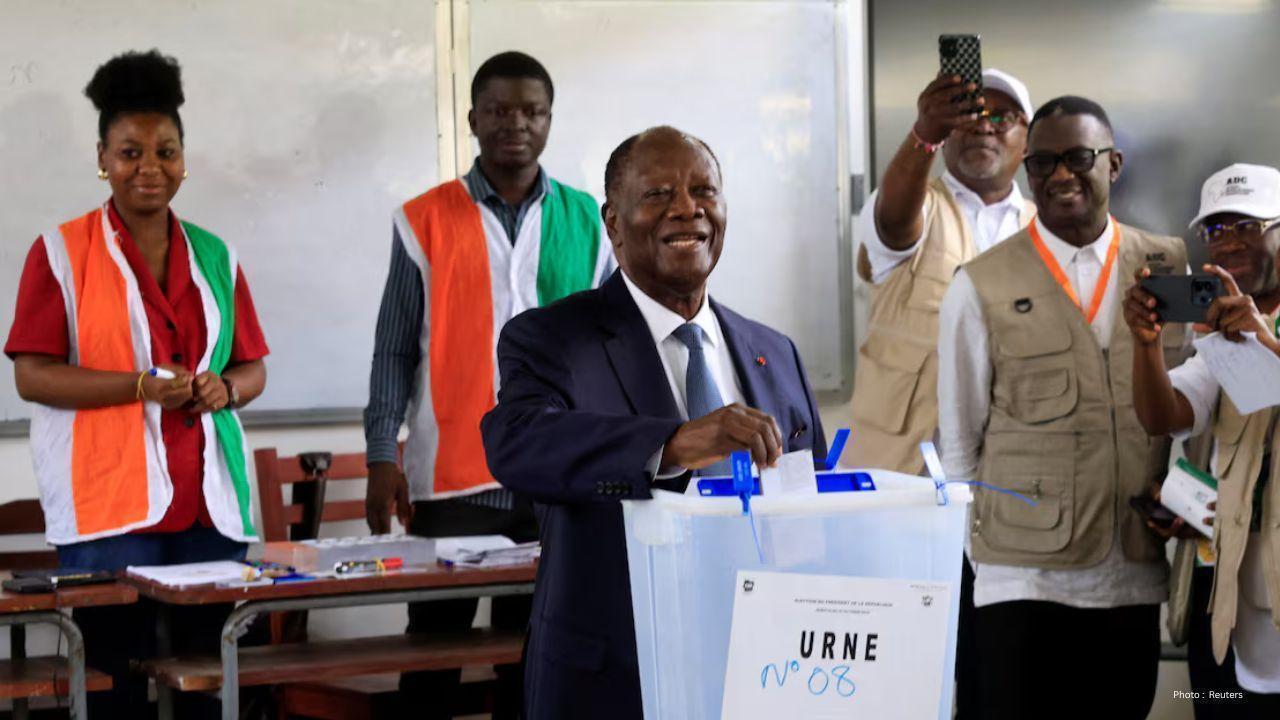
Ivory Coast President Alassane Ouattara has won a fourth term in office after securing a landslide victory in the country’s latest election. According to official results released on Monday, the 83-year-old leader received nearly 90% of the votes, ensuring another five years in power.
The result was not a surprise for many Ivorians, as Ouattara’s main political rivals were not allowed to run. Former President Laurent Gbagbo and Tidjane Thiam, a well-known former banker, were both declared ineligible by election officials. This left the president facing weaker candidates who did not have strong political support.
Former Commerce Minister Jean-Louis Billon finished second with just over 3% of the votes, while Simone Gbagbo, the former first lady, received about 2%. Both accepted their defeats. Simone Gbagbo even called Ouattara to personally congratulate him on his win, according to a source close to her.
Voter turnout was around 50%, similar to the last two elections but much lower than in 2010, when nearly 80% of eligible voters participated. Many citizens said they did not vote because they felt the outcome was already decided. “There was no point in voting,” said one voter in Abidjan. “The strong opponents were removed, so it was clear who would win.”
Ouattara first came to power in 2011 after a violent post-election crisis in which his rival Laurent Gbagbo refused to step down, leading to a civil war that killed about 3,000 people. Since then, Ouattara has overseen a long period of stability and steady economic growth in the world’s top cocoa-producing nation. Under his leadership, new roads, housing projects, and business investments have helped the economy expand, although many Ivorians say ordinary people still struggle with poverty and unemployment.
The president, a former deputy managing director of the International Monetary Fund (IMF), said in a statement that he plans to use his new term to continue economic growth and prepare the country’s next generation of leaders. “I will work to pass the torch to younger Ivorians,” Ouattara said, suggesting that he may not seek another term in the future.
However, analysts say there is no clear successor in sight. The ruling party is divided, and some fear that if Ouattara does not choose a successor soon, the country could face another political crisis. Experts warn that Ivory Coast could repeat the problems it faced after the death of its first president, Félix Houphouët-Boigny, when rival factions fought for power.
Saturday’s election day was mostly peaceful, but tension had built up in the days before. Protests broke out in several cities, including Yamoussoukro, where a curfew was imposed on Friday night. The government sent more than 40,000 security officers across the country to prevent unrest.
Human rights groups said the government used excessive force to control protests. Amnesty International reported that hundreds of people were arrested before and after the vote. The Interior Ministry confirmed that dozens of protesters received prison sentences of up to three years for causing public disorder.
Despite the large win, many Ivorians appear distant from politics. Experts say that after years of unrest and disappointment, people have lost faith in elections as a way to bring change. “Many people no longer believe politics can improve their lives,” said Rinaldo Dipagne of the International Crisis Group.
For now, Ouattara’s victory gives him a strong grip on power, but it also raises questions about the country’s democratic future. Without strong opposition voices or a clear plan for leadership transition, Ivory Coast risks falling into the same cycle of political tension it has faced in the past.
As the Constitutional Council prepares to confirm the final results, all eyes are on President Ouattara — not just for how he governs in the coming years, but whether he truly prepares to hand over power to a new generation, as he has promised.









DAE Achieves Remarkable Growth in Q1 2026 With Record Revenue
Dubai Aerospace Enterprise announces impressive financial results for Q1 2026, reflecting a surge in

Price Increase for Sony PS5 in Southeast Asia Effective May 1
Sony announces a price increase for the PS5 across Southeast Asia starting May 1, 2026, impacting ga

Potential ‘Super El Niño’ in 2026: Understanding the Climate Risks
Could a Super El Niño emerge in 2026? Discover its implications and potential global climate impacts

Global Energy Crisis Intensifies: Markets React to Oil Supply Challenges
Markets are on edge as oil disruptions escalate, influencing prices and economic stability. Explore

Must-See Tourist Spots in London You Can't Overlook
Explore London's essential attractions, from royal landmarks to vibrant markets, ensuring an unforge

Ultimate Guide to Snagging Cheap Flights in 2026
Unlock the secrets to booking affordable flights in 2026 with insightful tips and strategies tailore




