Post by : Saif Nasser
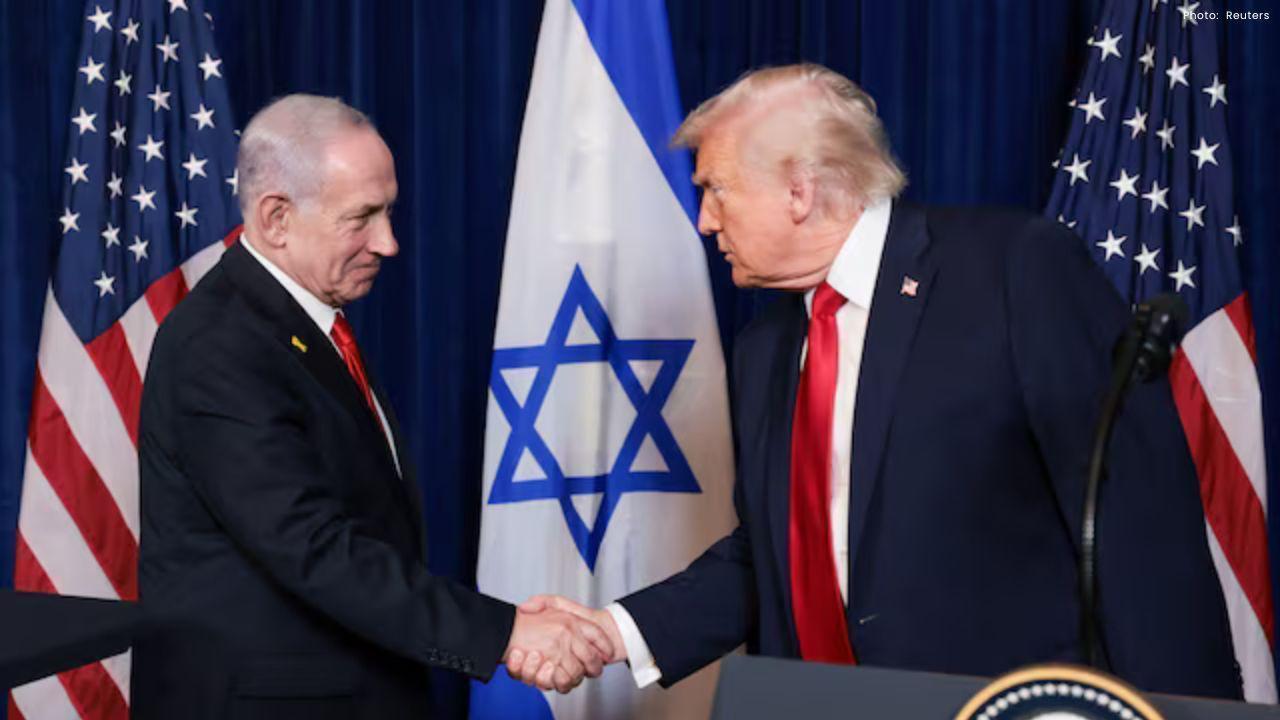
Israel has officially joined U.S. President Donald Trump’s new “Board of Peace,” a body created to oversee conflict resolution and temporary governance efforts in Gaza and possibly other global trouble spots. The move was confirmed by Israeli Prime Minister Benjamin Netanyahu during his visit to Washington, where he met President Trump and U.S. Secretary of State Marco Rubio.
The decision is already drawing strong reactions from diplomats, human rights experts, and international observers. Supporters say the board could help speed up reconstruction and stabilize Gaza after months of war. Critics argue that it risks weakening the role of the United Nations and leaves out key voices, especially Palestinian representation.
The Board of Peace was launched by President Trump in late January. At first, it was designed to help manage Gaza’s temporary governance and rebuilding after a ceasefire agreement. Later, Trump said the board’s role would grow and could be used to address other global conflicts as well. He is expected to chair the board himself.
According to official plans, the board will hold its first meeting in Washington on February 19. Gaza reconstruction is expected to be the main topic. A United Nations Security Council resolution passed in November gave approval for an international stabilization effort connected to this plan. It also allowed countries working with the board to help set up a stabilization force in Gaza.
During his Washington visit, Netanyahu confirmed that Israel had joined the board and signed the membership document. Images released after his meeting with Rubio showed the signed paper. Netanyahu also posted publicly that Israel had become a member. Afterward, he and Trump discussed Iran and regional security issues, showing that the talks went beyond Gaza alone.
The ceasefire in Gaza began in October under a Trump-backed plan accepted by both Israel and Hamas. However, the ceasefire has been fragile. Reports from both Palestinian and Israeli sources say that hundreds of Palestinians and several Israeli soldiers have been killed since the ceasefire started, showing that violence has not fully stopped.
The next phase of the Gaza plan includes several difficult steps. These include the possible disarmament of Hamas, further Israeli troop withdrawal, and the arrival of an international peacekeeping force. Each of these steps is sensitive and politically difficult. Hamas has long rejected calls to disarm, and security control in Gaza remains a major point of dispute.
The humanitarian situation in Gaza is severe. Local health authorities report very high death tolls and widespread displacement. Aid groups warn of hunger and damaged infrastructure across the territory. Because of this, reconstruction planning is urgent. Homes, hospitals, roads, and water systems need major repair or rebuilding.
Still, many experts are uneasy about the structure of the Board of Peace. One major concern is that the board does not include a Palestinian member. Critics say it is not fair or effective to plan Gaza’s future without direct Palestinian participation. They warn that this could make any decisions less legitimate and harder to enforce on the ground.
Some legal scholars and rights experts also argue that a U.S.-led board supervising a foreign territory looks too much like a colonial model, where outside powers control local governance. They say modern peace efforts should be more balanced and led through international systems like the United Nations.
Another concern is that the board could reduce the UN’s influence in peacekeeping and conflict resolution. For decades, the UN has been the main global body for these tasks. If major powers begin building separate structures, global coordination could weaken. That could lead to mixed rules, competing missions, and confusion in crisis zones.
Country support for the board is mixed. Some Middle Eastern partners of the United States have agreed to join. However, many traditional Western allies have been cautious and have not signed up. Their hesitation suggests doubts about how the board will operate and whether it will follow accepted international norms.
From an editorial point of view, the success of any peace body depends on three things: fairness, inclusion, and trust. If key parties feel excluded, the process becomes weaker. If global institutions feel pushed aside, cooperation becomes harder. And if affected civilians do not trust the system, rebuilding efforts can fail.
The idea of faster action and focused leadership can be attractive in times of crisis. Gaza needs rebuilding, security, and stable governance. But speed should not replace balance. A lasting peace plan must include all major stakeholders and work alongside, not against, established international frameworks.
The coming first meeting of the Board of Peace will show how serious and broad this effort really is. The world will be watching to see who participates, what rules are set, and whether local voices are added. The future of Gaza’s recovery may depend not just on money and security forces, but on how inclusive and credible the decision-making process becomes.







Reopening of the Strait of Hormuz: New Regulations to Impact Global Trade
Iran reopens the strategic Strait of Hormuz with new regulations affecting oil transport and global

Top 10 Must-See Attractions in NYC for First-Time Explorers
Discover essential experiences for first-time visitors to NYC, including attractions, culture, and i

Starbucks Engages Boyu Capital for Major Chinese Expansion
Starbucks teams up with Boyu Capital, selling a majority stake to boost growth and adapt to the Chin

Three Individuals Charged in Massive Meth Trafficking Case in Malaysia
In Malaysia, a married couple and another suspect are charged with trafficking 510kg of meth, facing

Singapore Police Revisit Geylang Murder Scene with Suspect
In Geylang, police return a murder suspect to the scene of a crime involving the fatal stabbing of a