Post by : Anees Nasser
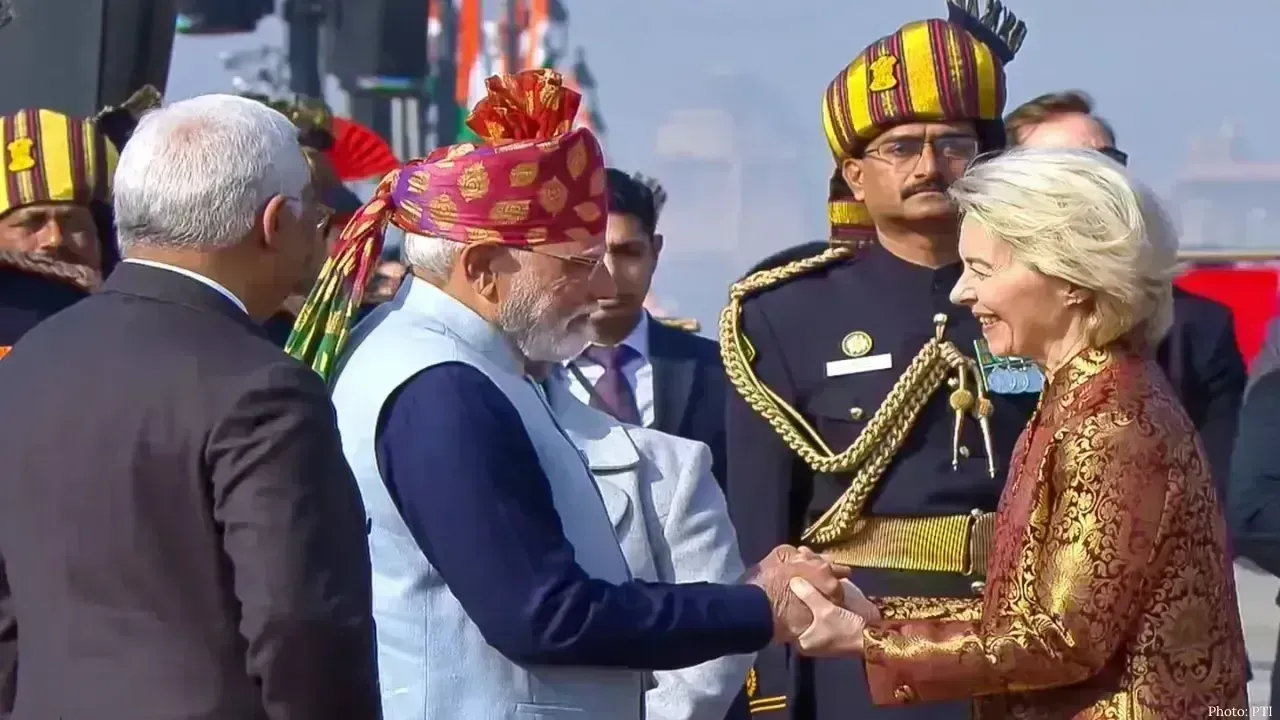
In a significant milestone after nearly two decades of discussions, India and the European Union (EU) finalized a comprehensive Free Trade Agreement (FTA) during the 16th India-EU Summit held on 27 January 2026. Officials hailed it as the “mother of all trade deals,” signaling a pivotal moment for bilateral relations that promises extensive impacts on trade, investment, strategic cooperation, and geopolitical alignment.
The summit was co-chaired by Prime Minister Narendra Modi, European Commission President Ursula von der Leyen, and European Council President Antonio Costa, taking place in New Delhi just after India’s 77th Republic Day celebrations.
Below is an analysis of the summit’s outcomes, essential deal provisions, market reactions, and wider strategic implications.
India’s relationship with the European Union is rooted in extensive diplomatic and economic collaborations. Although free trade agreement negotiations began in 2007, real progress was sporadic until a resurgence was noted in the early 2020s.
As of 2024–25, total trade between India and the EU is projected to be around $136.5 billion, making it India’s largest trading partner in goods. Indian exports—encompassing textiles, chemicals, and machinery—have seen remarkable growth, while the EU exports goods like machinery and chemicals to India.
The two sides have also broadened cooperation in various sectors such as climate action, technology, and defense, leading to a new Strategic EU-India Agenda designed to deepen connections.
After nearly 20 years of dialogue, India and the EU reached comprehensive FTA agreements, formally announced at the India-EU Summit on 27 January 2026.
Characterized as “balanced and future-oriented,” this agreement addresses trade in goods, services, and investments, including commitments to lower tariffs on a broad array of products and to establish preferential market access for exporters.
A central feature of the agreement is the substantial reduction of import duties from both sides. India has pledged to significantly lower tariffs on many EU products, while the EU will likely extend duty-free or preferential access for Indian goods, notably in sectors like textiles, leather, footwear, and machinery.
Currently, average EU tariffs on Indian imports stand at around 3.8 percent, climbing up to 10 percent for labor-intensive items. India's weighted average customs duty on EU imports is about 9.3 percent, with higher rates for areas like automobiles and plastics. The FTA aims to dismantle these barriers and boost exports.
For instance, tariffs on EU car imports—which range from 70-110 percent—are poised for reduction under this agreement, leading to permanent cuts, which will benefit European car manufacturers and provide diverse choices for Indian consumers.
Analysts project that the India-EU trade deal will significantly boost economic activities on both ends. Preliminary estimates suggest that Indian exports to the EU could increase by $3–5 billion shortly, building on a base of approximately $76 billion in 2024-25.
This growth is particularly vital for labor-intensive industries that can benefit from reduced tariffs and eased regulatory constraints. The diversification of export markets, especially against a backdrop of rising global protectionism, would help Indian companies mitigate over-reliance risks.
Investors reacted favorably to these trade announcements, especially within the textile and seafood sectors, which saw noticeable intraday stock increases as markets anticipated expanded European access.
While trade headlines captured attention, the India-EU Summit also reinforced strategic collaboration in domains like security and defense, technology, and global governance. These partnerships reflect joint interests beyond trade, positioning India and the EU as collaborative entities on the global stage.
Officials indicated aspirations to deepen their strategic engagement, including forming a Security and Defence Partnership for enhanced defense industry cooperation—an important move for geopolitical positioning.
The summit also served as a platform for discussions on multilateralism, climate policies, and geopolitical stability in the Indo-Pacific, necessitating comprehensive international collaboration.
The India-EU Free Trade Agreement emerges during a period of global economic uncertainty, characterized by increasing trade barriers from significant economies. European leaders have articulated that the deal sends a wider political signal against protectionism, advocating for open trade and diversified supply chains.
European Council President Antonio Costa pointed out that this agreement not only strengthens economic links but also shows a shared commitment to stability and global cooperation, especially in light of rising unilateral trade measures worldwide.
This landmark FTA also illustrates India’s broader strategy to diversify trade partnerships beyond traditional allies. Recently, New Delhi has sought agreements with various regions while balancing its interests among major powers.
The India-EU pact—expanding on agreements with countries such as the UK, Oman, and New Zealand—underscores the nation’s commitment to integrate more deeply into global trade networks, reduce dependency on singular markets, and secure favorable access to European technology and investment.
Although negotiations are finalized and the agreement announced, several procedural steps remain before it can take effect:
In India, the agreement awaits approval from the Union Cabinet and subsequent parliamentary processes.
In the EU, the deal requires ratification by the European Parliament, following established legislative protocols.
Consequently, the formal signing of the agreement is anticipated later in 2026, followed by implementation phases commencing in 2027, contingent upon legal and legislative completion.
Market participants swiftly reacted to the outcomes of the trade summit, particularly industries set to benefit from the liberalization of tariffs. Export-driven firms—especially in textiles, seafood, and other labor-intensive areas—experienced notable stock price increases, indicating investor enthusiasm for upcoming business opportunities.
Industry associations and trade groups have embraced these developments, underlining the potential for deeper integration into global value chains and enhanced competitiveness in European markets. Analysts noted that the deal's balanced design, safeguarding sensitive sectors, could support sustainable growth while preserving domestic industry interests.
The India-EU Free Trade Agreement redefines one of the globe’s most crucial economic partnerships. By dismantling trade barriers, encouraging investment flows, and enhancing strategic collaboration, this pact lays a groundwork for sustained economic engagement with broad global implications.
The long-term success of this agreement will depend on effective implementation, continuous diplomatic engagement, and responsiveness to evolving global economic situations.
India and the EU, representing nearly 20 percent of global trade and about a quarter of the world's population, now have a framework for shared prosperity that may influence economic trends for many years to come.
Disclaimer:
This article is for educational purposes only and does not constitute financial, legal, or policy guidance. The content reflects available expert analysis at the time of writing and may evolve as formal processes unfold.







Price Increase for Sony PS5 in Southeast Asia Effective May 1
Sony announces a price increase for the PS5 across Southeast Asia starting May 1, 2026, impacting ga

Potential ‘Super El Niño’ in 2026: Understanding the Climate Risks
Could a Super El Niño emerge in 2026? Discover its implications and potential global climate impacts

Global Energy Crisis Intensifies: Markets React to Oil Supply Challenges
Markets are on edge as oil disruptions escalate, influencing prices and economic stability. Explore

Must-See Tourist Spots in London You Can't Overlook
Explore London's essential attractions, from royal landmarks to vibrant markets, ensuring an unforge

Ultimate Guide to Snagging Cheap Flights in 2026
Unlock the secrets to booking affordable flights in 2026 with insightful tips and strategies tailore

The Impact of Consistent Small Investments on Wealth Building
Discover how investing small amounts regularly can positively transform your financial future over t