Post by : Saif Nasser
Ford Motor Company has announced a major retreat from electric vehicles (EVs), taking a $19.5 billion writedown and cancelling several EV projects. The move highlights how U.S. policies and declining consumer demand are reshaping the auto industry.
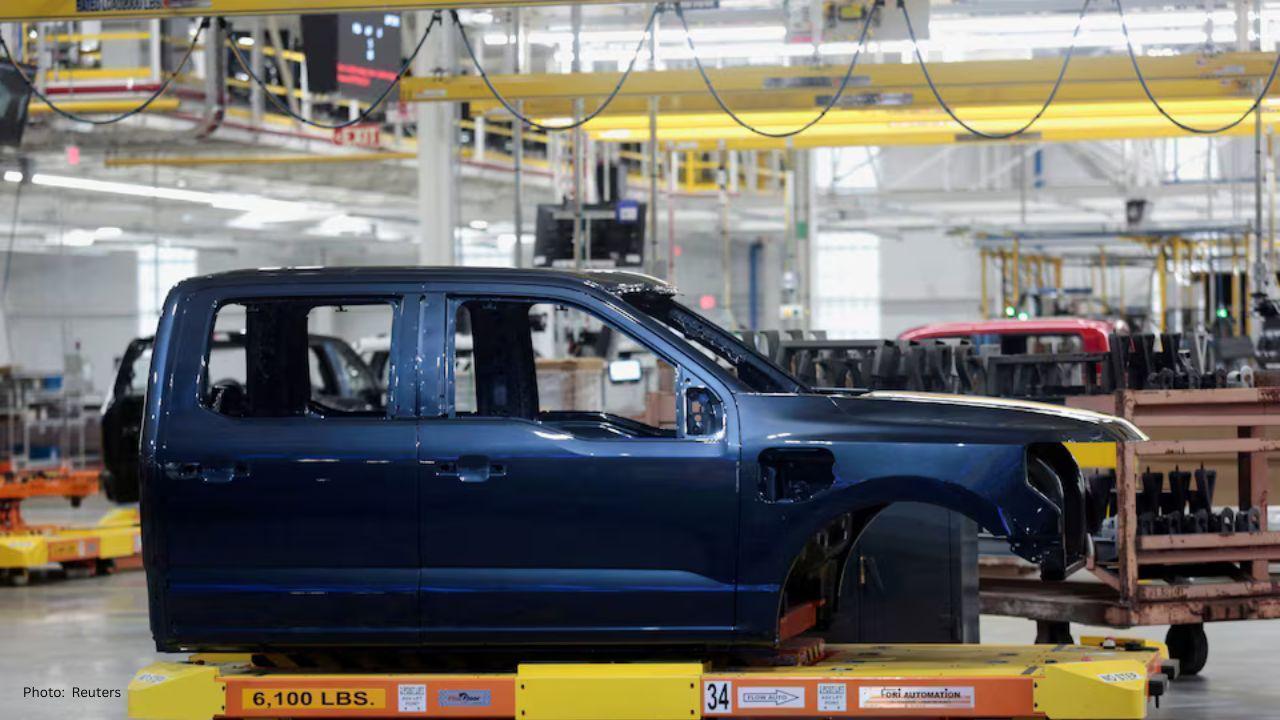
The company will replace its fully electric F-150 Lightning pickup with a new extended-range EV that uses a gasoline engine to recharge the battery. Ford is also scrapping a next-generation electric truck, codenamed the T3, and several planned electric commercial vans.
“When the market changed over the last few months, that prompted our decision,” Ford CEO Jim Farley said. The company will shift more toward gas-powered and hybrid vehicles, although some layoffs are expected at a Kentucky battery plant. In the long term, Ford plans to hire thousands of new workers.
Ford aims to increase its mix of hybrids, extended-range EVs, and pure EVs to 50% of its lineup by 2030, up from 17% today. The $19.5 billion writedown will be spread over several years. About $8.5 billion is from cancelled EV models, $6 billion from ending a battery joint venture with South Korea’s SK On, and $5 billion from other program-related costs. Despite these losses, Ford raised its 2025 guidance for adjusted earnings before interest and taxes to around $7 billion.
The shift reflects broader industry trends. U.S. EV sales fell about 40% in November after the expiration of a $7,500 consumer tax credit. Policies under former President Donald Trump, including eased emissions rules and reduced federal EV support, have encouraged carmakers to focus more on gas-powered vehicles.
The F-150 Lightning, launched in 2022, initially saw strong demand with 200,000 orders, but sales have lagged, with only 25,583 units sold through November—a 10% decline from last year. The T3 truck was planned for production in a new Tennessee facility, but Ford will now produce gas-powered trucks there starting in 2029.
Ford is also developing more affordable EVs through a special California “skunkworks” team. The first model, priced around $30,000, is expected to go on sale in 2027.
Other automakers are making similar changes. General Motors took a $1.6 billion charge earlier this year and expects more, while Stellantis cancelled an electric Ram pickup and is emphasizing hybrids. Toyota, a leader in hybrid technology, continues to show strong results.
The end of Ford’s joint venture with SK On allows Ford to operate its Kentucky battery plants independently, while SK On will manage a Tennessee plant. Ford plans to use these facilities to produce batteries for energy storage systems and the upcoming $30,000 midsize EV truck.
Analysts say Ford’s retreat highlights the challenges of competing in the EV market when government incentives, regulations, and consumer demand are unpredictable. By focusing on hybrids and smaller, affordable EVs, Ford aims to balance profitability with the transition to greener vehicles.










DAE Achieves Remarkable Growth in Q1 2026 With Record Revenue
Dubai Aerospace Enterprise announces impressive financial results for Q1 2026, reflecting a surge in

Price Increase for Sony PS5 in Southeast Asia Effective May 1
Sony announces a price increase for the PS5 across Southeast Asia starting May 1, 2026, impacting ga

Potential ‘Super El Niño’ in 2026: Understanding the Climate Risks
Could a Super El Niño emerge in 2026? Discover its implications and potential global climate impacts

Global Energy Crisis Intensifies: Markets React to Oil Supply Challenges
Markets are on edge as oil disruptions escalate, influencing prices and economic stability. Explore

Must-See Tourist Spots in London You Can't Overlook
Explore London's essential attractions, from royal landmarks to vibrant markets, ensuring an unforge

Ultimate Guide to Snagging Cheap Flights in 2026
Unlock the secrets to booking affordable flights in 2026 with insightful tips and strategies tailore




