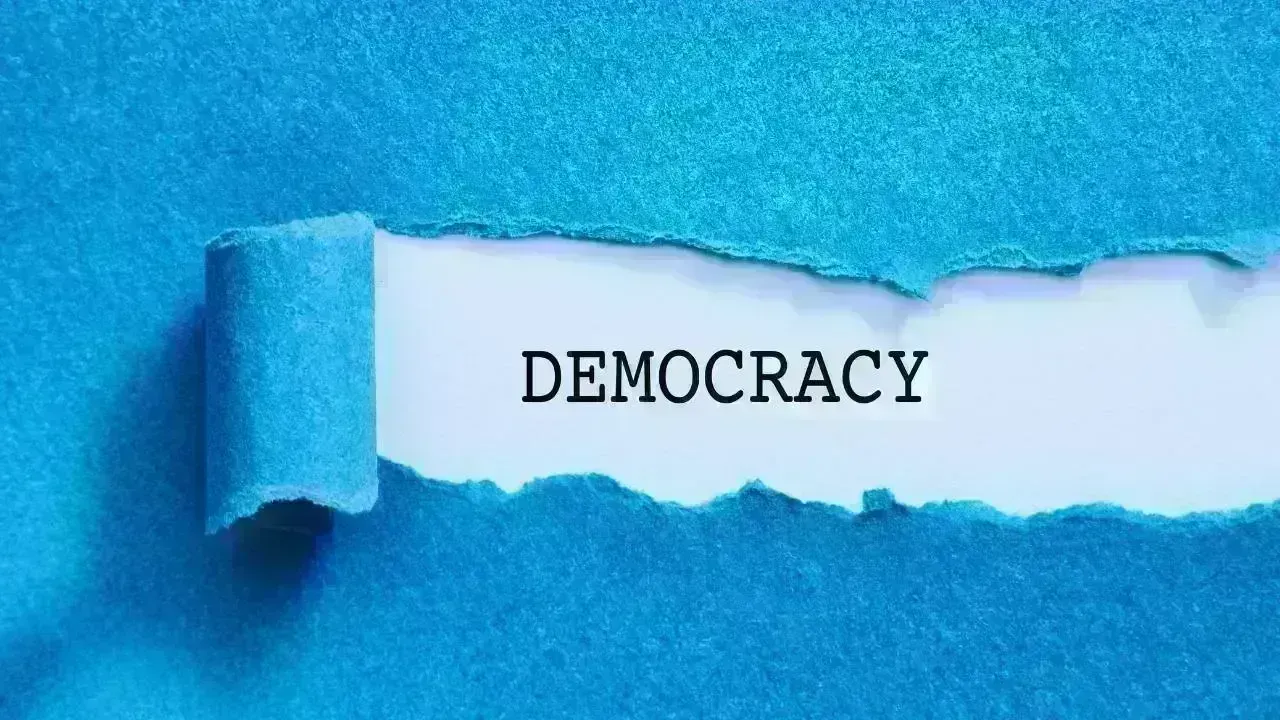
Post by : Anees Nasser
Democracy has always adapted in times of crisis, yet 2025 feels unprecedented. Unlike past upheavals marked by tanks and coups, today's threats are subtler and more intricate. They infiltrate our lives through screens, speeches, headlines, and hashtags.
Ongoing wars, impending elections in delicate political climates, and algorithms dictate the narratives we digest daily. The consequence is a landscape rife with distrust, anxiety, and fatigue, leaving democracies precariously balanced.
For the average voter, casting a ballot seems insufficient. Assessments of governance appear diminished, leaders ephemeral, and truths seem negotiable. In a world where social media often drowns out parliamentary discourse, the stability of democratic institutions stands on a knife's edge.
2025 not only hinges on political choices.
It tests whether democratic frameworks can withstand continuous turmoil.
In wartime, fear takes precedence. Safety overtakes liberty, while survival marginalizes civil discourse. This year sees wars across continents fostering emergency protocols, restricting borders, and militarizing governmental frameworks.
In periods of prolonged conflict, governments usually:
Suppress public dissent under the guise of safety
Consolidate power for efficient governance
Censor or manipulate information
Diminish legislative scrutiny
Delay electoral reforms
Such transformations are often branded temporary.
History indicates a failure to reverse these processes entirely.
When populations concede to limitations in the name of security, democracy becomes conditional.
War distills complex narratives into simplistic conflicts of “us” versus “them,” portraying dissent as betrayal.
Discourse tends towards national pride rather than policy discussion.
In 2025, governments gain public backing not through tangible achievements but leveraging fear:
Fear of foreign aggression
Fear of societal chaos
Fear of outsiders
Fear of economic downturns
This manipulation of emotion allows leaders to elude accountability while retaining public favor.
In the face of uncertainty, nationalism flourishes.
Democracy, however, withers.
Elections, once centered on ideologies and plans, have transformed into theaters of emotion.
Contemporary campaigns aim to:
Manipulate fear-based narratives
Target anger rather than reason
Propagate exaggerated threats
Portray opponents as existential threats
Interweave reality with entertainment strategies
Voters are no longer engaged but rather provoked.
Modern electoral strategies focus not on logical persuasion but on triggering reactions.
Many elections due in coming months are characterized by:
Faltering economies
Persistent conflicts
Declining trust in institutions
Social divisions
Propagation of misinformation online
When faith in electoral processes diminishes, even legitimate results face skepticism. Losing factions resist acceptance, questioning legitimacy.
Outcomes may be democratically valid yet face public rejection.
This scenario represents a severe electoral failure—not through fraud but through disbelief.
Algorithms dictate:
The news you encounter
The dominant opinions that surface
The perceived popularity of leaders
The pressing issues of the day
The real danger lies not in censorship.
It resides in unchecked curation.
Political awareness is no longer molded by:
Journalists
News editors
Scholarly analysts
Instead, it is driven by algorithms focused on profit.
Those who harness algorithmic influence now eclipse the traditional political apparatus.
While Orwell envisioned censorship as totalitarianism, 2025 faces pervasive distractions.
Discerning truth now demands:
Thorough investigation
Substantiation
Patience
Conversely, misinformation thrives on:
Emotion
Speed
Sensationalism
Within a digitally engaged world, genuine facts emerge quietly and slowly, while falsehoods explode across platforms.
By the time truths emerge, opinions have solidified.
Consequently, elections hinge on misinformation rather than subsequent clarity.
Previously, military intrusions were tactile. Now, they manifest digitally.
Nations destabilize one another not solely through brute force but rather by:
Online misinformation drives
Political rhetoric
Social media maneuvers
Narratives of economic compulsion
Psycho-political strategies
A nation need not breach territorial borders.
Instead, it can sway voter opinions.
The elections of 2025 unfold amidst this digital onslaught.
Citizens feel fatigued.
Recent years have brought:
Pandemic strains
Economic turmoil
Inflationary pressures
Job insecurities
Rising living costs
Geopolitical unrest
Exhausted populations rarely fact-check.
They tend to react emotionally.
They pivot politically.
When people feel ignored long enough, they cease to listen.
A weary populace poses severe risks to democratic structures.
A disillusioned society is catastrophic.
Modern politics lacks regulation.
It is a production.
Leaders prioritize virality over substantive debate.
Statements cater to spectacle rather than policy logic.
Cameras capture emotions, sidelining legislative matters.
Popularity often eclipses skill.
Visibility supersedes governance.
This phenomenon represents a perilous trend in democratic procedures.
A youth shaped amid financial downfalls, climate emergencies, and civic unrest struggles to rely on authority.
This generation witnesses:
Leaders failing on climate commitments
Housing becoming inaccessible
Education costs escalating
Employment uncertainty growing
Systems favoring the elite
Repeated disillusionment weakens belief.
Many young individuals now vote with skepticism rather than optimism.
Democracy relies on trust.
Cynicism stifles engagement.
Fear stands as the oldest tool in governance.
In 2025, it is further refined.
Fear manifests as:
Quickly disseminated
Amplified by algorithms
Reinforced through social channels
Spread widely across platforms
Perpetually fueled
Fear ensures compliance.
It dampens scrutiny.
Fear cultivates allegiance.
Yet, fear suffocates liberty.
Journalism used to form the bedrock of democracy.
Now it grapples with:
Click-driven revenue models
Political biases
Algorithmic marginalization
Erosion of credibility
Legal intimidations
Sensationalism trumps factual reporting.
Convenience surpasses truth.
While freedom of the press is legally upheld, its impact wanes.
The weakening of journalism signals the solitude of democracy.
By 2025:
Leaders receive defense, not scrutiny
Political entities are venerated, not questioned
Fidelity is prioritized over virtue
Identity surpasses evidence
People stop asking:
“Is my leader right?”
Instead, they inquire:
“Is my leader winning?”
This paradigm is anything but democratic.
It resembles fandom.
Views are formulated months prior:
Poll manipulation strategies
Media framing techniques
Narrative over-saturation
Emotional orchestration
As citizens prepare to cast votes, their opinions have often been preconditioned.
Although the act of voting is genuine, the choices are curated.
Democracy isn’t extinct.
It is wounded.
Revival necessitates:
Reforming media landscapes
Ensuring digital accountability
Promoting funding transparency
Enhancing civic education
Regulating algorithms
Reinforcing institutions
Democracy cannot flourish under the perception of tradition.
It requires safeguards much like infrastructure.
Being merely a voter is not sufficient.
People should comprehend:
The mechanics of propaganda
The workings of algorithmic influence
The effect of political rhetoric
The engineering of public opinion
How to ascertain truths
Informed voters prove harder to manipulate.
Ignorant ones are simple to rally.
Democracy deteriorates through:
Normalization of corruption
Absence of accountability
Rising inequalities
Weakening institutions
Curtailment of free speech
Loss of judicial independence
Governments cannot profess patriotism while subtly undermining democracy.
“It doesn’t matter who wins.”
That thought spells doom for democracy.
When citizens believe their voices are insignificant, they cease to express them.
Silence equates to submission.
It necessitates:
Free media
Impartial judiciary
Autonomous institutions
Involved citizenry
Ethical governance
Votes without supportive systems lean toward superficiality.
Democracy devoid of integrity resembles mere performance.
Digital platforms wield more power than:
Political entities
Governments
Media organizations
Their influence over public discourse is unparalleled.
Regulating these platforms isn't censorship.
It is an act of preservation.
War puts nations to the test.
Elections assess faith.
Digital algorithms question truthfulness.
The year 2025 challenges all three simultaneously.
Democracy is threatened not only by weaponry.
It faces pressure from the digital realm.
The struggle extends beyond pure politics.
It is inherently psychological.
And every personal device acts as a potential battleground.
The fate of democratic values rests not on grand speeches.
It will be determined by individuals ready to:
To think critically.
To ask questions.
To stay vigilant.
To reject convenient falsehoods.
To embrace complexity.
To cast informed votes.
The democratic framework remains intact.
However, it now demands something different.
Not allegiance.
Courage.
Disclaimer:
This article presents an analytical viewpoint grounded in global political trends and publicly available data. It does not endorse any particular political stance or suggestion. Readers are encouraged to explore a variety of sources and expert perspectives to form well-rounded opinions.









Anticipated Dates for UAE Eid Al Adha 2026 Unveiled by Astronomical Experts
Experts predict Eid Al Adha 2026 in the UAE to start on May 27, prompting early holiday planning amo

DAE Achieves Remarkable Growth in Q1 2026 With Record Revenue
Dubai Aerospace Enterprise announces impressive financial results for Q1 2026, reflecting a surge in

Price Increase for Sony PS5 in Southeast Asia Effective May 1
Sony announces a price increase for the PS5 across Southeast Asia starting May 1, 2026, impacting ga

Potential ‘Super El Niño’ in 2026: Understanding the Climate Risks
Could a Super El Niño emerge in 2026? Discover its implications and potential global climate impacts

Global Energy Crisis Intensifies: Markets React to Oil Supply Challenges
Markets are on edge as oil disruptions escalate, influencing prices and economic stability. Explore

Must-See Tourist Spots in London You Can't Overlook
Explore London's essential attractions, from royal landmarks to vibrant markets, ensuring an unforge




