Post by : Saif Nasser
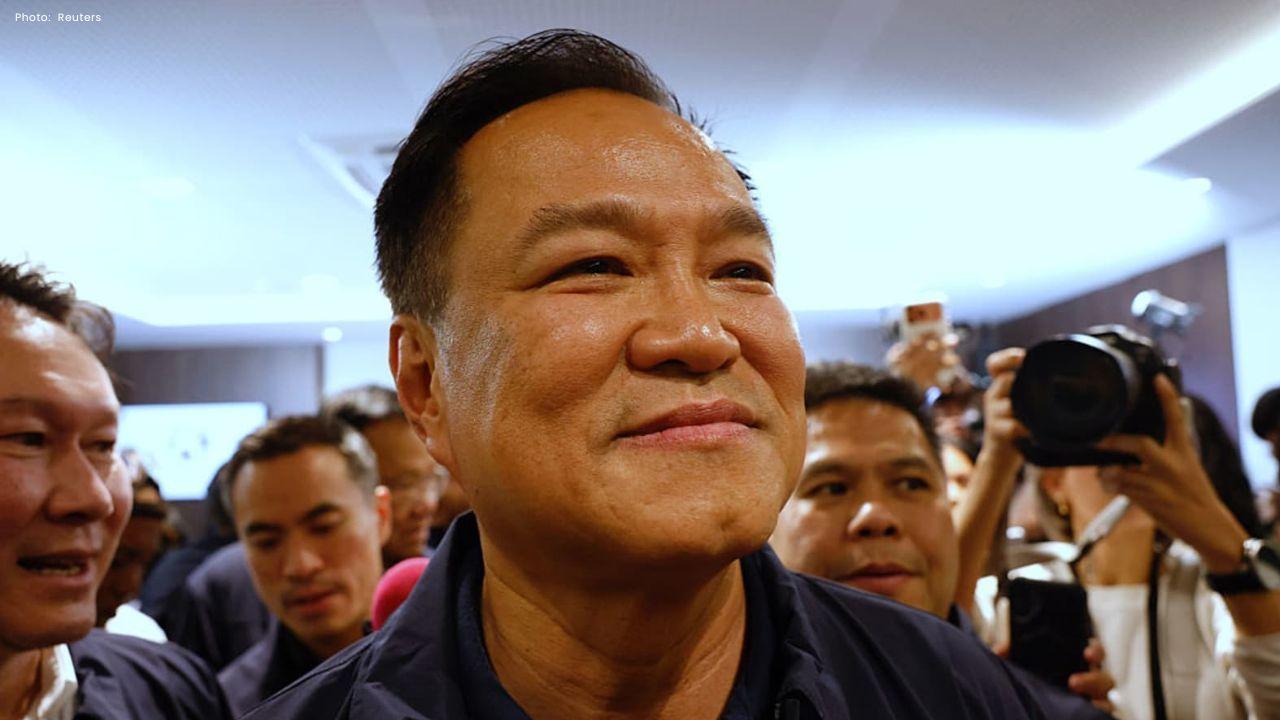
Thailand’s Prime Minister Anutin Charnvirakul has secured a powerful election victory, giving his Bhumjaithai Party a strong lead in parliament and placing him in a commanding position to form the next government. The result marks a major shift in Thailand’s political landscape and could bring a period of greater stability after years of coalition tensions and leadership changes.
Preliminary results from the election show Bhumjaithai winning about 192 seats out of 500 in the lower house. This puts the party far ahead of its closest rivals. The progressive People’s Party won around 117 seats, while the once-dominant Pheu Thai Party secured about 74. The remaining seats are split among several smaller parties. While Bhumjaithai did not win an outright majority, it is now clearly the central force around which the next coalition government will likely be built.
This election was not scheduled far in advance. Anutin called a snap vote less than 100 days after taking office. He stepped into the top job after the previous prime minister was removed during a political crisis linked to a border conflict with Cambodia. Many analysts believe Anutin timed the election carefully to take advantage of rising nationalist feeling in the country during that conflict. The strategy appears to have worked. Voters responded strongly to his message of national unity, firm leadership, and stability.
During his public remarks after the vote, Anutin said the victory belongs to all Thai people, not just his supporters. He promised that his party would work fully for the benefit of the country. His campaign focused on order, national interest, and practical economic support for citizens. Key promises included consumer subsidy programs and a tougher stance on certain cross-border agreements with Cambodia. His message attracted conservative voters and many rural political networks.
One important part of Bhumjaithai’s success was its ability to bring local politicians and regional power brokers into its camp. The party built strong ground-level support in many provinces. Political observers say this helped it convert nationalist sentiment into actual votes across districts, not just in opinion polls. Surveys before the election had often shown the People’s Party in the lead, but on election day that support did not fully translate into seats.
The People’s Party has already said it will not join a government led by Anutin. Its leader stated that his party will move into the opposition instead of trying to build a rival coalition. This makes Bhumjaithai’s coalition talks easier, because the main progressive bloc has removed itself from government bargaining. Smaller and mid-sized parties are now expected to play a key role in coalition building.
Alongside the parliamentary vote, Thai citizens also took part in a national referendum on whether to draft a new constitution. Early counts show that nearly two-thirds of voters supported replacing the current charter, which was introduced after the 2014 military coup. Critics have long argued that the present constitution gives too much power to unelected bodies, especially the senate. Supporters of change say a new charter could make the political system more democratic and more balanced. However, the process will take time and requires more referendums before a new constitution can fully take effect.
Thailand has experienced many political resets over the past decades, with multiple constitutions and several military interventions. Because of this history, many citizens and business groups are watching closely to see whether this election result truly brings steadier governance. Some analysts say this may be the first time in years that a ruling bloc has enough effective strength to govern without constant deadlock between partners.
At the same time, strong power also brings strong responsibility. Voters will expect Anutin’s government to manage the economy carefully, handle foreign relations wisely, and avoid deep political division. Nationalist momentum can help win elections, but long-term success depends on policy results that improve daily life.
The size of this victory gives Anutin political space to act, but it also raises expectations. The coming months will show whether this dominant win becomes a turning point toward stable reform — or simply another chapter in Thailand’s long and complex political story.









Starbucks Engages Boyu Capital for Major Chinese Expansion
Starbucks teams up with Boyu Capital, selling a majority stake to boost growth and adapt to the Chin

Three Individuals Charged in Massive Meth Trafficking Case in Malaysia
In Malaysia, a married couple and another suspect are charged with trafficking 510kg of meth, facing

Singapore Police Revisit Geylang Murder Scene with Suspect
In Geylang, police return a murder suspect to the scene of a crime involving the fatal stabbing of a

Mattel Revives Masters of the Universe Action Figures Ahead of Film Launch
Mattel is reintroducing Masters of the Universe figures in line with its upcoming film, tapping into
China Executes 11 Members of Criminal Clan Linked to Myanmar Scam
China has executed 11 criminals associated with the Ming family, known for major scams and human tra