Post by : Saif Nasser
Sudan is facing a new and dangerous stage in its long war after the Rapid Support Forces (RSF) captured the city of al-Fashir in the Darfur region. The fall of this city could divide the country into two parts and make peace even harder to achieve.
For the past 18 months, al-Fashir has suffered from a severe siege. The city was the last main base of the Sudanese army in Darfur, and around 250,000 civilians were trapped there with little food and medicine. Witnesses say that since the RSF took control, many people have been detained or forced to leave their homes. The International Organization for Migration said about 26,000 people have fled because of the new fighting.
General Abdel Fattah al-Burhan, the head of the Sudanese army, said his soldiers had to withdraw from al-Fashir to avoid more destruction and civilian deaths. But reports suggest that many army members are still surrounded by RSF fighters in different parts of the city.
The RSF’s victory could split Sudan between east and west. Experts fear that Darfur may now fall completely under RSF control, while the army continues to rule the east. A senior U.S. adviser warned that Sudan might face the same problem as Libya, where two rival governments have divided the country.
The RSF leader, General Mohamed Hamdan Dagalo, known as Hemedti, already runs a separate administration in Darfur. His fighters have become stronger, using advanced weapons and long-range drones. Observers believe that the RSF may try to push further east toward the capital, Khartoum.
The United Nations has warned that foreign countries are worsening the war by supplying weapons. The Sudanese army accuses the United Arab Emirates of giving military help to the RSF, but the UAE denies this. U.N. Secretary-General Antonio Guterres said outside interference is blocking peace efforts and called on all nations to stop sending arms to the warring sides.
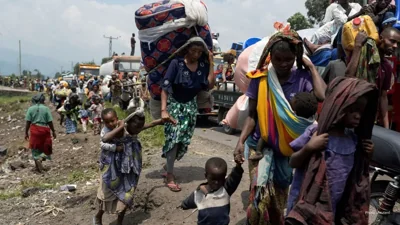
People in and around al-Fashir are now in great danger. Witnesses told reporters that RSF fighters are rounding up civilians and sending them to nearby towns, where they plan to set up camps. Some families walked long distances without food or water to reach safety. The United Nations said that many displaced people are dehydrated, weak, and deeply traumatized.
There are also fears of revenge attacks, especially against the Zaghawa tribe, which has supported the army. Earlier, similar attacks happened in the Zamzam camp south of al-Fashir, where unarmed civilians were killed.
The RSF claims it will protect civilians and allow humanitarian work, but videos shared online show fighters celebrating near dead bodies. In one video, RSF deputy leader Abdelrahim Dagalo said that capturing al-Fashir was just the beginning. “Our liberation of al-Fashir is the liberation of Sudan, all the way to Port Sudan,” he said.
The capture of al-Fashir marks a major turning point in Sudan’s civil war, which began over two years ago. The RSF’s growing control gives it more power but also increases the risk that Sudan could break apart completely. Millions have already been forced to leave their homes, and large parts of the country are facing hunger and famine.









Reopening of the Strait of Hormuz: New Regulations to Impact Global Trade
Iran reopens the strategic Strait of Hormuz with new regulations affecting oil transport and global

Top 10 Must-See Attractions in NYC for First-Time Explorers
Discover essential experiences for first-time visitors to NYC, including attractions, culture, and i

Starbucks Engages Boyu Capital for Major Chinese Expansion
Starbucks teams up with Boyu Capital, selling a majority stake to boost growth and adapt to the Chin

Three Individuals Charged in Massive Meth Trafficking Case in Malaysia
In Malaysia, a married couple and another suspect are charged with trafficking 510kg of meth, facing

Singapore Police Revisit Geylang Murder Scene with Suspect
In Geylang, police return a murder suspect to the scene of a crime involving the fatal stabbing of a