Post by : Saif Nasser
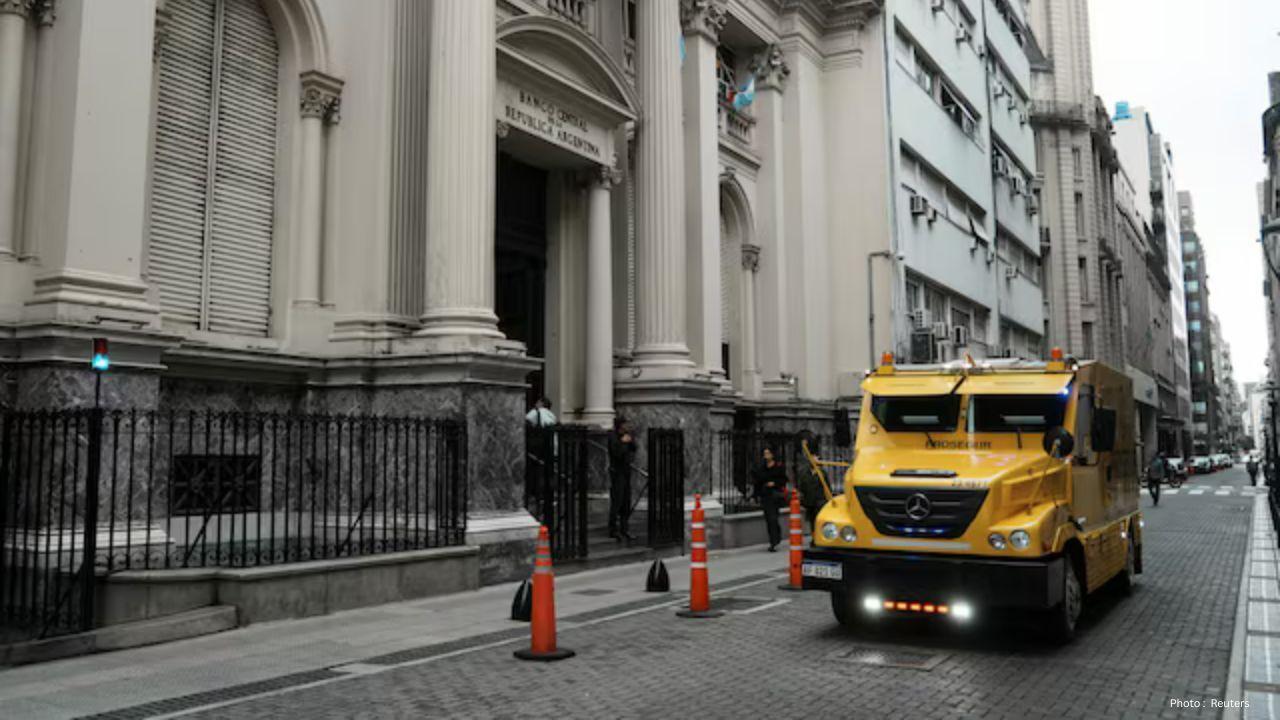
Argentina’s central bank has announced a new $20 billion currency swap agreement with the United States Treasury Department, a major step aimed at stabilizing its weakening peso and strengthening the country’s financial reserves.
The deal was signed just six days before Argentina’s important midterm elections, where economic issues are expected to play a key role. The announcement came as the Argentine peso dropped to a record low of 1,475 per US dollar on Monday, losing 1.7% of its value in a single day.
What the Deal Means
According to the Central Bank of Argentina (BCRA), the agreement allows the two countries to exchange their currencies to help control rapid changes in the exchange rate and manage financial market pressures.
In a short statement, the BCRA said the deal would help the bank “expand its tools for monetary and exchange rate policy” and increase the “liquidity of its international reserves.” This means the central bank will have more flexibility and resources to defend the peso if it continues to lose value.
However, the U.S. Treasury Department has not yet released its own statement about the agreement and did not share details on how the swap line will work or how much money will be made available immediately.
A Move to Calm Market Volatility
Argentina’s economy has faced severe challenges for years, including high inflation, low foreign reserves, and a struggling currency. The peso has weakened sharply in 2025, putting pressure on businesses, families, and the government.
Officials said the new agreement is part of a “comprehensive strategy” to help the central bank respond better to currency market swings and capital flight. In simple terms, this means the deal gives Argentina more financial security during times of instability.
The announcement brought mixed reactions. Some investors saw it as a positive step that could help bring short-term stability. Others worried about the long-term risks, given Argentina’s history of economic crises and defaults.
US Treasury’s Role and IMF Support
US Treasury Secretary Scott Bessent said last week that the arrangement would be supported by Special Drawing Rights (SDRs) from the International Monetary Fund (IMF). These SDRs are special international reserve assets held by the U.S. Treasury’s Exchange Stabilization Fund and can be converted into dollars.
Bessent said the United States would not add new conditions for Argentina under this agreement, apart from ensuring that President Javier Milei’s government continues to follow its economic reform and spending control policies.
President Milei has been pushing for strict fiscal discipline, meaning less government spending and fewer subsidies, to reduce Argentina’s budget deficit. He believes that shrinking the size of government and encouraging private businesses will help the country recover from years of economic trouble.
Market and Expert Reactions
Currency traders said that since early October, the US Treasury has been actively buying Argentine pesos, while selling dollars into the local market to help strengthen the peso. Analysts estimate that hundreds of billions of dollars have already been traded through these operations.
Brad Setser, a former US Treasury official and senior fellow at the Council on Foreign Relations, expressed concern that the US might be taking a financial risk by supporting the peso. “It does seem to me that the Treasury is taking an unusually large risk of losing money,” Setser said.
He and other analysts believe the Argentine peso is still “overvalued,” pointing to signs such as high imports, more Argentines traveling abroad to buy cheaper goods, and the central bank’s failure to meet IMF reserve goals.
Bank Concerns and Funding Challenges
According to a report by The Wall Street Journal, several major US banks — including JPMorgan Chase, Bank of America, and Goldman Sachs — were hesitant to lend Argentina the full $20 billion without strong guarantees or collateral. The banks have not commented publicly on the matter.
This concern reflects the financial world’s doubts about Argentina’s ability to repay its debts, as the country has defaulted on international loans multiple times in the past two decades.
Political Context: Elections Ahead
The timing of the currency swap deal is politically important. Argentina will hold its midterm parliamentary elections on October 26. President Milei’s party is hoping to gain more seats in Congress, where it currently holds a minority.
Economy Minister Luis Caputo had said last week that he hoped to finalize the swap agreement before the elections, as the government wants to show that it is taking strong steps to protect the economy.
However, Milei’s leadership has faced several political defeats in recent months, and public frustration is growing over inflation and job losses.
Trump’s Remarks Cause Stir
US President Donald Trump, who has supported Milei’s reform plans, made headlines last week by saying the US would not “waste our time” with Argentina if Milei’s party loses in the midterm vote. His comment briefly shocked local markets and added uncertainty to the peso’s movement.
Treasury Secretary Bessent later clarified that US cooperation with Argentina would continue as long as the government keeps following “good policies,” regardless of election results.
Argentina’s Fragile Economic Future
Argentina’s new $20 billion deal with the US gives its central bank some breathing room and could help slow down the peso’s fall in the short term. But many economists say the country’s problems run much deeper — including inflation above 120%, shrinking reserves, and low investor confidence.
For ordinary Argentines, the economic crisis has meant rising prices, lower wages, and growing poverty. Many hope that the new agreement will bring some relief, though most remain cautious after years of financial instability.








Starbucks Engages Boyu Capital for Major Chinese Expansion
Starbucks teams up with Boyu Capital, selling a majority stake to boost growth and adapt to the Chin

Three Individuals Charged in Massive Meth Trafficking Case in Malaysia
In Malaysia, a married couple and another suspect are charged with trafficking 510kg of meth, facing

Singapore Police Revisit Geylang Murder Scene with Suspect
In Geylang, police return a murder suspect to the scene of a crime involving the fatal stabbing of a

Mattel Revives Masters of the Universe Action Figures Ahead of Film Launch
Mattel is reintroducing Masters of the Universe figures in line with its upcoming film, tapping into

China Executes 11 Members of Criminal Clan Linked to Myanmar Scam
China has executed 11 criminals associated with the Ming family, known for major scams and human tra