Post by : Priya
Photo:AP
When rivers swell beyond their limits, it is rarely nature alone that carries the blame. The flooding crisis unfolding in Pakistan, triggered by India’s release of excess water from its overflowing dams, is yet another reminder of the fragile relationship between water, politics, and human survival in South Asia.
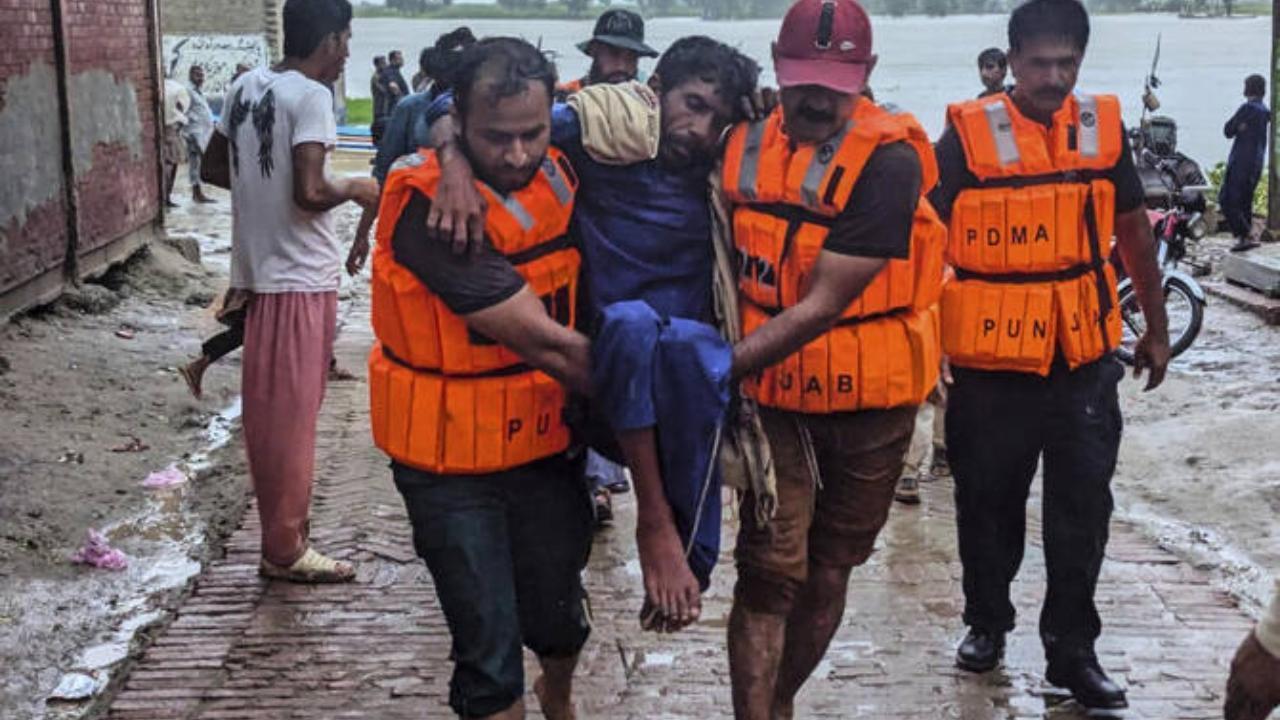
Over the past week, thousands of Pakistani families have been forced to leave their homes in Punjab and Sindh as rivers like the Sutlej, Ravi, and Chenab surged beyond safe levels. While India’s government was compelled to release water due to heavy rainfall and the threat of dam breaches, the consequences have fallen heavily on the Pakistani side of the border. Fields are under water, homes are damaged, and livelihoods are once again at risk.
A Crisis Beyond Borders
Floods are not new to this region. Every monsoon, communities brace themselves for swollen rivers, clogged drains, and damaged roads. Yet, this year’s crisis highlights a larger truth: the flow of rivers in South Asia does not respect political lines. What begins as rainfall in Himachal Pradesh, Punjab (India), or Jammu and Kashmir eventually pours down into Pakistani Punjab and Sindh.
For Pakistan, this means that water-related decisions made in New Delhi or in India’s state capitals often shape the fate of millions across the border. When dams reach capacity in India, the “release valves” open, and Pakistan bears part of the consequence.
The Human Face of Disaster
Behind statistics of “thousands evacuated” lie painful human stories. Families in low-lying villages have had only hours to gather their essentials—often no more than a few clothes, food grains, and livestock—before boats and rescue trucks moved them to temporary shelters.
Displacement is not just about losing homes. It is about children missing school, farmers watching their standing crops rot underwater, and women struggling to find safe drinking water for their families. Relief camps, though set up quickly, often lack proper sanitation and healthcare, raising fears of disease outbreaks once the water recedes.
In Pakistan’s agrarian economy, one season of destroyed crops can echo far into the future. Wheat, cotton, rice, and sugarcane fields in affected areas now face severe damage. For many farmers, this is not just a bad year but a threat to long-term survival.
Water as a Shared Responsibility
The Indus Waters Treaty (1960) has long governed water sharing between India and Pakistan. While the agreement is still regarded as one of the most successful water-sharing treaties in the world, current realities reveal its limitations. The treaty largely focuses on water allocation for agricultural and hydroelectric use, but it does not provide strong mechanisms for flood management, dam coordination, or climate change adaptation.
Experts have consistently urged for better real-time communication between New Delhi and Islamabad. Technology exists today—satellite monitoring, joint forecasting, and data-sharing platforms—that could help prevent sudden shocks. Yet, trust and political tensions often block cooperation, leaving ordinary citizens to pay the price.
Climate Change: The Silent Multiplier
The monsoon itself is transforming under the weight of climate change. South Asia is experiencing unpredictable rainfall—sometimes prolonged dry spells, followed by sudden cloudbursts. This unpredictability has led to dams filling faster than expected, forcing emergency releases.
For Pakistan, already one of the world’s most climate-vulnerable nations, such climate shocks multiply existing challenges. Deforestation, weak river embankments, and poor urban drainage leave the country particularly exposed. The 2022 floods, which submerged one-third of the country, serve as a painful reminder that Pakistan cannot treat floods as temporary events—they are long-term realities of a changing climate.
The Need for Cooperation
The current crisis should push both India and Pakistan to see water not as a weapon, but as a shared responsibility. Despite political rivalry, both nations must establish mechanisms for joint flood management. Sharing weather forecasts, setting up early-warning systems, and gradually building trust through disaster collaboration could save lives on both sides of the border.
At the community level, Pakistan must also strengthen its own disaster preparedness. Stronger embankments, improved drainage channels, early warning technologies, and investment in climate-resilient infrastructure are not luxuries but necessities.
A Moment for Reflection
Every rising river carries with it more than just water—it carries ethical questions. Should borders decide whose homes are saved and whose are lost? Should geopolitics weigh heavier than human lives?
The current floods in Pakistan underscore the need for both immediate humanitarian response and long-term rethinking of water cooperation in South Asia. With 1.7 billion people sharing an interconnected river system, the stakes are too high for negligence.









DAE Achieves Remarkable Growth in Q1 2026 With Record Revenue
Dubai Aerospace Enterprise announces impressive financial results for Q1 2026, reflecting a surge in

Price Increase for Sony PS5 in Southeast Asia Effective May 1
Sony announces a price increase for the PS5 across Southeast Asia starting May 1, 2026, impacting ga

Potential ‘Super El Niño’ in 2026: Understanding the Climate Risks
Could a Super El Niño emerge in 2026? Discover its implications and potential global climate impacts

Global Energy Crisis Intensifies: Markets React to Oil Supply Challenges
Markets are on edge as oil disruptions escalate, influencing prices and economic stability. Explore

Must-See Tourist Spots in London You Can't Overlook
Explore London's essential attractions, from royal landmarks to vibrant markets, ensuring an unforge

Ultimate Guide to Snagging Cheap Flights in 2026
Unlock the secrets to booking affordable flights in 2026 with insightful tips and strategies tailore




