Post by : Naveen Mittal
Space missions have always relied on Earth-based control centers — humans monitoring data, sending commands, and waiting hours for responses. But that model is changing fast.
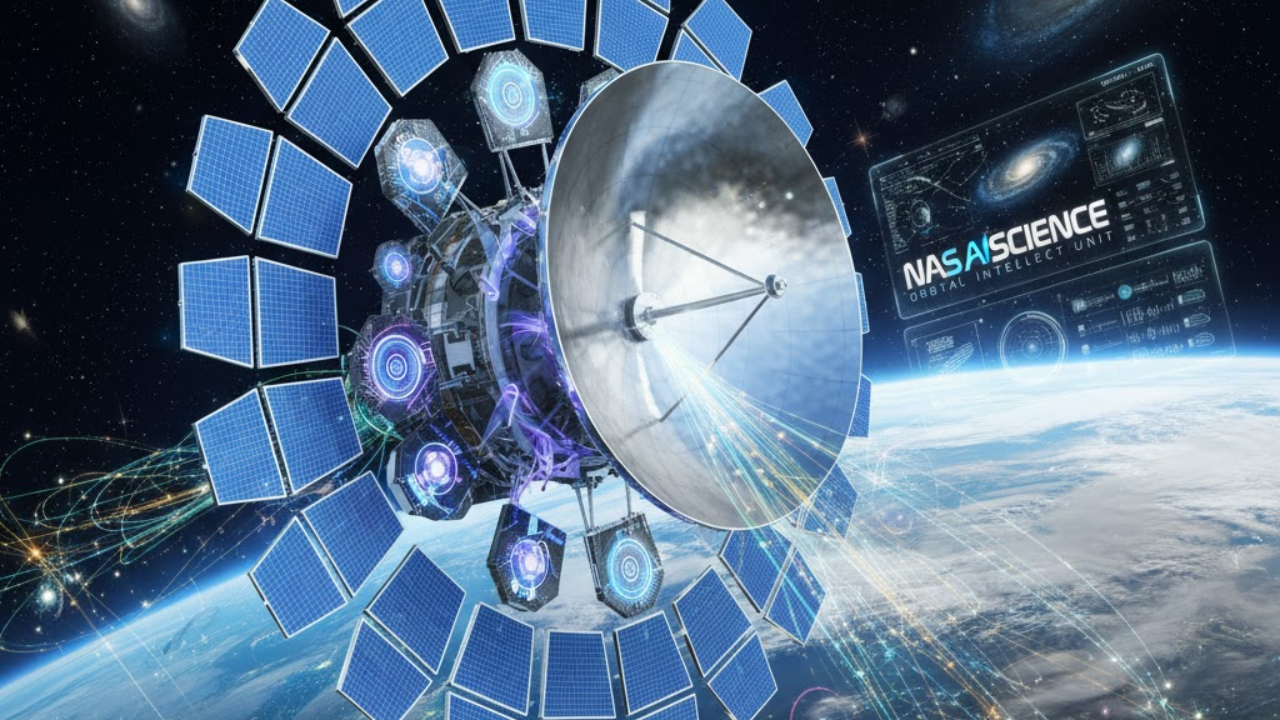
In a groundbreaking move, NASA has launched an AI-powered satellite capable of making real-time decisions while orbiting Earth. This marks a new era of autonomous space exploration, where artificial intelligence doesn’t just assist — it leads.
The project, known as the Earth Observing System AI Initiative (EOS-AI), represents NASA’s bold experiment in building self-thinking spacecraft.
Traditionally, satellites collect enormous amounts of data and transmit it back to Earth for analysis — a process that can take hours or even days. But with AI embedded directly into the satellite’s onboard computer, EOS-AI can:
Analyze images and sensor data in real time.
Detect events like wildfires, volcanic eruptions, or storm formation instantly.
Decide what information to send to Earth — and what to ignore.
This means scientists can receive only the most relevant, high-value data, drastically reducing communication delays and storage costs.
As NASA’s engineers put it: “We’ve given the satellite a brain.”
Space is vast, but bandwidth is limited. Every day, satellites capture terabytes of data — far more than can be transmitted to Earth in real time.
This challenge has pushed NASA to rethink traditional models of data management and decision-making in orbit.
By training machine learning algorithms to recognize patterns — such as smoke plumes, ocean temperature anomalies, or cloud formations — satellites can now prioritize what’s important.
AI doesn’t just collect; it interprets. This ability could help scientists respond to disasters faster, monitor climate change with greater precision, and even discover cosmic phenomena that might otherwise go unnoticed.
NASA’s onboard system uses a combination of:
Convolutional Neural Networks (CNNs) for image recognition and anomaly detection.
Reinforcement learning to improve decision-making based on new data.
Edge computing to process vast datasets directly on the satellite, rather than relying on ground stations.
This integration allows the satellite to act independently — a major step toward fully autonomous missions.
For instance, when the AI detects smoke and heat signatures from a wildfire, it can instantly:
Capture high-resolution imagery of the affected area.
Alert emergency agencies on Earth through data relay networks.
Continue monitoring the site to track fire spread — all without waiting for human input.
The potential impact of NASA’s AI satellite extends far beyond efficiency. It’s a paradigm shift in Earth observation.
Faster Disaster Response: AI-driven detection of floods, earthquakes, or oil spills enables near-instant alerts to global agencies.
Climate Intelligence: Real-time atmospheric analysis could dramatically improve forecasting accuracy and help model long-term climate patterns.
Agriculture & Environment: Satellites can now assess crop health, water levels, and deforestation automatically, aiding sustainability goals.
By making autonomous decisions in orbit, NASA’s satellite becomes a proactive observer rather than a passive recorder.
NASA isn’t alone in this revolution. The European Space Agency (ESA), ISRO (India), and SpaceX are also experimenting with AI-driven mission control.
However, NASA’s project stands out for its real-time inference capabilities — the ability for AI to learn, adapt, and make mission-critical choices on its own.
This development could soon extend to deep space missions, where communication delays are measured in minutes or even hours. For instance:
A Mars rover could decide which rock samples are worth collecting.
A Jupiter probe could autonomously adjust its orbit to capture unexpected atmospheric events.
Future asteroid missions might identify mining potential without waiting for Earth-based analysis.
In other words, AI won’t just explore space — it will understand it.
Despite its autonomy, NASA emphasizes that the AI satellite isn’t replacing human control but enhancing it.
Mission controllers can set parameters and goals, but the AI makes micro-decisions based on live data. This “human-AI collaboration” ensures both precision and flexibility.
NASA scientists compare it to an intelligent co-pilot — one that never sleeps, processes millions of data points per second, and learns from every orbit.
The heart of the system lies in NASA’s HawkEye Processor, a specialized chip optimized for deep learning and energy efficiency.
Combined with low-power edge AI software, this processor allows the satellite to analyze complex data streams while conserving fuel and energy.
These innovations highlight how space agencies are merging AI, cloud computing, and nanosatellite technology to make exploration smarter and more sustainable.
NASA’s AI satellite is part of a larger vision — one where artificial intelligence enables self-sufficient exploration of the solar system.
In the coming years, autonomous systems will become standard in:
Space debris management — detecting and avoiding collisions automatically.
Planetary mapping — using AI to identify geological features on Mars, Europa, and Titan.
Interstellar probes — navigating vast distances without human input.
As AI continues to evolve, future spacecraft may even collaborate with each other — forming intelligent, interconnected constellations that share data, learn collectively, and make real-time scientific discoveries.
NASA’s autonomous satellite is more than a technological milestone — it’s a philosophical shift.
For the first time, machines in orbit can think for themselves, analyze their surroundings, and make decisions that once required human expertise.
This is not science fiction. It’s the dawn of machine intelligence in space, where AI becomes an explorer, a scientist, and a guardian of our planet — all at once.
As one NASA engineer aptly said: “We’ve taught satellites not just to see space, but to understand it.”
And in doing so, NASA has taken humanity one step closer to a self-aware universe — where artificial intelligence extends human curiosity beyond the stars.








Anticipated Dates for UAE Eid Al Adha 2026 Unveiled by Astronomical Experts
Experts predict Eid Al Adha 2026 in the UAE to start on May 27, prompting early holiday planning amo

DAE Achieves Remarkable Growth in Q1 2026 With Record Revenue
Dubai Aerospace Enterprise announces impressive financial results for Q1 2026, reflecting a surge in

Price Increase for Sony PS5 in Southeast Asia Effective May 1
Sony announces a price increase for the PS5 across Southeast Asia starting May 1, 2026, impacting ga

Potential ‘Super El Niño’ in 2026: Understanding the Climate Risks
Could a Super El Niño emerge in 2026? Discover its implications and potential global climate impacts

Global Energy Crisis Intensifies: Markets React to Oil Supply Challenges
Markets are on edge as oil disruptions escalate, influencing prices and economic stability. Explore

Must-See Tourist Spots in London You Can't Overlook
Explore London's essential attractions, from royal landmarks to vibrant markets, ensuring an unforge




