Post by : Anees Nasser
In mid-January 2026, our planet faced one of the most severe space weather occurrences in recent memory. The Sun released a massive solar radiation storm, rated as S4 (Severe) on the NOAA Space Weather Scales — a magnitude not observed since 2003. This extraordinary surge of high-energy particles, stemming from intense solar activity, reached the Earth’s magnetic field, triggering widespread impacts on space systems and atmospheric conditions.
Solar radiation storms arise when the Sun emits bursts of charged particles — predominantly protons — traveling at high speeds. As these particles penetrate Earth's protective magnetic field, they interact with the atmosphere, resulting in heightened radiation levels in near-space environments. The January 2026 storm was ignited by a massive X-class solar flare and a corresponding coronal mass ejection (CME), a vast cloud of plasma and magnetic fields expelled from the Sun's active surface.
This event stands out not only for its intensity but also for its widespread visibility and potential repercussions. Space weather experts and monitoring organizations worldwide, including NOAA and ESA, have been diligently observing the storm as it develops and impacts Earth’s environment.
The cause of the January 2026 space weather incident was a potent X1.9 solar flare originating from an active region on the Sun’s surface. X-class flares are the most powerful type of solar flares, capable of unleashing vast amounts of energy and ejecting charged particles into space. Shortly after this flare erupted, a swift coronal mass ejection (CME) was launched, carrying with it a substantial cloud of solar material.
CME events traverse the solar system and, if directed at Earth, can engage with our planet’s magnetic field. In this case, the CME arrived with remarkable speed, initiating severe geomagnetic activity and heightening solar radiation levels in near-Earth space. This series of eruptive solar activities has fostered conditions conducive to a dangerous radiation storm.
The combination of an X-class flare alongside a CME is a recognized catalyst for significant space weather occurrences. When charged particles from a CME contact Earth’s magnetic field, they can provoke disturbances in the magnetosphere — the protective magnetic barrier around our planet — resulting in what scientists refer to as geomagnetic storms. Strong interactions can lead to stunning visual effects while posing challenges for technological infrastructures.
Solar radiation storms fall under a scale ranging from S1 (minor) to S5 (extreme) based on the intensity of energetic particle flows. A storm rated at S4 (Severe) signifies a significantly intense occurrence where elevated radiation can impact satellites, spacecraft, and aviation operations. The current storm — classified as S4 — represents the most significant event since comparable conditions were seen in 2003.
The intensity of the storm is crucial as it reflects real increases in energetic particles traversing near-Earth space. Elevated radiation levels can exert direct implications for humans and technology operating beyond Earth’s atmospheric shield, particularly in low-Earth orbit and on high-latitude flight paths.
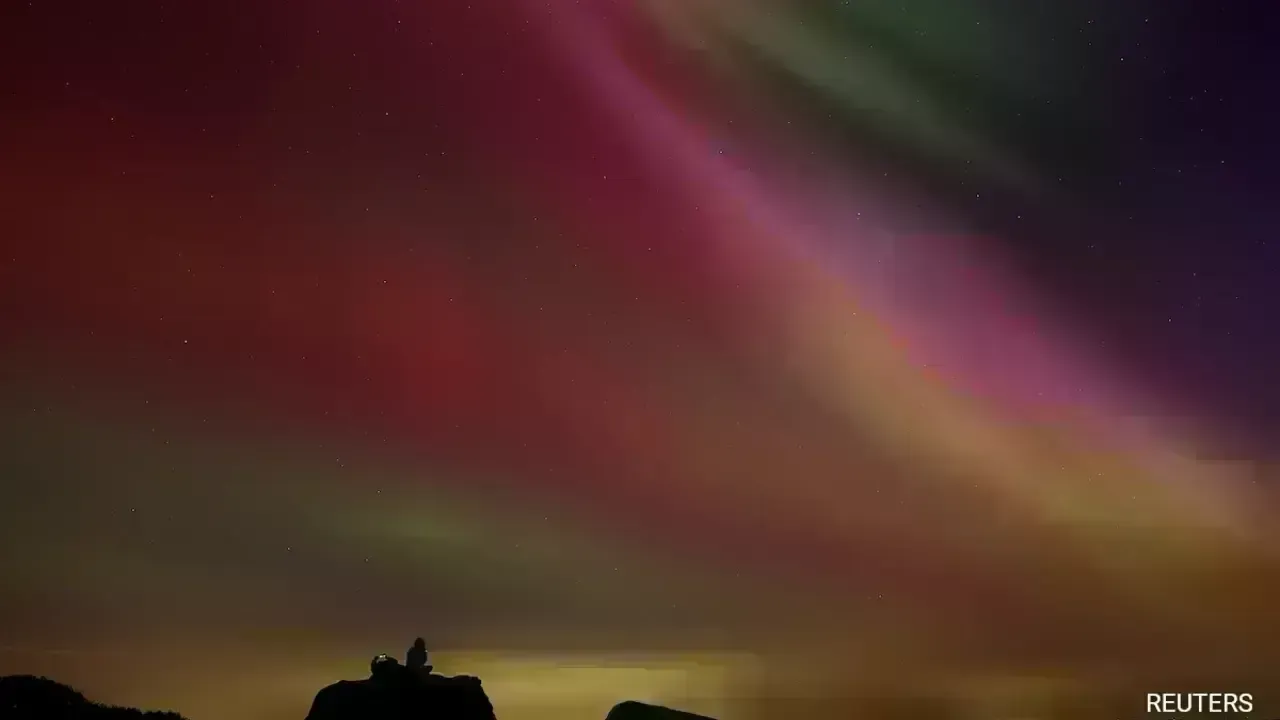
One of the most striking outcomes of the solar radiation storm has been the widespread manifestation of auroras — Northern and Southern Lights — at latitudes far beyond their typical boundaries. Traditionally limited to high polar zones, auroras were seen across extensive areas of the United States, Europe, and even ventured into mid-latitude territories.
North American residents witnessed brilliant green, red, and pink auroral curtains illuminating the night sky as far south as California, Texas, and Alabama, where such spectacles are infrequent. Observers in Europe enjoyed similarly breathtaking vistas, while communities elsewhere, like Ireland, experienced vibrant auroras deemed historic and potentially once-in-a-lifetime occurrences.
In the Southern Hemisphere, the aurora australis (southern lights) also exhibited uncommon sightings, with reports of visibility in regions of Australia and New Zealand not typically associated with robust auroral events.
Widespread auroral activity occurs when charged solar particles flow along Earth’s magnetic field lines towards the poles, colliding with atoms in the upper atmosphere, thus causing them to emit light. During intense geomagnetic disturbances, the auroral oval — the area where auroras are observable — can expand toward lower latitudes, offering extraordinary sights to observers globally.
While the visual impact of the storm has been remarkable, the increased radiation also creates obstacles for modern technology. Saturated satellites in orbit around Earth are especially susceptible to elevated levels of energetic particles, which can disrupt onboard systems, degrade solar panels, and impact navigational and communication capabilities.
Space agencies and satellite operators are vigilantly monitoring these consequences. Protective measures, such as transitioning satellites into safe operational modes or modifying systems, are being enacted to alleviate potential disruptions. For example, precision navigation systems like GPS may face temporary accuracy issues during these intense space weather conditions.
The storm also bears consequences for aviation, particularly for flights traversing polar paths. At high latitudes, increased solar radiation can heighten exposure levels for passengers and crew alike. It can also interfere with high-frequency (HF) radio communications, typically relying on in remote polar regions where other forms of communication may falter.
Airlines and aviation regulators are encouraged to review routes and communication plans to ensure safety and efficiency. While the risks may not directly threaten flight safety, they can impede operational procedures and necessitate meticulous management during harsh space weather occurrences.
Solar storms of this scale are rare but not unheard of. The Halloween storms of 2003, which the current event draws comparison to, incited significant geomagnetic activity, power system disruptions, and vibrant auroras at low latitudes.
Historical precedents also highlight even more intense events, such as the Carrington Event of 1859, which yielded auroras worldwide and caused telegraph systems to malfunction. Although the January 2026 storm does not reach the extremity of the Carrington Event, it underscores the substantial potential for impactful space weather during peaks in solar activity.
Current solar activity is aligned with Solar Cycle 25, a phase characterized by increasing sunspot and flare occurrences. These cycles, spanning approximately 11 years, inherently herald periods of intensified solar eruptions and activities.
Researchers and space weather organizations leverage a network of satellites and ground-based monitoring equipment to observe and evaluate the solar storm’s evolution and effects. Instruments aboard NOAA’s GOES satellites measure solar wind metrics, particle distributions, and magnetic field interactions, supplying vital real-time data to forecasters.
Collaboration among international bodies, like the European Space Agency (ESA), ensures comprehensive data informs both scientific comprehension and practical preparedness. This monitoring enables the identification of potential hazards, forecasting auroral activity, and advising critical infrastructure stakeholders about the expected impacts.
As the storm’s effects continue to unfold, scientists will be monitoring several key indicators:
Whether solar wind conditions remain heightened and continue to drive geomagnetic activity.
How sustained the enhanced auroral visibility is at lower latitudes.
Any subsequent solar flares or CME events that could prolong or escalate space weather impacts.
Geomagnetic storms generally diminish over several days as Earth’s magnetic field stabilizes and solar wind conditions ease. Yet, lasting effects may stick around, especially with additional solar activities. Ongoing monitoring remains crucial to assess continual impacts and potential risks.
Disclaimer: This article reflects current scientific observations and reports. Space weather phenomena are inherently dynamic, and conditions may shift rapidly. For timely updates, consult verified space weather prediction centers and scientific agencies.









Anticipated Dates for UAE Eid Al Adha 2026 Unveiled by Astronomical Experts
Experts predict Eid Al Adha 2026 in the UAE to start on May 27, prompting early holiday planning amo

DAE Achieves Remarkable Growth in Q1 2026 With Record Revenue
Dubai Aerospace Enterprise announces impressive financial results for Q1 2026, reflecting a surge in

Price Increase for Sony PS5 in Southeast Asia Effective May 1
Sony announces a price increase for the PS5 across Southeast Asia starting May 1, 2026, impacting ga

Potential ‘Super El Niño’ in 2026: Understanding the Climate Risks
Could a Super El Niño emerge in 2026? Discover its implications and potential global climate impacts

Global Energy Crisis Intensifies: Markets React to Oil Supply Challenges
Markets are on edge as oil disruptions escalate, influencing prices and economic stability. Explore

Must-See Tourist Spots in London You Can't Overlook
Explore London's essential attractions, from royal landmarks to vibrant markets, ensuring an unforge




