Post by : Naveen Mittal
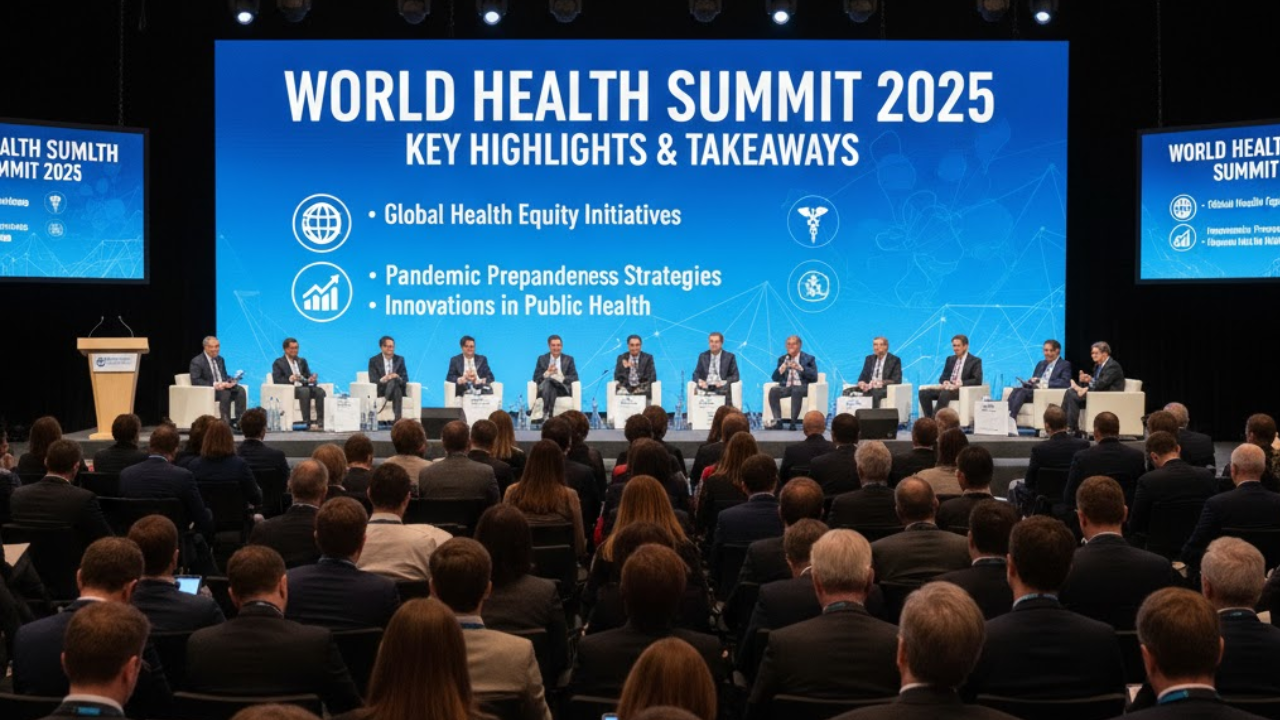
The World Health Summit 2025 convened ministers, scientists, health practitioners, philanthropists, private-sector leaders and civil society to confront urgent global health priorities at a time of overlapping crises: accelerating climate change, persistent pandemic risk, inequitable access to care and rapid technological disruption. This year’s Summit stood out for its emphasis on operationalizing commitments — moving from declarations to financeable, measurable actions — and for centering three cross-cutting themes: technology (notably AI), resilience (pandemic preparedness and health systems strengthening), and sustainability (the climate-health nexus). The Summit produced concrete policy guidance, new financing pledges, and practical roadmaps for national and local implementation. This article provides a deep, SEO-optimized analysis of the Summit’s major sessions, evidence-based takeaways, and a pragmatic action plan for governments, funders and health organizations.
AI is transformational — but governance and equity must come first. Leaders pushed for global standards on safe AI use in clinical care, health data governance, and algorithmic transparency.
Pandemic preparedness saw a renewed financing and legal push. Delegates favored sustained financing, common procurement corridors for countermeasures, and binding rapid-response protocols.
Climate change is now an immediate health emergency. The Summit reframed climate policy as health policy — prioritizing adaptation funding, heat-health plans, and resilient health infrastructure.
Health equity moved from rhetoric to measurable indicators. New commitments emphasized disaggregated data, community-led delivery models, and targeted financing for marginalized groups.
Cross-sectoral financing models gained traction. Blended finance, pandemic insurance corridors and pooled procurement mechanisms were proposed to de-risk investments in resilience.
The world in 2025 faces a complex health landscape: lingering effects of recent pandemics, uneven vaccine uptake, strained health workforces, and mounting climate-driven morbidity. Donor fatigue in some regions is paired with surges in philanthropic and private capital interest. Rapid digitalization (telehealth, remote diagnostics, AI systems) offers major gains — but also introduces governance, privacy and inequality risks.
WHS 2025 set three practical objectives:
Translate high-level commitments into financeable national plans.
Launch operational frameworks for digital health governance and AI ethics.
Strengthen global early-warning and response architecture with financing commitments.
AI presentations showcased advances in diagnostics, imaging, triage, drug discovery and predictive analytics. Demonstrations included AI-assisted radiology tools, natural language clinical note summarizers, and population-level predictive models for outbreak detection.
However, speakers emphasized risks: algorithmic bias, data privacy, reproducibility gaps, and regulatory fragmentation. Delegates warned against premature deployment in clinical settings without robust clinical validation and governance.
Global minimal standards for clinical AI validation: adoption of a common checklist for algorithm testing, including external validation and reporting of performance by demographic subgroup.
Interoperability & data portability principles: to avoid vendor lock-in and permit audits.
Data stewardship models: promote trusted data intermediaries or data trusts, with community representation and clear consent models.
Clinical governance: mandate human oversight for high-risk clinical decisions and clear liability frameworks.
Pilot certified AI tools in supervised settings; require third-party audit reports before national rollout.
Invest in digital literacy and AI training for clinicians.
Establish multidisciplinary AI oversight committees at national health ministries.
The Summit stressed that pandemic preparedness must be continuous and financed as recurring core public goods, not episodic emergency spending. Reforms discussed included legal instruments for rapid sharing of samples and data, pre-agreed financing windows, and supply chain buffering.
Pandemic preparedness financing facility: a replenishable fund to finance surge manufacturing, diagnostics, and stockpile replenishment.
Common procurement corridors: pre-negotiated contracts to scale production of countermeasures during a crisis and equitable allocation formulas.
Regional rapid response hubs: decentralized laboratories, training centers and logistics nodes to reduce reliance on single suppliers.
Integrate genomics, wastewater surveillance, sentinel clinical systems and digital syndromic surveillance.
Standardize data formats and sharing protocols; invest in local laboratory capacity and workforce.
Encourage public-private partnerships to scale diagnostics under quality assurance frameworks.
Strengthen workforce surge capacity via reserve rosters and cross-training.
Embed mental health and psychosocial support into response plans.
Invest in primary care as the foundation for early detection and community trust.
Summit sessions documented rising heat-related illness, climate-driven vector changes, food insecurity, and displacement. Delegates reframed climate action as immediate health preservation.
Climate-resilient health facilities: national programs to retrofit hospitals for heat, flooding and power resilience, and to transition to low-carbon energy sources.
Heat-health action plans: early warning systems, community cooling centers, and outreach to vulnerable groups.
Nature-based interventions: restoring wetlands and urban green spaces to reduce heat islands and improve air quality.
Mobilize blended finance: development finance institutions, green bonds, and private capital to fund health sector decarbonization.
Redirect a portion of climate adaptation funds explicitly to health system resilience.
WHS 2025 emphasized measurable equity targets, recommending standardized indicators (e.g., access by income quintile, rural/urban, ethnicity) and transparency dashboards to drive accountability.
Evidence shared showed community health worker models and community governance structures greatly improve access, trust and uptake of services. Sessions pushed for direct financing to community organizations and integration of local knowledge into planning.
Recommendations urged policies that consider multiple axes (gender, disability, migration status), not just single-dimension targeting, to avoid inadvertently widening disparities.
Pandemic surge finance corridors: pre-arranged credit lines and contingent financing tied to WHO triggers.
Health resilience bonds: investment products combining public guarantees and private return to fund long-term resilience projects.
Targeted domestic resource mobilization: tax reforms and earmarked levies for health security.
Use blended finance to absorb first losses and use public credit enhancement for risky, high-impact projects (e.g., decentralized diagnostics, green hospitals).
Donors and governments were urged to link financing to measurable outputs (e.g., reduced outbreak detection time, percent of facilities climate-resilient) and to use independent evaluation mechanisms.
Speakers called for operationalizing One Health beyond rhetoric: integrated surveillance of humans, animals and environment; joint budgets; and shared governance at national levels.
Mental health was framed as central to resilience. Recommendations included scaling community mental health services, integrating into primary care, and funding psychosocial supports during crises.
Calls were made for better stewardships, diagnostics to reduce unnecessary antibiotic use, and incentives to revive antibiotic pipelines with stewardship safeguards.
Decentralized genomic surveillance pilot: a regional hub employing rapid sequencing and local training to detect variants within days.
AI-assisted triage in primary care: early trials reduced time to referral and improved diagnostic accuracy under supervision.
Community cooling program: a municipal program combining heat alerts, green canopy, and pop-up cooling centers that cut heat-related ER visits.
These case studies illustrated feasibility and the need for careful evaluation before scale.
Time to detect and report novel pathogens (hours/days).
Percent of health facilities meeting climate-resilient standards.
AI validation coverage: percent of deployed algorithms with external validation and subgroup performance reporting.
Equity index: access differentials across socioeconomic strata for essential interventions.
Global and national dashboards with disaggregated data.
Independent evaluation panels to audit progress and finances.
Community scorecards to reflect lived experience and service quality.
Develop integrated resilience plans that combine pandemic, climate and health systems strengthening into single, financeable documents.
Commit seed funding to climate-resilient facility upgrades and reserve workforce rosters.
Implement AI governance frameworks aligned with global minimal standards and mandate external validations.
Expand community health financing and legally recognize community health worker cadres.
Establish data sharing agreements for surveillance with privacy safeguards and data stewardship models.
Create blended finance facilities for health resilience and pandemic surge capacity.
Fund regional rapid response hubs and ensure operational linkages to existing networks.
Support market shaping for green health infrastructure through guarantees and concessional capital.
Prioritize equity in all funding decisions by requiring disaggregated impact assessments.
Pilot certified AI tools in low-risk settings and implement clinician training.
Adopt heat-health protocols and disaster continuity plans.
Strengthen primary care platforms to serve as surveillance and early response nodes.
Partner in public procurement frameworks with clear quality and validation requirements.
Invest in interoperable solutions and open APIs to prevent vendor lock-in.
Commit to equitable access clauses for low- and middle-income country deployments.
Governance fragmentation: Without harmonized standards, national fragmentation will impede cross-border response.
Data privacy vs surveillance: Balancing privacy and rapid detection requires robust governance and public trust.
Funding sustainability: Many financing proposals require sustained political will; short-term pledges are insufficient.
Technology overreach: Overreliance on AI without validation may widen inequities.
Workforce constraints: Aging and burned-out health workforces may limit scale despite funding.
Annual global stocktake against WHO/partner targets for preparedness and health system resilience.
Independent audits for pandemic fund disbursements and climate-health investments.
Community feedback loops included in evaluation to ensure interventions are contextually relevant.
Adaptive management: funders require iterative learning cycles and reallocation mechanisms based on evidence.
Q. How will AI regulation avoid stifling innovation?
Answer: By adopting risk-based approaches — basic tools face light oversight, high-risk clinical tools require rigorous validation. Harmonized minimum standards reduce duplication and uncertainty.
Q. Will pandemic finance compete with other health priorities?
Answer: Integrated resilience planning aims to align pandemic funding with broader health system investments so they reinforce, not compete with, core services.
Q. How can small countries access financing for climate-resilient health facilities?
Answer: Through blended finance, regional pooled funds, and by tapping concessional climate adaptation finance earmarked for health infrastructure.
Q. What ensures equitable distribution of AI tools globally?
Answer: Procurement clauses, licensing terms for low- and middle-income settings, and open validation datasets to lower barriers to safe adoption.
This article is for informational purposes only and does not constitute legal, medical, or financial advice. The analysis synthesizes Summit themes and publicly discussed policy options as of October 2025. Readers should consult primary Summit materials, official government guidance, and subject-matter experts before making policy, clinical, or investment decisions.










Anticipated Dates for UAE Eid Al Adha 2026 Unveiled by Astronomical Experts
Experts predict Eid Al Adha 2026 in the UAE to start on May 27, prompting early holiday planning amo

DAE Achieves Remarkable Growth in Q1 2026 With Record Revenue
Dubai Aerospace Enterprise announces impressive financial results for Q1 2026, reflecting a surge in

Price Increase for Sony PS5 in Southeast Asia Effective May 1
Sony announces a price increase for the PS5 across Southeast Asia starting May 1, 2026, impacting ga

Potential ‘Super El Niño’ in 2026: Understanding the Climate Risks
Could a Super El Niño emerge in 2026? Discover its implications and potential global climate impacts

Global Energy Crisis Intensifies: Markets React to Oil Supply Challenges
Markets are on edge as oil disruptions escalate, influencing prices and economic stability. Explore

Must-See Tourist Spots in London You Can't Overlook
Explore London's essential attractions, from royal landmarks to vibrant markets, ensuring an unforge




