Post by : Saif Nasser
The capture of Venezuelan President Nicolas Maduro by the United States has triggered strong reactions across the world and has placed China’s diplomatic strategy under intense pressure. The event has raised serious questions about international law, national sovereignty, and how far global powers can go without approval from the United Nations.
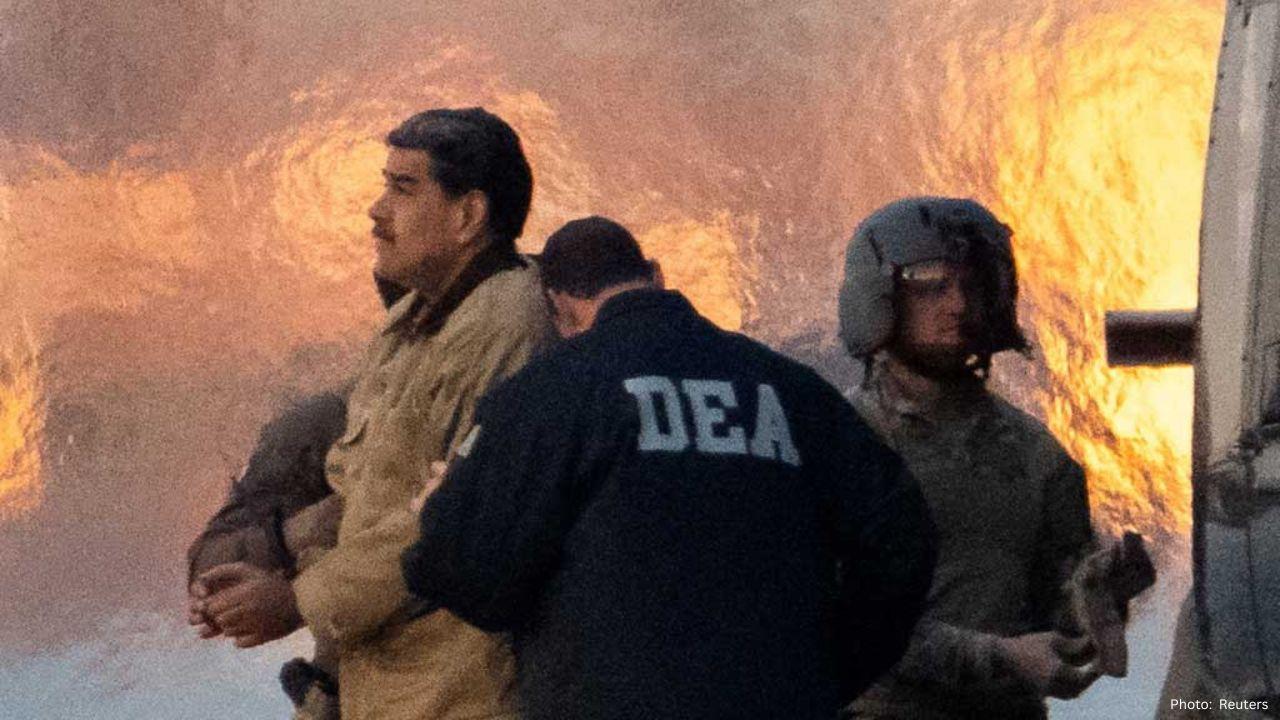
According to reports, US forces seized Maduro from Venezuela and transferred him to New York to face narcotics-related charges. Images of the Venezuelan leader being blindfolded and handcuffed shocked many countries. Maduro later pleaded not guilty in a US court. Almost immediately, the legality of the US action became a topic of debate at the United Nations Security Council.
China strongly condemned the move. Chinese leaders accused the United States of acting as if it were above international law. China’s Foreign Minister Wang Yi said no country has the right to behave like the world’s police or the world’s judge. He stressed that every nation’s sovereignty and security must be respected under international law.
China follows a long-standing policy of non-intervention. This means it opposes military or political interference in another country’s internal affairs unless approved by the UN Security Council. Because of this policy, China regularly criticizes military actions taken without global approval. The seizure of Maduro directly challenges this principle and forces China to show whether it can defend its position on the world stage.
The issue was formally raised at the UN Security Council after Colombia requested an emergency meeting, supported by China and Russia. During the meeting, China expressed shock and strong opposition to the US action. Chinese representatives warned that using military force to solve political problems often leads to greater instability rather than peace. The UN Secretary-General also warned that such actions could set a dangerous example for the future.
Analysts say China now plays a key role in shaping global opinion against the US decision. While China may not be able to offer military or direct economic help to Venezuela at this moment, it can use its diplomatic influence to rally developing nations and build pressure through international institutions.
The situation is especially sensitive because Venezuela is one of China’s closest partners in Latin America. The two countries have shared strong ties for decades, especially since former leader Hugo Chavez strengthened relations with Beijing. After Chavez’s death, Maduro continued this partnership. China invested heavily in Venezuela’s oil industry and infrastructure, especially after Western sanctions hurt the Venezuelan economy.
China also benefited from this relationship. Venezuela supported China’s global initiatives and followed Beijing’s political positions on many international issues. For China, the capture of Maduro is not just a legal or political issue, but a blow to its image as a dependable partner that protects its allies.
The crisis also raises concerns among other Latin American countries that have aligned with China in recent years. Many of these nations joined China’s security and cooperation initiatives believing they offered protection from foreign interference. Now, they may question whether China can truly shield them if a powerful country like the United States decides to act alone.
Chinese President Xi Jinping has called on all nations to respect international law and follow UN principles. He urged major powers to set a responsible example, although he avoided naming the United States directly. His remarks reflect China’s careful approach, balancing strong words with diplomatic caution.
At the same time, the United States has continued to use tough language toward other countries in the region, including Colombia, Mexico, and Cuba. This has added to fears that military force could again become a tool of foreign policy, rather than diplomacy.
For China, the Maduro case is a major test. It challenges Beijing’s claim that global problems can be solved without force and without Western dominance. How China responds in the coming weeks, especially at the United Nations, will shape its reputation as a global leader and defender of international rules.
The capture of Maduro has clearly gone beyond Venezuela. It has reopened old debates about power, law, and fairness in global politics. As the world watches closely, the outcome may redefine how countries respond when international norms are pushed to their limits.

The Impact of Consistent Small Investments on Wealth Building
Discover how investing small amounts regularly can positively transform your financial future over t

7.5 Magnitude Earthquake Strikes Japan, Tsunami Alerts Issued
Japan experiences a hefty 7.5 quake, prompting tsunami alerts and safety measures. Stay updated on a
Reopening of the Strait of Hormuz: New Regulations to Impact Global Trade
Iran reopens the strategic Strait of Hormuz with new regulations affecting oil transport and global

Top 10 Must-See Attractions in NYC for First-Time Explorers
Discover essential experiences for first-time visitors to NYC, including attractions, culture, and i
Starbucks Engages Boyu Capital for Major Chinese Expansion
Starbucks teams up with Boyu Capital, selling a majority stake to boost growth and adapt to the Chin
Three Individuals Charged in Massive Meth Trafficking Case in Malaysia
In Malaysia, a married couple and another suspect are charged with trafficking 510kg of meth, facing