Post by : Bianca Suleiman
Amidst strategic ambitions for Greenland, the primary hindrance is not political hurdles but rather the Arctic's icy clutches.
The dense, shifting ice obstructs harbors, isolates coastlines, conceals mineral wealth, and transforms waters around Greenland into perilous zones for navigation.
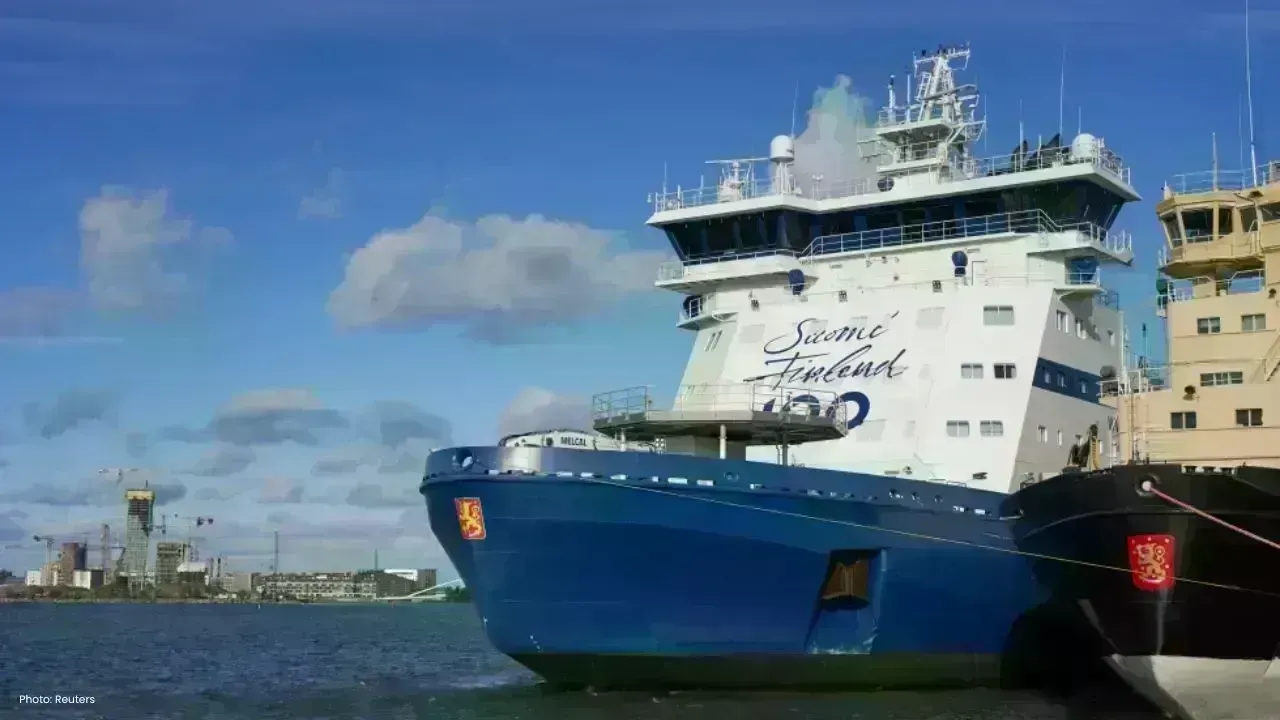
To traverse these frozen expanses, one essential tool is needed: icebreakers.
These massive vessels, designed to cleave through ice, create navigable routes that would otherwise render regular ships ineffective. Despite the growing significance of the Arctic for global security and resource extraction, the U.S. finds itself critically lacking in these vessels.
The U.S. Icebreaker Deficit
Currently, the U.S. operates just three icebreakers, one of which is almost non-functional. In contrast, Russia boasts nearly 100 ice-capable ships, including nuclear-powered ones. Canada is working to expand its fleet to nearly 50, while China has surpassed the U.S. in icebreaker numbers and is swiftly enhancing its fleet.
While Washington has committed to acquiring 11 new icebreakers, optimistic delivery schedules still point to a multi-year wait.
According to Alberto Rizzi from the European Council on Foreign Relations, “Should the U.S. need to transport large quantities of materials to Greenland right now, there would be a significant delay of two to three years, limiting access to the island.”
“On a map, Greenland appears to be encircled by water, but in actuality, it's surrounded by ice,” he added.
Significance of Greenland
President Donald Trump has frequently highlighted the importance of Greenland for American security and economic strength. The island occupies a strategic location within the Arctic and is rich in critical resources, including rare earth minerals essential for contemporary technology and defense.
During a recent address at the World Economic Forum in Davos, Trump emphasized that extracting these minerals would entail drilling through “hundreds of feet of ice.”
However, experts indicate that without a dependable fleet of icebreakers to ensure the continuity of supply routes, support mining endeavors, and safeguard military bases, such aspirations are unrealistic.
Even major defense initiatives like the proposed $175 billion “Golden Dome” missile defense system would face challenges in construction and maintenance without reliable year-round access to the Arctic.
Limited Options for New Icebreakers
For additional icebreakers, the U.S. has few alternatives. Only a select few nations possess the capability to design and construct them: Russia, China, Canada, and Finland.
Finland stands out as a world leader in this field, having built approximately 60% of the planet's icebreakers and designed much of the remainder, drawing from decades of experience operating in the frigid Baltic Sea.
“These are very specialized skills,” remarked Rizzi. “Finland has transformed necessity into strategic economic advantage.”
Canada plays a pivotal role as well, while China is in the progress of establishing its own advanced polar fleet.
The Ice Pact and Cooperation Challenges
During Trump’s initial term, the U.S. prioritized the construction of icebreakers, a focus that has continued under President Biden through the Ice PACT agreement with Canada and Finland.
This agreement outlines plans for 11 new icebreakers, with four to be constructed in Finland and the others at shipyards in the U.S. and Canada, utilizing Finnish designs.
Nevertheless, diplomatic tensions regarding Greenland and trade disputes have created an unstable environment for cooperation, despite experts asserting the necessity of joint efforts.
“Cooperation is crucial for feasibility,” stated Sophie Arts of the German Marshall Fund. “Currently, the U.S. does not have a viable option to handle this independently.”
The Price of Arctic Ambition
Even with sufficient icebreakers, transforming Greenland into a significant mining or military hub would entail immense costs. Infrastructure must be established under some of the planet's most challenging conditions, and returns on investments may take years.
“Everything is more expensive in the Arctic—transportation, construction, maintenance, and security,” noted Arctic expert Marc Lanteigne. “In this region, progress is slow.”
However, Denmark and other European allies have indicated a willingness to explore deeper collaboration, provided sovereignty concerns are respected.
Danish Prime Minister Mette Frederiksen expressed support for bolstering Arctic security, including U.S.-led initiatives, “as long as it is undertaken with an acknowledgment of our territorial integrity.”
Control Over Arctic Access
Despite political rhetoric, one undeniable truth remains: today, Europe, particularly Finland, holds significant control over Arctic accessibility.
European Commission President Ursula von der Leyen recently affirmed this reality, stating that Finland is currently selling icebreakers to the U.S.
“This signifies that Arctic security can only be accomplished collaboratively,” she stated.
Following an emergency summit in Brussels, the European Union announced plans for increased defense investments in Greenland, including additional icebreakers.
The Icy Reality
Without an advanced icebreaker fleet, U.S. goals in Greenland remain largely unachievable.
Minerals cannot be extracted, bases cannot be reliably resupplied, and power cannot be asserted.
In the Arctic, physical resources matter more than political declarations—at present, the U.S. is years away from having the necessary tools.









7.5 Magnitude Earthquake Strikes Japan, Tsunami Alerts Issued
Japan experiences a hefty 7.5 quake, prompting tsunami alerts and safety measures. Stay updated on a

Reopening of the Strait of Hormuz: New Regulations to Impact Global Trade
Iran reopens the strategic Strait of Hormuz with new regulations affecting oil transport and global

Top 10 Must-See Attractions in NYC for First-Time Explorers
Discover essential experiences for first-time visitors to NYC, including attractions, culture, and i

Starbucks Engages Boyu Capital for Major Chinese Expansion
Starbucks teams up with Boyu Capital, selling a majority stake to boost growth and adapt to the Chin

Three Individuals Charged in Massive Meth Trafficking Case in Malaysia
In Malaysia, a married couple and another suspect are charged with trafficking 510kg of meth, facing