Post by : Shakul
In a pivotal move, the United States and Armenia have finalized a significant strategic partnership agreement in Yerevan just prior to the parliamentary elections. This development signifies Armenia's increasing alignment with Western countries amid rising tensions with Russia.
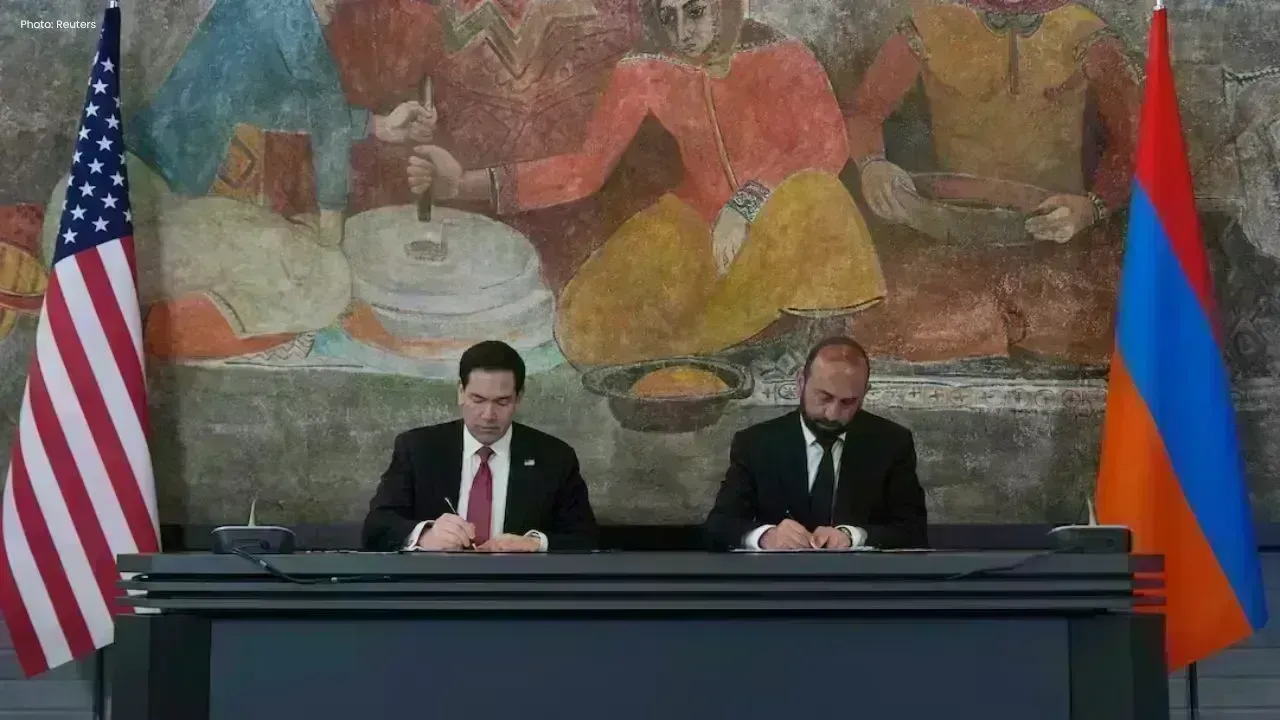
During a high-profile ceremony on Tuesday, U.S. Secretary of State Marco Rubio and Armenian Foreign Minister Ararat Mirzoyan put pen to paper on the agreement. It encompasses collaboration in areas such as critical minerals, regional transport connectivity, and economic growth.
This visit arrives just two weeks ahead of the upcoming parliamentary elections set for June 7, where Prime Minister Nikol Pashinyan's ruling Civil Contract party is met with fierce opposition from factions advocating for stronger ties with Russia.
The partnership also involves a framework focused on critical mineral resources, pledging cooperation to ensure reliable access to essential minerals crucial for modern industries and technological advancements.
A key aspect of the agreement supports the plan for a 43-kilometer transit corridor in southern Armenia, linking Azerbaijan directly to its Nakhchivan exclave and Turkey. This project is referred to as the “Trump Route for International Peace and Prosperity,” or TRIPP.
This corridor is viewed as vital for the ongoing peace efforts between Armenia and Azerbaijan after years of conflict in the South Caucasus. While the two nations reached a peace understanding the previous year, a formal peace treaty is still pending.
The new route is anticipated to bolster trade connections between Asia and Europe, while diminishing reliance on pathways through Russia and Iran. Analysts suggest that this endeavor could become crucial for global trade and energy supply chains.
Armenia's increasing collaboration with Western nations has intensified strains with Moscow. Russia has cautioned that Armenia's closer relationship with the West might lead to economic repercussions, including escalated gas prices. Recently, Moscow imposed limits on imports of Armenian products such as flowers, mineral water, and brandy, indicating displeasure regarding Yerevan’s foreign policy trajectory.
Even amidst these challenges, Armenian leadership is committed to enhancing its relationships with Western allies, notably the European Union and the United States, as evidenced by a recent European Union summit held in Armenia.
Political analysts argue that the upcoming elections will significantly impact Armenia's geopolitical orientation for years to come. The nation is currently navigating a delicate balance between its historical ties to Russia and its expanding connections with Western and regional partners.


Meta Unveils Subscription Plans for Instagram, Facebook, and WhatsApp
Meta introduces new subscription plans for users of Instagram, Facebook, and WhatsApp, featuring enh

Suvarna Joy on Education Leadership, Resilience, and Building Purpose Through Adversity in the UAE
Suvarna Joy shares her journey of education leadership, motherhood, faith, and resilience within the

Anticipated Dates for UAE Eid Al Adha 2026 Unveiled by Astronomical Experts
Experts predict Eid Al Adha 2026 in the UAE to start on May 27, prompting early holiday planning amo

DAE Achieves Remarkable Growth in Q1 2026 With Record Revenue
Dubai Aerospace Enterprise announces impressive financial results for Q1 2026, reflecting a surge in

Price Increase for Sony PS5 in Southeast Asia Effective May 1
Sony announces a price increase for the PS5 across Southeast Asia starting May 1, 2026, impacting ga

Potential ‘Super El Niño’ in 2026: Understanding the Climate Risks
Could a Super El Niño emerge in 2026? Discover its implications and potential global climate impacts




