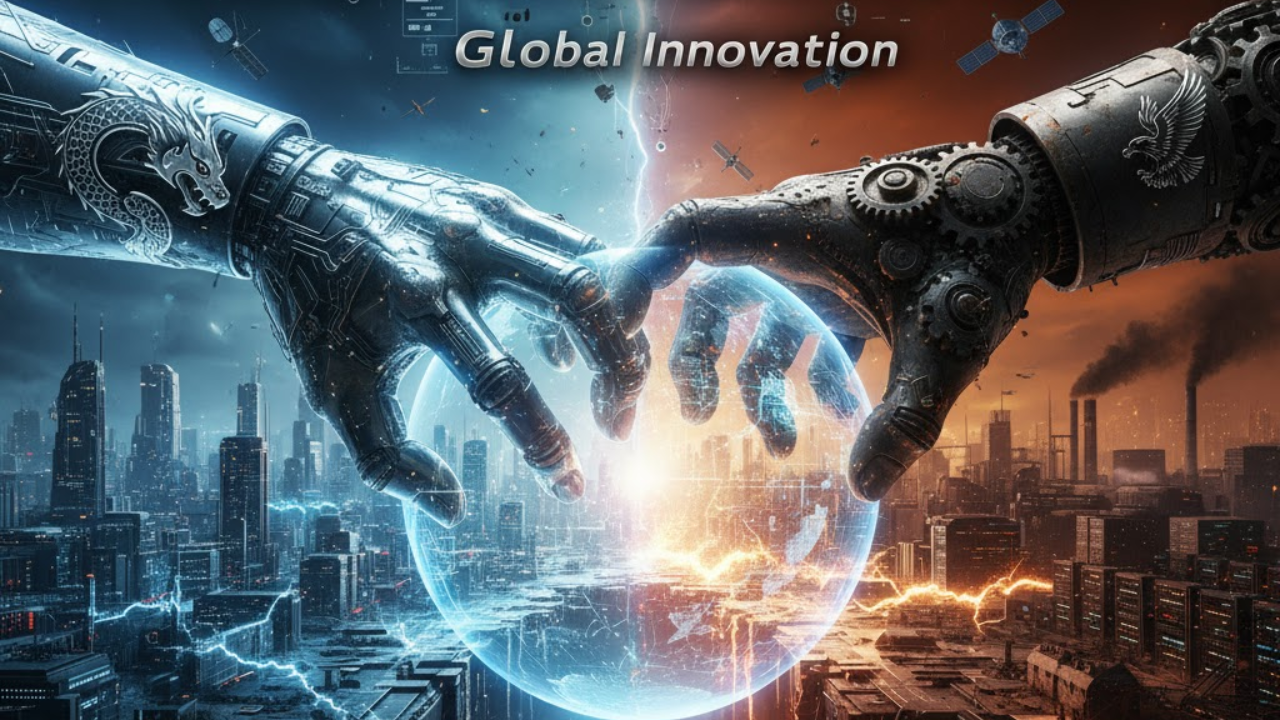
Post by : Naveen Mittal
In the 20th century, power was measured in nuclear warheads. In the 21st, it’s measured in algorithms, semiconductors, and artificial intelligence.
Welcome to the New Tech Cold War — a high-stakes global race for technological dominance, where nations are battling not with missiles, but with microchips and machine learning models.
This isn’t just competition for innovation. It’s a struggle for control over the digital future — and whoever wins will shape the next century of geopolitics, economics, and security.
Unlike the Cold War of the 1950s, this conflict isn’t about ideology — it’s about data, dominance, and digital infrastructure.
From Washington to Beijing, from Seoul to Berlin, governments are pouring billions into artificial intelligence (AI), quantum computing, advanced robotics, space technology, and 5G/6G networks.
Every breakthrough is now seen as a potential weapon — one that can secure military advantage, economic growth, and technological sovereignty.
As one analyst at the World Economic Forum put it: “In this era, code is the new currency of power.”
At the center of the global tech rivalry stand the United States and China — the two superpowers driving much of the world’s technological agenda.
The U.S. remains home to the world’s leading AI firms — OpenAI, Google DeepMind, and Anthropic. But China is closing the gap fast, with companies like Baidu, Alibaba, and Tencent developing powerful large language models and supercomputers.
China’s “AI 2030 Strategy” aims to make it the global leader in artificial intelligence before the decade ends.
Meanwhile, the U.S. is countering with the CHIPS and Science Act, allocating over $280 billion to boost domestic semiconductor production and research in AI and quantum computing.
Semiconductors — the chips powering everything from smartphones to fighter jets — have become the new oil of the digital age.
The U.S. has imposed export bans to restrict China’s access to advanced chipmaking tools, while Taiwan’s TSMC and South Korea’s Samsung remain key players caught between both powers.
China, in turn, is investing heavily in chip self-sufficiency, pledging more than $140 billion to develop a fully independent semiconductor ecosystem.
NASA’s Artemis Program and China’s Tiangong Space Station highlight a new space race, while both nations race toward quantum supremacy — the ability to perform calculations faster than any classical computer can.
Quantum communication networks, which are virtually unhackable, could redefine cybersecurity and espionage in the next decade.
The tech cold war isn’t just a U.S.-China story. Other nations are now carving out their own digital sovereignty strategies.
Europe has launched the Digital Markets Act and Gaia-X initiative to build independent cloud and data ecosystems free from American or Chinese control.
India is rapidly positioning itself as a semiconductor hub and AI talent powerhouse, driven by initiatives like Digital India and IndiaAI 2025.
Japan and South Korea are investing in robotics, autonomous systems, and advanced materials, ensuring they remain crucial players in global supply chains.
The Middle East — particularly Saudi Arabia and the UAE — is funding AI megaprojects to diversify economies beyond oil.
This expanding field of players has turned technological innovation into a global chessboard of influence.
Technology isn’t just powering economies; it’s shaping global power structures.
AI and Cybersecurity: Algorithms now influence national elections, defense systems, and global financial markets.
Data Colonialism: Nations are racing to control who owns and accesses the world’s data — the “new oil” of the digital age.
Supply Chain Warfare: Control over rare earth elements, batteries, and chip manufacturing has become a strategic tool in global diplomacy.
The rise of digital sanctions — restrictions on technology exports, cloud access, or AI software licenses — is replacing traditional economic warfare.
While much of this competition feels adversarial, it’s also driving unprecedented scientific collaboration and innovation.
Breakthroughs in green tech, biotechnology, quantum encryption, and neuromorphic computing are emerging as nations race to outdo each other.
For instance:
The European Union is leading research in sustainable nanomaterials.
Japan and South Korea are pushing frontiers in battery chemistry and robotics.
India’s Chandrayaan-3 mission and NASA’s AI satellite programs symbolize how innovation and national pride are now deeply intertwined.
The race for supremacy is ironically accelerating global progress — as every player competes to go faster, cleaner, and smarter.
Beyond politics and profits, this technological arms race carries a deeper question:
Will innovation unite the world or divide it further?
The push for dominance risks fragmenting global cooperation — splitting the internet, trade networks, and even scientific research into competing blocs.
However, many experts argue that shared challenges — climate change, pandemics, and space exploration — will eventually force collaboration, even among rivals.
As one MIT policy researcher noted: “The future of technology will be shaped not by who wins the race — but by how responsibly they run it.”
The New Tech Cold War is not about destruction — it’s about direction.
The nation that leads in artificial intelligence, quantum computing, biotechnology, and renewable innovation will define global standards, economic priorities, and even cultural influence for decades.
2025 marks a turning point — a world where the frontiers of science are the new borders of power.
Whether this race sparks conflict or collaboration will determine not just the next industrial revolution — but the fate of global progress itself.
The Cold War built walls. The Tech Cold War builds networks — invisible, intelligent, and intertwined.
As nations race to control code, chips, and data, one thing is clear:
The future is being coded now, and whoever controls the technology of today will command the world of tomorrow.
The question that remains isn’t who will win the race, but whether humanity can survive it together








Anticipated Dates for UAE Eid Al Adha 2026 Unveiled by Astronomical Experts
Experts predict Eid Al Adha 2026 in the UAE to start on May 27, prompting early holiday planning amo

DAE Achieves Remarkable Growth in Q1 2026 With Record Revenue
Dubai Aerospace Enterprise announces impressive financial results for Q1 2026, reflecting a surge in

Price Increase for Sony PS5 in Southeast Asia Effective May 1
Sony announces a price increase for the PS5 across Southeast Asia starting May 1, 2026, impacting ga

Potential ‘Super El Niño’ in 2026: Understanding the Climate Risks
Could a Super El Niño emerge in 2026? Discover its implications and potential global climate impacts

Global Energy Crisis Intensifies: Markets React to Oil Supply Challenges
Markets are on edge as oil disruptions escalate, influencing prices and economic stability. Explore

Must-See Tourist Spots in London You Can't Overlook
Explore London's essential attractions, from royal landmarks to vibrant markets, ensuring an unforge




