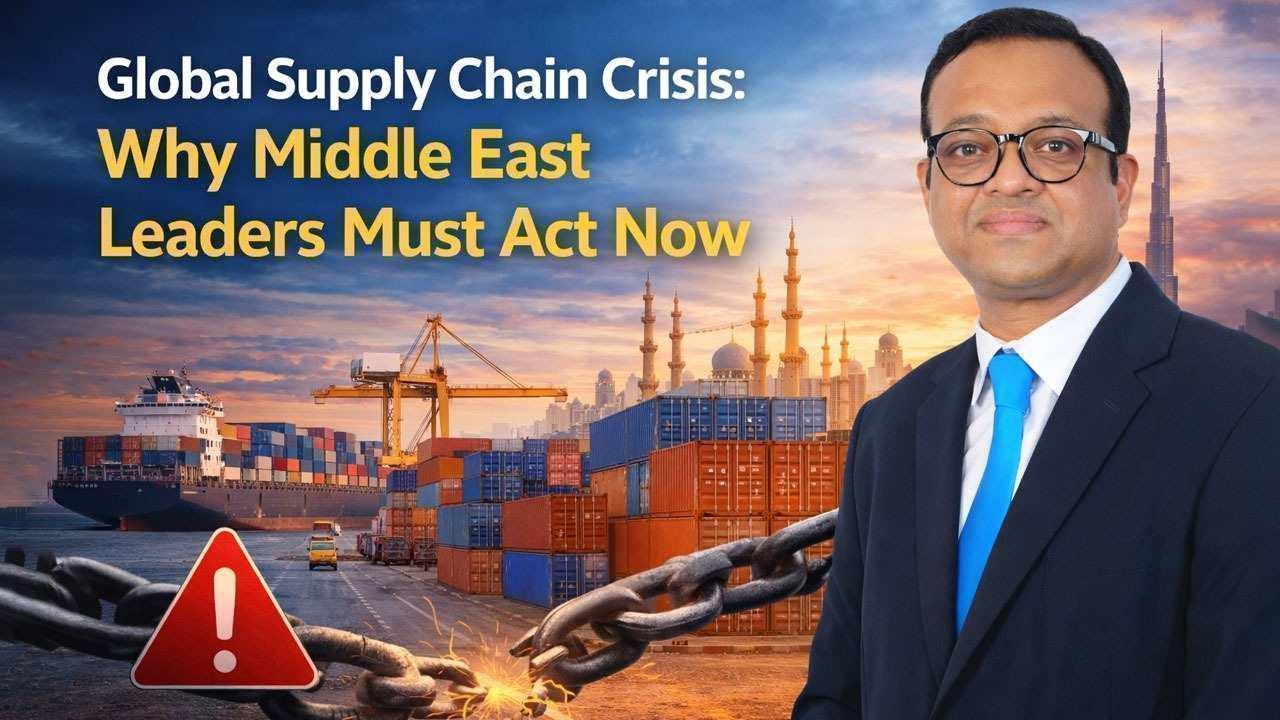
Post by : Samir Nasser
Supply Chain Transformation in the Middle East: Strategic Imperatives for Business Leaders Amid Global Disruptions
The global supply chain is currently experiencing significant disruption due to geopolitical tensions, potential trade route constraints such as risks around the Strait of Hormuz, and ongoing demand–supply imbalances. These factors are contributing to rising energy prices, particularly in markets such as the United States and Canada, with broader implications for commodity pricing and availability worldwide. As logistics networks face increasing uncertainty, the movement of goods has become more critical than ever. In this context, supply chain resilience and efficiency are essential to manage disruptions and ensure continuity of supply.
The Middle East, positioned at the junction of Asia, Europe, and Africa, has unfolded as a global trade and logistics hub, and its strategic significance has grown due to its vast oil and natural gas deposits. Supported by its abundant energy resources, today it is considered one of the world's most powerful geo-economic regions. The UAE has made several strategic investments to become a global integrated trade and logistics hub, and it aspires to escalate the UAE's logistics contribution to the economy from AED 136.7 billion in 2024 to over AED 200 billion, consistent with the UAE's National Logistics Strategy as detailed in We the UAE 2031.
We, the UAE 2031, Qatar’s National Vision 2030, and Saudi Arabia’s Vision 2030, have all marked strong emphasis on building a world-class commerce and logistics hub to boost economic transformation and regional economic leadership roles.
Despite that, the COVID-19 pandemic, the blockage of the Suez Canal in 2021, and fears of the Red Sea are some of the recent disruptions that demonstrate how fragile the global supply chain is. Increasing lead times, insurance, and shipping costs have made business operations more expensive than ever.
Hence, to reduce customer dissatisfaction, enhanced operational planning, synchronization, and safety stocks are indispensable. Leaders today perceive that a cost reduction mindset no longer assures success for long-term competitiveness, as the business dynamics are constantly evolving. Rather, supply chain management is now a boardroom leadership challenge to deal with that requires the closest attention, more than just process or technology changes.
Therefore, to achieve the regional Vision 2030-31, business leaders in the Middle East need to prioritize the transformation of their supply chain management practices, strengthen integration across all interconnected functions, and systematically address the following critical business dimensions.
When supply chains are interrupted, it has an immediate impact on cash flow. Many enterprises in the UAE and the rest of the region have endured financial hardship in recent years despite high demand. Inventory accumulated in some areas, while shortages arose in others. Costs rose, payments were delayed, and smaller suppliers faced rising pressure. It is not enough for a robust supply chain to simply reduce costs; it must also protect liquidity. The decisions that are made regarding inventory levels, transportation arrangements, the conditions of the suppliers, and consumer credit directly affect financial stability.
Consequently, addressing budget variance, focusing on the cost of goods sold in each operation, and addressing how alternative and reliable sourcing techniques and integrated logistical operations help a company manage expenses and maintain financial resilience are crucial.
Supply chains in the Middle East extend beyond national borders and connect businesses to markets globally. Recent challenges have demonstrated that businesses and organizations that primarily relied on contracts were often at risk. When ships were late or routes changed without warning, legal papers didn't really protect them in the actual world. In contrast, businesses that had developed strong relationships across their supplier networks were more resilient.
They had good relationships with ports, logistics companies, suppliers, and distributors as well. This helped them share information and make choices. These organizations finally succeeded in accommodating themselves to the altered conditions by working together effectively now that their people trusted one another and a strategic alliance had been formed. Nowadays, people must work together. It’s become a necessity to do business. Integrated planning, Effective inventory control is about preparing for changes and working in advance with key partners, who now more than ever will dictate your competitive position.
The Gulf is the land of its own power and on a fast track to nowhere. Markets emerge suddenly, projects grow speedily, and operating environments change overnight. Currently, speed is more about leaders' decision-making than the speed of moving items. Enterprises reliant on a glacial approval process and muddled data struggle to react.
Those who enable their teams and make decisions based on quality, up-to-the-minute data points can move swiftly even in times of doubt. This is not so much a time for raw operational speed as it is for smart, timely decisions. Companies that create elastic capacity, ramp their business up and down smartly, and consistently respond to demand are clear market winners.
Since the Middle East is strategically located, this presents many commercial possibilities. Its trade has a constantly changing environment as far as government policies go; disruptions are to be expected at key transport routes; and unwritten rules sometimes suddenly become formal laws. Supply chains can also be strong: by even things up. Avoiding single-point failures and risk concentration--a company needs to be strong across its network of partners, markets, and customer base. Resilience ensures that while efficiency is key to survival, setbacks can still be accommodated.
For resilience, organizations must manage internal and external threats. Changes in geopolitics, regulation, energy costs, and trade can affect supply networks, as can poor succession planning, leadership transition, and management failure. Governance and ownership conflicts also increase family-owned business vulnerability. Depending too much on one big supplier could be risky if they have financial issues. Being resilient means adapting to changes in markets, people, government, and suppliers, not just making predictions.
When disruptions occur, customers are often willing to accept delays. What they do not tolerate is uncertainty and inconsistency. Companies that communicate clearly, deliver on commitments, and maintain quality even under pressure build trust. Over time, this reliability becomes a powerful competitive advantage. In today’s market, being dependable is often more valuable than being the lowest-cost option. Being on time, meeting specifications, and optimizing utilization are the real foundations of sustainable business success.
Constant transformation of supply chains is the key to longevity. The Arabian Gulf Region is changing rapidly with new statutes, investments, and strategic plans. Companies that constantly review their plans work out and succeed. Companies that think that supply chain transformation is a one-time effort will miss the bus. The companies have had to restructure their supply chain. The strong leadership and governance are the reasons.
Ethics, integrity, and oversight build trust and stability. A successful recruitment and retention strategy means that the organization has flexible skills. Health and safety measures protect people and the business, while a strong company culture carries values, responsibility, and involvement. That combines improvement with business operations, not as an exception to them.
The absence of real-time information among senior management contributed to the escalation of several previous crises. There was a lack of clarity regarding the location of the goods, the shipments that were delayed, and the suppliers that were jeopardized. By ensuring that concerns are identified at an early stage, organizations can avoid them from becoming more severe.
Because this region aspires to be a leader in smart logistics, visibility throughout the entire supply chain is very necessary. For decision-making, a single source of truth is provided by system integration, seamless data flows across partners, end-to-end traceability, and accurate and fast ERP transactions.
Lack of timely information by leaders exacerbated several current situations. It was unclear where their inventory was or which shipments were late. They also didn't know which vendors were struggling. Businesses may identify and resolve difficulties early by understanding their inventories, shipments, and suppliers. This is how exposure helps businesses. It helps them manage inventories, shipping, and vendors.
In order to be at the forefront of intelligent logistics, the supply chain needs to be made transparent from the beginning to the end. System integration, seamless data flows between partners, end-to-end traceability, and accurate and timely ERP transactions that give a single source of truth for decision-making are how this visibility is accomplished.
There is a need for individuals at ports, warehouses, and transportation networks. It was made clear by the outbreak that the importance of worker safety, leaders, and qualified personnel cannot be overstated.
Technology makes operations more efficient. People can keep things going even when things are difficult. Businesses that make investments in areas such as leadership development, safety, staff training, and employee engagement have supply chains that are more robust.
The daily decisions that are made are guided by ethical leadership, integrity, and compliance. Keeping individuals attracted and retaining them is essential to maintaining institutional competency, while a robust culture is essential to preserving trust and responsibility. In order to have a successful supply chain, workers need to be in good health, motivated, and well-led.
Currently, sustainability is of the utmost importance. The observance of rules is no longer relevant. Competitors can be outperformed by sustainable businesses. Honesty and integrity are qualities that are expected from customers, investors, and partners of businesses. In the United Arab Emirates and other Gulf nations, governments are demanding sustainability. There is also a connection to international initiatives.
Companies that reduce their environmental impact and give back to their communities’ fare better. Sustainable sourcing, energy-efficient operations, and waste minimization are examples of green supply chain practices. This category includes decreased emissions, resource efficiency, and social responsibility for environmental and community sustainability. Doing the right thing in business is now a simple matter.
Every link in the supply chain impacts consumer satisfaction. You can clone infrastructure and tech. Trust and exceptional service are invaluable. In hard times, companies that provide reliable service, keep consumers informed, and fix issues before they worsen stand out. Tech innovation, customer satisfaction, and well-equipped service facilities with qualified technicians lead to service excellence. These skills turn operational strength into client loyalty.
The Middle Eastern supply chains must shift. People want to succeed, not because they're terrified. The Middle East aspires to be a location where people can trust to do business and is savvy about how it does things, so business leaders must accept that things will always be uncertain. Middle Eastern supply chains need more than cost savings and efficiency.
Leaders who balance and integrate supply chain performance will shape Gulf competitiveness in the future. This vision will improve financial health, cooperation, decision-making, resilience, visibility, people, sustainability, and service excellence. This strategy will help companies weather disruptions and shape Middle Eastern commerce and logistics.
The corresponding author, Dr. Ferdoush Saleheen, is a supply chain transformation specialist and former Chief Supply Chain Officer. He currently serves as an Assistant Professor at Sharjah Maritime Academy. You can reach at: ferdoushsaleheen@gmail.com
Co-author, Prof. Dr. Md. Mamun Habib, is a Professor at Independent University, Bangladesh, and a visiting scientist at the University of Texas at Arlington, USA. You can reach at: mamunhabib@iub.edu.bd
This article is published with permission from the original authors.







Anticipated Dates for UAE Eid Al Adha 2026 Unveiled by Astronomical Experts
Experts predict Eid Al Adha 2026 in the UAE to start on May 27, prompting early holiday planning amo

DAE Achieves Remarkable Growth in Q1 2026 With Record Revenue
Dubai Aerospace Enterprise announces impressive financial results for Q1 2026, reflecting a surge in

Price Increase for Sony PS5 in Southeast Asia Effective May 1
Sony announces a price increase for the PS5 across Southeast Asia starting May 1, 2026, impacting ga

Potential ‘Super El Niño’ in 2026: Understanding the Climate Risks
Could a Super El Niño emerge in 2026? Discover its implications and potential global climate impacts

Global Energy Crisis Intensifies: Markets React to Oil Supply Challenges
Markets are on edge as oil disruptions escalate, influencing prices and economic stability. Explore

Must-See Tourist Spots in London You Can't Overlook
Explore London's essential attractions, from royal landmarks to vibrant markets, ensuring an unforge




