Post by : Naveen Mittal
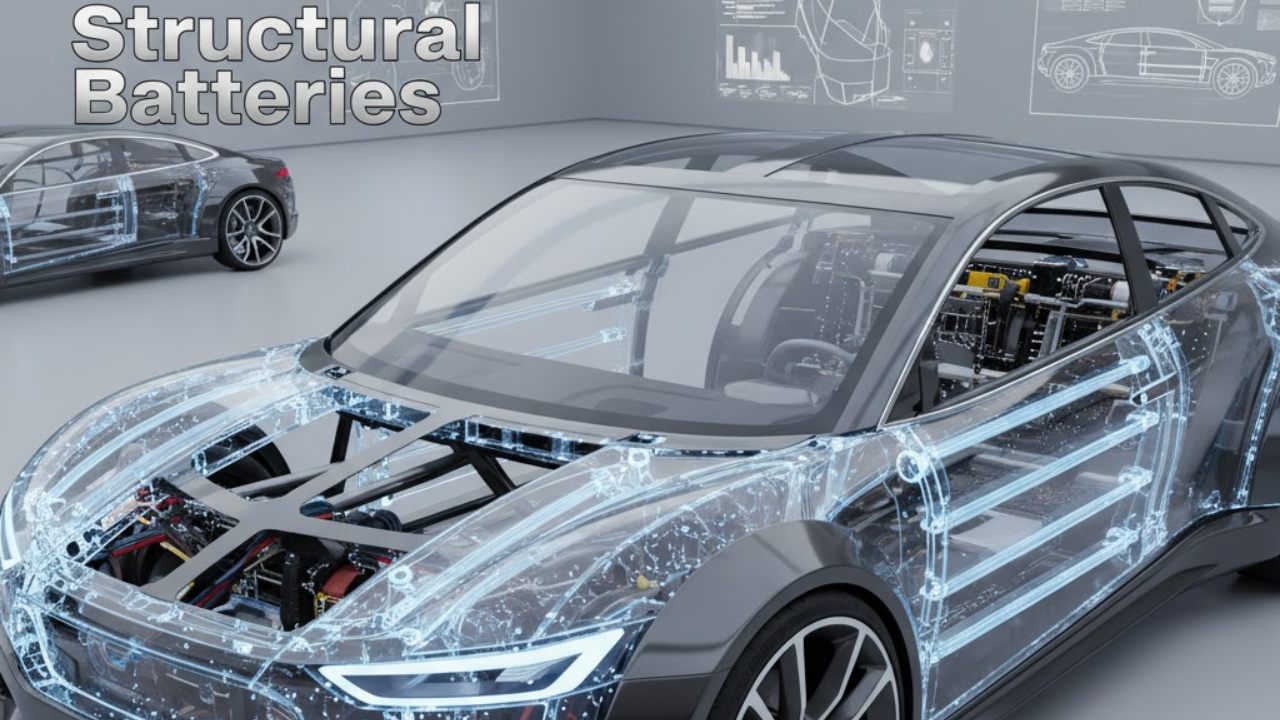
Electric vehicles and aircraft are on the brink of a transformation — one where their bodies won’t just support movement, but also store the energy that powers them. The concept driving this change is called Structural Battery Composites (SBCs), and it’s poised to redefine how we think about energy storage and design.
Today’s electric vehicles depend on massive lithium-ion battery packs that make up nearly half of their total weight. But what if those heavy cells could disappear, replaced by materials that are strong and energy-storing at the same time?
That’s the promise of structural batteries — composite materials that double as both the skeleton and the power source of a machine. These composites are made from carbon fibers infused with lithium-conducting polymers, turning the very frame of a car or plane into a living energy network.
Electric vehicle manufacturers are racing to solve one major problem: range anxiety without adding bulk. Structural battery composites may be the missing piece.
By embedding energy storage directly into body panels, roofs, and chassis components, engineers could:
Eliminate bulky battery packs.
Free up cabin and trunk space.
Extend range without increasing overall mass.
Researchers at Chalmers University of Technology achieved a breakthrough with a carbon-fiber composite that’s both as strong as aluminum and capable of storing energy. Companies like Tesla, BMW, and Polestar are already exploring prototypes that use this concept for next-generation EVs.
The result could be electric cars that are lighter, faster, and more energy-efficient — not by adding batteries, but by becoming them.
While the automotive sector pushes toward electrification, the aerospace industry sees an even greater opportunity. In aviation, every kilogram saved translates to major gains in performance and fuel efficiency.
Airbus and Rolls-Royce are testing composite airframes that can hold electric charge, potentially reducing aircraft weight by up to 25%. Imagine wings that store power for takeoff or fuselages that act as giant batteries during flight.
This innovation could make electric aircraft viable for commercial use, especially in regional travel — where current battery packs are too heavy for sustained flight.
To understand how this technology works, think of a sandwich structure:
The carbon fiber layers act as the electrodes (anode and cathode).
A solid polymer electrolyte lies between them, conducting lithium ions.
When current flows, ions move through the electrolyte, just like in a conventional battery — but the composite also carries structural loads. It’s both mechanically strong and electrochemically active.
Recent research in solid-state electrolytes has made these materials safer, eliminating risks like overheating or leakage while increasing energy density.
Structural batteries could reshape how vehicles and aircraft are designed:
Form follows function: Designers can integrate energy storage into the aesthetic form of a car or aircraft.
Improved efficiency: A lighter structure means higher mileage and longer flight times.
Sustainability edge: Fewer components mean reduced material waste and lower carbon footprint.
Even beyond transportation, this technology could find use in consumer electronics, wearables, and smart infrastructure, where compact and flexible energy sources are in demand.
Market analysts predict a boom in energy-storing structural materials, with the industry projected to exceed $3 billion by 2032.
Automakers such as Polestar and Volvo have already partnered with Chalmers University to create early prototypes, aiming for the first commercial structural battery EV within this decade.
Though promising, the technology faces hurdles before mass production:
Energy density: Still lower than current lithium-ion cells.
Cost: Advanced carbon composites remain expensive.
Repair complexity: Fixing damaged energy-storing structures requires specialized expertise.
But these limitations are shrinking quickly as nanomaterial research and AI-powered design tools advance. Many experts believe that within a decade, SBCs will be as common as lithium-ion batteries are today.
Structural batteries symbolize more than an engineering milestone — they represent a shift in thinking. Instead of viewing power sources as separate components, designers can now integrate them directly into the skeleton of machines.
As one Chalmers researcher put it: “The future car will not have a battery — it will be one.”
From next-gen electric vehicles to energy-storing aircraft, structural composites could unlock a future where every structure around us is alive with power — strong, smart, and self-charging.










Anticipated Dates for UAE Eid Al Adha 2026 Unveiled by Astronomical Experts
Experts predict Eid Al Adha 2026 in the UAE to start on May 27, prompting early holiday planning amo

DAE Achieves Remarkable Growth in Q1 2026 With Record Revenue
Dubai Aerospace Enterprise announces impressive financial results for Q1 2026, reflecting a surge in

Price Increase for Sony PS5 in Southeast Asia Effective May 1
Sony announces a price increase for the PS5 across Southeast Asia starting May 1, 2026, impacting ga

Potential ‘Super El Niño’ in 2026: Understanding the Climate Risks
Could a Super El Niño emerge in 2026? Discover its implications and potential global climate impacts

Global Energy Crisis Intensifies: Markets React to Oil Supply Challenges
Markets are on edge as oil disruptions escalate, influencing prices and economic stability. Explore

Must-See Tourist Spots in London You Can't Overlook
Explore London's essential attractions, from royal landmarks to vibrant markets, ensuring an unforge




