Post by : Mina Rahman
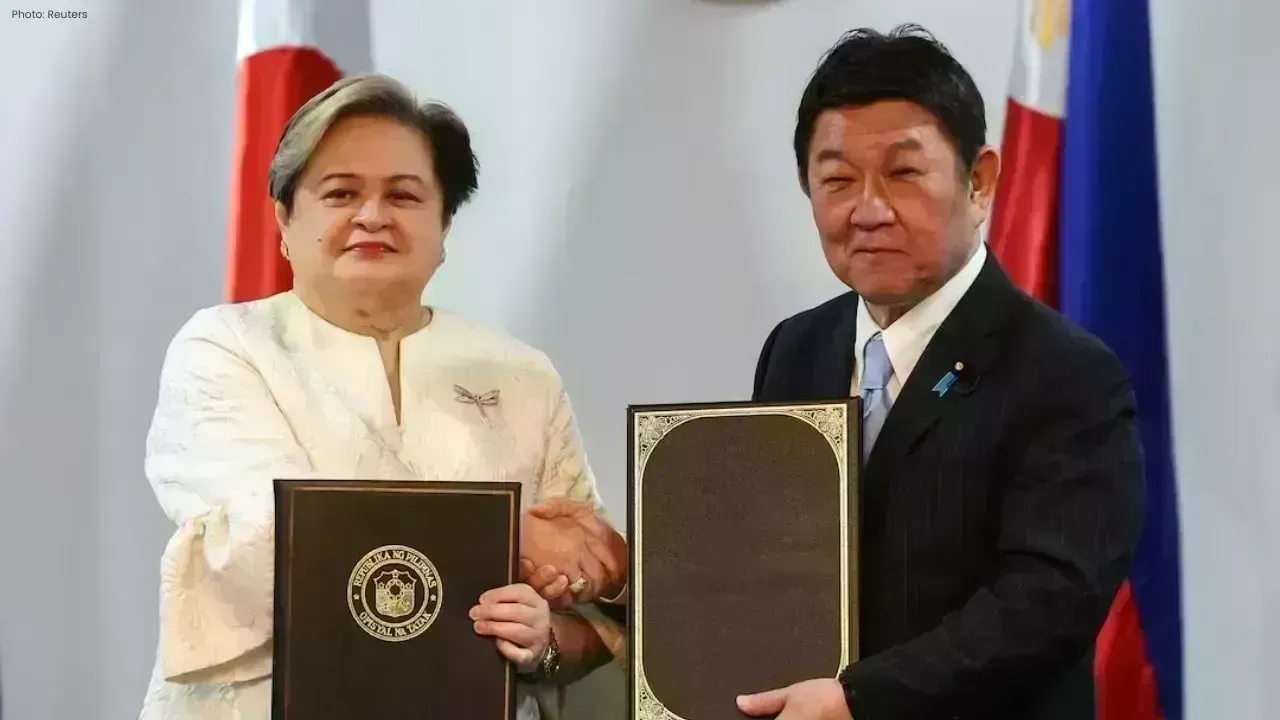
In a pivotal move towards bolstering defense relations, the Philippines and Japan formalized two significant agreements on Thursday. These accords facilitate the swift exchange of military supplies and services, aimed at ensuring operational synergy in light of increasing security challenges in the region.
The newly established Acquisition and Cross-Servicing Agreement (ACSA) comes shortly after the implementation of a landmark Reciprocal Access Agreement between these two U.S. allies in Asia. Together, these agreements signify a concerted effort to augment defense collaboration in a region marked by rising geopolitical tensions.
During his nine-day tour of the Middle East and Asia, Japanese Foreign Minister Toshimitsu Motegi signed the agreements in Manila. His itinerary included visits to Israel, the Palestinian territories, Qatar, and India, underscoring Japan’s increasing strategic footprint throughout the area.
Alongside his Philippine counterpart, Defense Secretary Theresa Lazaro, Motegi unveiled a $6 million Official Security Assistance package from Japan. This funding will aid in constructing facilities to accommodate rigid-hulled inflatable boats provided by Japan, thus enhancing the Philippines’ maritime capabilities.
Japan has voiced ongoing concerns regarding escalating maritime disputes in East Asia, opposing unilateral efforts to change the status quo. Tokyo has underscored the importance of Philippine maritime security within a broader trilateral arrangement that also involves the United States.
“The Secretary and I reaffirmed the importance of Japan-Philippines-U.S. cooperation in today’s increasingly challenging strategic environment,” Motegi stated at a joint press conference with Lazaro.
Japan supports the 2016 ruling by the Permanent Court of Arbitration in The Hague, which deemed China’s expansive claims in the South China Sea invalid—a decision that Beijing has rejected. Lazaro emphasized that both countries share a commitment to uphold the rule of law, including the rights of navigation and overflight, and recognized Japan’s critical role as a strategic partner.
Motegi’s visit aligns with the Philippines’ assumption of the chairmanship of the Association of Southeast Asian Nations, amid escalating tensions surrounding Taiwan. Japan has stressed the significance of stability and peace in the Taiwan Strait for global security. In November, Japanese Prime Minister Sanae Takaichi cautioned that a potential Chinese incursion into Taiwan could prompt military actions from Japan, evoking a strong backlash from Beijing, including travel restrictions and bans on certain dual-use exports.
China claims sovereignty over Taiwan, located just 100 kilometers from Japanese territory, and has not ruled out military intervention to assert control. In contrast, Taiwan insists that only its citizens can determine the future of the island.
In response to these evolving regional challenges, Japan is initiating a historic military buildup designed to counter China's expanding influence while reinforcing alliances within East Asia.









The Impact of Consistent Small Investments on Wealth Building
Discover how investing small amounts regularly can positively transform your financial future over t

7.5 Magnitude Earthquake Strikes Japan, Tsunami Alerts Issued
Japan experiences a hefty 7.5 quake, prompting tsunami alerts and safety measures. Stay updated on a
Reopening of the Strait of Hormuz: New Regulations to Impact Global Trade
Iran reopens the strategic Strait of Hormuz with new regulations affecting oil transport and global

Top 10 Must-See Attractions in NYC for First-Time Explorers
Discover essential experiences for first-time visitors to NYC, including attractions, culture, and i

Starbucks Engages Boyu Capital for Major Chinese Expansion
Starbucks teams up with Boyu Capital, selling a majority stake to boost growth and adapt to the Chin

Three Individuals Charged in Massive Meth Trafficking Case in Malaysia
In Malaysia, a married couple and another suspect are charged with trafficking 510kg of meth, facing