Post by : Saif Nasser
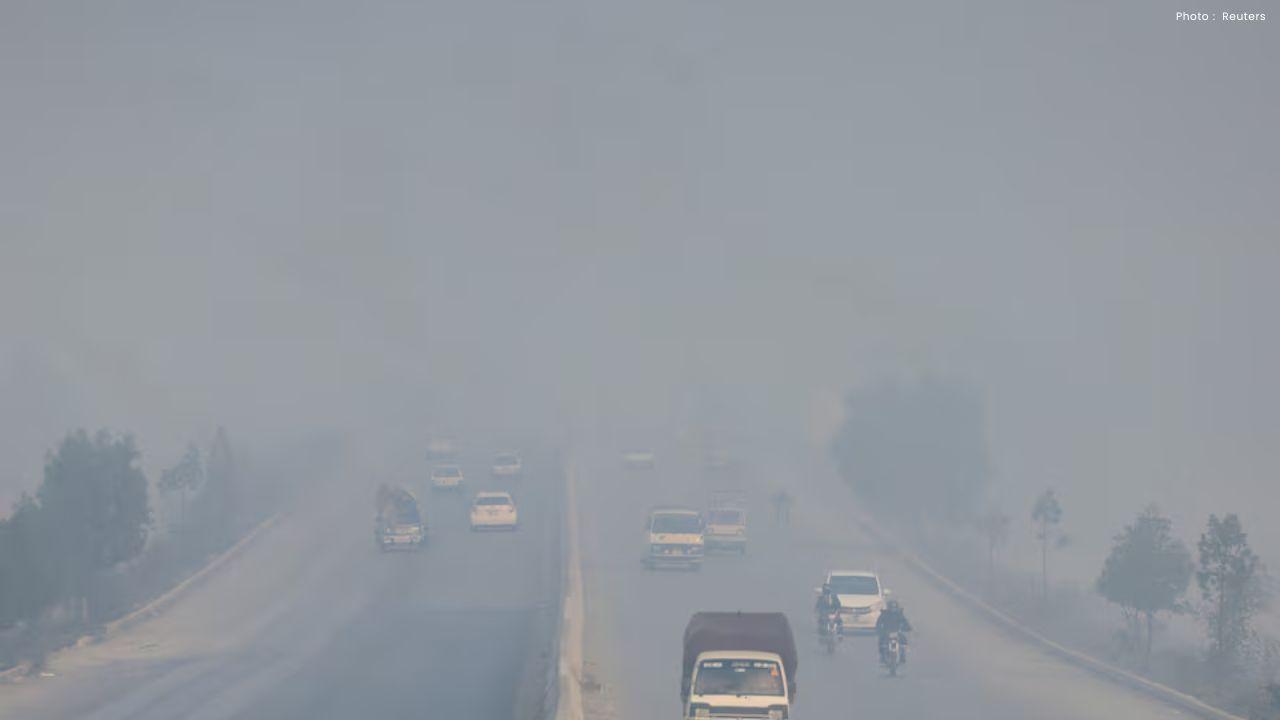
A new global report has placed Pakistan at the top of a worrying list. According to air quality data for 2025, Pakistan has been ranked the most polluted country in the world, highlighting a serious environmental and health crisis.
The report, released by Swiss air quality monitoring group IQAir, shows that pollution levels in Pakistan are far above safe limits. The main concern is a type of pollution called PM2.5. These are very tiny particles in the air that can enter the lungs and even the bloodstream, causing serious health problems.
In Pakistan, PM2.5 levels were found to be up to 13 times higher than the safe level recommended by the World Health Organization. The WHO guideline suggests that PM2.5 should not exceed 5 micrograms per cubic meter, but Pakistan’s levels are far above this limit.
This high level of pollution is not just a number—it has real effects on people’s lives. Poor air quality can lead to breathing problems, heart disease, and other serious illnesses. Children, the elderly, and people with existing health conditions are especially at risk.
The report also shows that Pakistan is not alone in facing pollution problems, but its situation is among the worst. Countries like Bangladesh and Tajikistan also ranked high on the pollution list, while many others failed to meet safe air quality standards. In fact, out of 143 countries studied, 130 did not meet the WHO guidelines.
Another key finding is that many of the world’s most polluted cities are located in South Asia. Cities in India, Pakistan, and China dominate the list, showing that air pollution is a major regional issue. For example, India’s Loni was ranked as the most polluted city in 2025.
The causes of pollution in Pakistan are complex. Rapid urban growth, increasing number of vehicles, industrial emissions, and burning of waste all contribute to poor air quality. In large cities like Karachi and Lahore, pollution levels often rise to dangerous levels, especially during winter when smog becomes severe.
Environmental experts say that the problem has been building for years. As cities expand and populations grow, pollution sources increase. At the same time, weak enforcement of environmental rules makes it harder to control emissions.
The report also points out a global trend. While Pakistan’s situation has worsened, some parts of the world have shown improvement. In 2025, 13 countries managed to meet the WHO’s air quality standards, compared to only seven in the previous year. This shows that progress is possible, but it requires strong policies and action.
The issue of air pollution is closely linked to climate change and environmental management. Poor air quality not only harms human health but also affects agriculture, water, and overall quality of life.
Experts suggest several steps to reduce pollution. These include promoting clean energy, improving public transport, reducing industrial emissions, and controlling waste burning. Public awareness is also important, as individuals can take small steps to reduce pollution in daily life.
However, solving this problem will require strong action from the government. Policies need to be enforced strictly, and long-term planning is necessary to balance economic growth with environmental protection.
The ranking of Pakistan as the most polluted country is a serious warning. It shows that urgent steps are needed to protect public health and improve air quality.
Air pollution may not always be visible, but its impact is deep and long-lasting. Without action, the problem could grow worse, affecting millions of people and future generations.









Anticipated Dates for UAE Eid Al Adha 2026 Unveiled by Astronomical Experts
Experts predict Eid Al Adha 2026 in the UAE to start on May 27, prompting early holiday planning amo

DAE Achieves Remarkable Growth in Q1 2026 With Record Revenue
Dubai Aerospace Enterprise announces impressive financial results for Q1 2026, reflecting a surge in

Price Increase for Sony PS5 in Southeast Asia Effective May 1
Sony announces a price increase for the PS5 across Southeast Asia starting May 1, 2026, impacting ga

Potential ‘Super El Niño’ in 2026: Understanding the Climate Risks
Could a Super El Niño emerge in 2026? Discover its implications and potential global climate impacts

Global Energy Crisis Intensifies: Markets React to Oil Supply Challenges
Markets are on edge as oil disruptions escalate, influencing prices and economic stability. Explore

Must-See Tourist Spots in London You Can't Overlook
Explore London's essential attractions, from royal landmarks to vibrant markets, ensuring an unforge




