Post by : Naveen Mittal
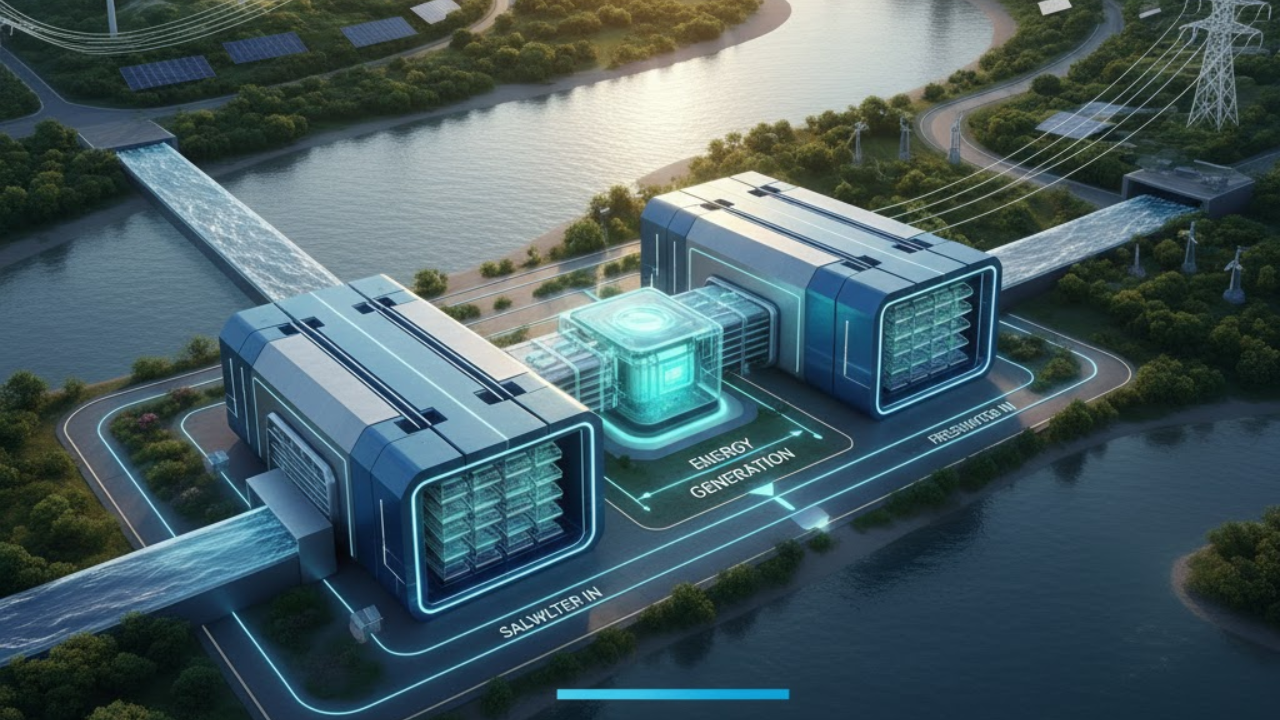
Every time freshwater meets seawater at a river delta, a silent exchange of energy takes place. Hidden within that natural mix lies an enormous — and mostly untapped — source of renewable power. Scientists call it osmotic energy, or more popularly, blue energy.
As the world searches for clean and sustainable energy sources beyond solar and wind, osmotic power is emerging as a dark horse — a constant, predictable, and planet-friendly way to generate electricity from saltwater differences.
Osmosis — the process of water molecules moving through a membrane from a less salty area to a saltier one — is a simple concept from school science books. But when applied on a large scale, it becomes a natural energy engine.
Here’s how it works:
Freshwater and seawater are separated by a semipermeable membrane.
Freshwater molecules naturally move into the saltier side to balance the concentration.
This movement creates pressure, which can be used to drive turbines and generate electricity.
It’s a subtle yet powerful force — one that continuously occurs wherever rivers meet the sea. And since the ocean never stops, osmotic power is available 24/7, unlike solar or wind energy that depend on weather conditions.
The global renewable energy conversation has long focused on solar panels, wind farms, and hydropower dams. But these sources all come with challenges — intermittency, space limitations, and ecological impact.
That’s where blue energy shines.
It doesn’t rely on sunlight or wind, and it doesn’t require large-scale construction like traditional dams. It simply uses natural salinity gradients, making it one of the most sustainable energy technologies in development today.
According to research by the World Economic Forum (WEF), osmotic power could produce up to 2,000 terawatt-hours per year — nearly the same amount as global hydroelectric output.
Modern osmotic power plants use advanced nanomaterials and ion-selective membranes to enhance efficiency. There are currently two main approaches being explored:
Pressure-Retarded Osmosis (PRO)
Freshwater flows into seawater through a special membrane.
The resulting pressure drives a turbine that generates electricity.
Reverse Electrodialysis (RED)
Alternating membranes selectively allow positive and negative ions to pass.
This creates a voltage difference that can be harvested as electric current.
Companies in Norway, the Netherlands, and Japan are leading the way, building prototype osmotic power plants near estuaries and wastewater outlets.
The term blue energy represents both its oceanic origin and its environmental promise.
Unlike fossil fuels, osmotic energy:
Emits zero carbon during operation.
Doesn’t disturb marine ecosystems.
Can operate continuously, day and night.
Requires minimal land use, making it ideal for coastal cities.
As global energy demands rise and governments push for net-zero targets, blue energy offers a stable, long-term supplement to existing renewables.
Imagine a future where:
Desalination plants and wastewater facilities generate their own electricity through osmotic membranes.
Coastal cities harness the natural mixing of river and seawater to power streetlights and infrastructure.
Floating ocean platforms use osmotic systems to power data centers or marine research labs.
That future isn’t far away. Pilot projects like Statkraft’s Tofte Plant in Norway and REDstack’s Afsluitdijk facility in the Netherlands have already proven osmotic power’s real-world potential.
With increasing investment in blue energy startups and green innovation, osmotic technology is expected to see exponential growth by 2030.
According to Allied Market Research, the global salinity gradient power market could exceed $6 billion by 2032, driven by rising demand for sustainable and decentralized power solutions.
While osmotic power sounds like a perfect solution, a few challenges remain before large-scale adoption:
High cost of membranes: Manufacturing nanomaterials with high efficiency and durability is expensive.
Scaling issues: Current plants generate only a few megawatts — not yet enough for industrial-scale use.
Membrane fouling: Salt and biological material buildup can reduce efficiency over time.
However, researchers are optimistic. Advances in graphene oxide membranes, AI-driven design optimization, and biomimetic filtration are expected to make osmotic systems more affordable and scalable in the near future.
Unlike solar panels glinting on rooftops or giant wind turbines towering over fields, osmotic power operates silently and invisibly — a quiet revolution happening at the world’s coastlines.
It doesn’t need vast land or noisy infrastructure, just the natural rhythm of freshwater and seawater meeting and mixing.
For nations looking to diversify their clean energy mix, blue energy could become a hidden backbone — reliable, renewable, and remarkably gentle on the planet.
As we move deeper into the renewable era, osmotic power stands out not as a replacement but as a complementary force — a bridge between nature’s chemistry and human innovation.
It’s poetic in its simplicity: every drop of water holds energy, waiting to be unlocked.
And as technology advances, the tides that have always powered life on Earth may soon start powering our cities too.










Anticipated Dates for UAE Eid Al Adha 2026 Unveiled by Astronomical Experts
Experts predict Eid Al Adha 2026 in the UAE to start on May 27, prompting early holiday planning amo

DAE Achieves Remarkable Growth in Q1 2026 With Record Revenue
Dubai Aerospace Enterprise announces impressive financial results for Q1 2026, reflecting a surge in

Price Increase for Sony PS5 in Southeast Asia Effective May 1
Sony announces a price increase for the PS5 across Southeast Asia starting May 1, 2026, impacting ga

Potential ‘Super El Niño’ in 2026: Understanding the Climate Risks
Could a Super El Niño emerge in 2026? Discover its implications and potential global climate impacts

Global Energy Crisis Intensifies: Markets React to Oil Supply Challenges
Markets are on edge as oil disruptions escalate, influencing prices and economic stability. Explore

Must-See Tourist Spots in London You Can't Overlook
Explore London's essential attractions, from royal landmarks to vibrant markets, ensuring an unforge




