Post by : Mikhael Nasser
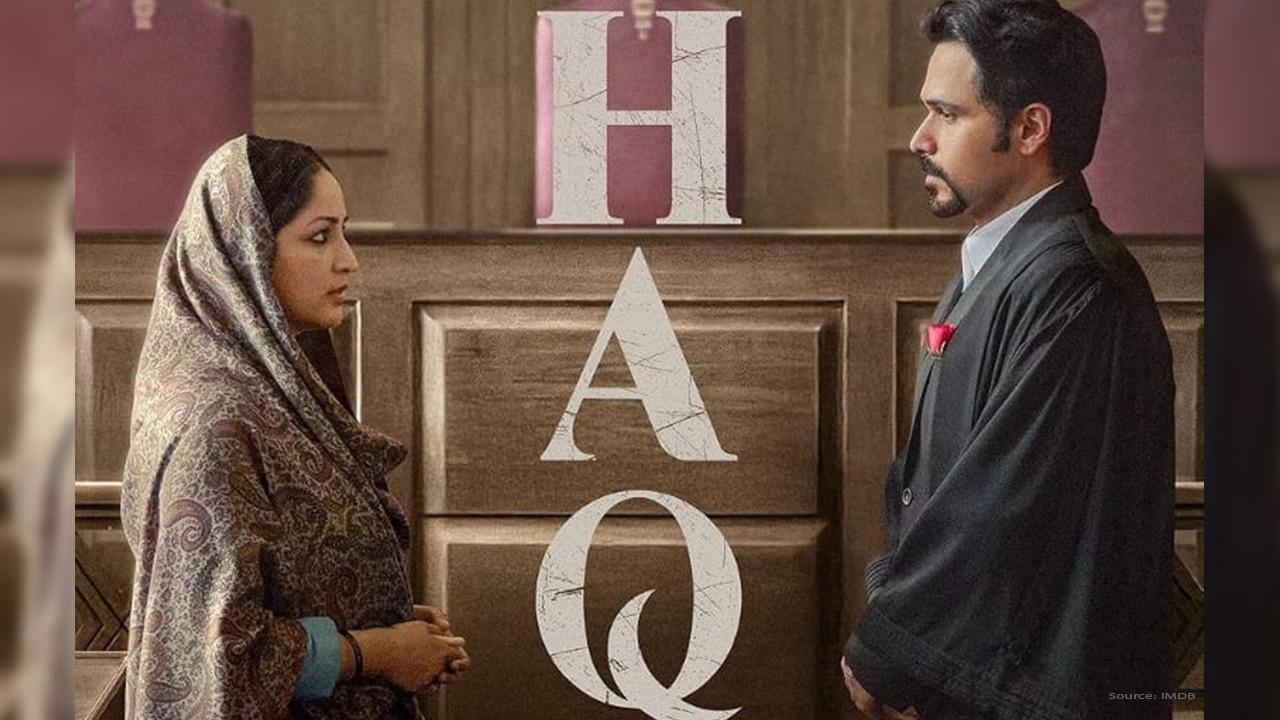
Cinema can reframe public debates, and Haq positions itself as a film that revisits a landmark moment in India's legal history. Directed by Suparn S Varma, the movie features Yami Gautam Dhar and Emraan Hashmi in principal roles and draws its inspiration from the pivotal Shah Bano Begum case of 1985.
Scheduled for release on November 7, 2025, Haq goes beyond courtroom spectacle to interrogate how law, religion and social norms interact — especially where women's rights are concerned. The film frames an individual's legal fight as a catalyst for wider public conversation.
At its core, the narrative takes cues from the Supreme Court judgment in Mohd. Ahmed Khan vs. Shah Bano Begum (1985), a case that reshaped debates about maintenance and gender equity in India.
In the drama, Yami Gautam Dhar portrays Shazia Bano, abandoned by her husband, played by Emraan Hashmi. Determined to secure financial maintenance, she invokes Section 125 of the Indian Criminal Procedure Code, the statute that has been used to claim support for divorced or deserted women.
What begins as an individual legal action escalates into a public flashpoint. Shazia’s pursuit of maintenance becomes emblematic of broader struggles over equal protection and the limits of religiously informed personal law.
Director: Suparn S Varma
Lead Cast:
Yami Gautam Dhar as Shazia Bano
Emraan Hashmi as Adv. Mohd. Ahmed Khan
Producers: Junglee Pictures, Insomnia Films, and Baweja Studios
Language: Hindi
Runtime: Around 136 minutes
Release Date: November 7, 2025
The original Shah Bano decision prompted nationwide debate about statutory protections and personal law. Haq reintroduces that historical debate to contemporary audiences, highlighting the social dynamics that followed the ruling.
Yami Gautam's role avoids portraying the protagonist as passive. Instead, the character is shown exercising legal agency — a depiction intended to foreground questions of empowerment and recourse under the law.
The film foregrounds the friction between religiously grounded personal laws and the constitutional guarantee of equality, prompting viewers to consider whether and how faith-based norms should affect civil rights.
Alongside its thematic ambitions, Haq offers concentrated courtroom drama, charged exchanges and visual moments designed to underscore the human costs of legal disputes.
The plot opens with a domestic rupture: Shazia is left by her husband and chooses to seek legal remedy. The narrative then moves into the courtroom, where testimony, statutory interpretation and social reaction converge.
As proceedings advance, the case becomes a focal point for wider civic debate. Teaser footage suggests striking imagery — from court corridors to mass demonstrations — that illustrates how a private grievance can assume public significance.
The film’s association with real events has already provoked legal objection. Siddiqua Begum Khan, daughter of Shah Bano, has petitioned the Madhya Pradesh High Court to seek a stay on the release, alleging inaccuracies and absence of family consent.
This challenge brings into relief enduring questions about filmmakers' ethical responsibilities when dramatizing public-interest cases, and where the boundary lies between artistic license and respect for lived histories.
Historical Recontextualisation: The film situates a past legal milestone within present-day discussions on gender and law.
Performance-Driven: Lead actors aim to anchor the film’s legal and emotional tensions through committed portrayals.
Timely Themes: Issues of equality, maintenance and legal interpretation remain urgent across many jurisdictions.
Broader Resonance: By connecting a national case to universal concerns about justice, the film seeks relevance beyond its immediate context.
If you follow legal dramas or social-issue cinema, Haq promises a film that combines courtroom procedure with questions about rights and religion.
It adapts a case that shaped Indian legal discourse.
It presents concentrated courtroom set-pieces with strong central performances.
It challenges viewers to consider the relationship between faith-based norms and uniform legal standards.
It illustrates how one individual's pursuit can reverberate across society.
Haq underscores that securing justice often involves contested, difficult public debate rather than a simple legal victory.
The film is positioned to provoke discussion as it reaches cinemas on November 7, 2025, and may remain a point of reference in conversations about law, gender and public memory.
This article is offered for information and commentary. Haq is a dramatized interpretation inspired by events and should not be read as a precise legal or historical record. Readers are advised to view the film as a creative representation rather than a documentary account.










Anticipated Dates for UAE Eid Al Adha 2026 Unveiled by Astronomical Experts
Experts predict Eid Al Adha 2026 in the UAE to start on May 27, prompting early holiday planning amo

DAE Achieves Remarkable Growth in Q1 2026 With Record Revenue
Dubai Aerospace Enterprise announces impressive financial results for Q1 2026, reflecting a surge in

Price Increase for Sony PS5 in Southeast Asia Effective May 1
Sony announces a price increase for the PS5 across Southeast Asia starting May 1, 2026, impacting ga

Potential ‘Super El Niño’ in 2026: Understanding the Climate Risks
Could a Super El Niño emerge in 2026? Discover its implications and potential global climate impacts

Global Energy Crisis Intensifies: Markets React to Oil Supply Challenges
Markets are on edge as oil disruptions escalate, influencing prices and economic stability. Explore

Must-See Tourist Spots in London You Can't Overlook
Explore London's essential attractions, from royal landmarks to vibrant markets, ensuring an unforge




