
Post by : Saif Nasser
Global stock markets rose on Tuesday as investors became more confident about trade and financial stability, while gold prices fell. The boost came after signs that tensions between the United States and China may ease and worries over credit risks in the banking sector slowed down.
In Asia, Japan’s stock market reacted strongly to news that Sanae Takaichi is likely to become the country’s next prime minister. Investors saw this as a positive development for economic growth and market-friendly policies. The Tokyo Nikkei index briefly reached a record high, while the Japanese yen weakened against the U.S. dollar.
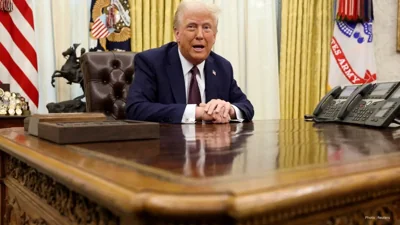
U.S. President Donald Trump said he expects to reach a fair trade deal with Chinese President Xi Jinping at their upcoming meeting in South Korea. He also downplayed the chances of conflict over Taiwan. This raised hope among investors that the trade tensions, which have caused market uncertainty for months, could be resolved. In addition, a new deal between the U.S. and Australia for the supply of rare earth minerals also encouraged market optimism.
Investor confidence had been shaken last week due to concerns over bad loans at regional U.S. banks and the prolonged federal government shutdown. These issues had raised fears of wider financial instability. However, many investors decided to buy stocks while prices were lower, expecting markets to recover. Chris Weston, head of research at Pepperstone, said, “The market has hurdled the wall of worry with ease, with new capital injected into risk and fresh oxygen into the market’s lungs.”
Despite optimism, European Central Bank chief economist Philip Lane issued a warning for euro zone banks. He said banks could face trouble if dollar funding becomes scarce. Lane highlighted that banks with large U.S. dollar exposures may struggle if financial conditions suddenly change. He referenced the market turmoil in April as an example of how quickly conditions can become risky.
Economist Chris Scicluna of Daiwa Capital Markets noted that investors are watching risks in the U.S. financial sector closely. If there is a sudden problem in U.S. banks, it could affect European banks as well. Scicluna said, “The tone of the speeches out of the ECB Governing Council has been, on balance, becoming more cautious, more attuned to risks and downside risks.” He added that the ECB is unlikely to cut interest rates soon, unlike the U.S. Federal Reserve, which may lower rates up to three times in the next six months according to market expectations.
The possibility of U.S. rate cuts and news that the government shutdown may end soon encouraged investors to return to stocks. All three major U.S. stock indexes rose sharply overnight, and chip companies reached record highs. Analysts expect S&P 500 companies to show overall earnings growth of 9.3% in the third quarter compared to last year, an improvement from earlier estimates of 8.8%.
In the currency market, the U.S. dollar strengthened slightly, rising 0.25% against the Japanese yen to 151.14. Investors anticipate that Takaichi, Japan’s likely next prime minister, will support economic stimulus and oppose further interest rate hikes. This outlook is seen as negative for the yen and Japanese bonds but positive for Japanese stocks. The Nikkei index reached just below 50,000 points, near a historic high.
The Bank of Japan will hold a meeting next week. Traders expect only a 20% chance of an interest rate increase, as Governor Kazuo Ueda has given few clues about the timing. The market will closely watch his statements for any signals about future monetary policy.
Overall, the rise in global stocks and the dip in gold reflect improving investor confidence. Positive developments in U.S.-China trade talks, expected policy support in Japan, and easing fears about U.S. banking risks have all contributed to this optimism. While some risks remain, markets are benefiting from a temporary sense of stability and opportunity.
Analysts advise caution, noting that geopolitical issues, such as U.S.-China relations and Taiwan tensions, and financial risks in Europe and the U.S. could still affect market performance. Investors are closely monitoring developments in trade, monetary policy, and banking health to guide future decisions.
The renewed appetite for risk highlights how sensitive markets are to political and economic news. Stock gains and lower gold prices show that investors are prioritizing opportunities for growth over traditional safe-haven assets, at least for now.
As markets continue to react to global events, traders will be watching upcoming meetings and economic announcements closely. The outcome of U.S.-China trade talks, decisions by the Federal Reserve and the Bank of Japan, and updates on banking stability will likely determine whether current market optimism can be sustained in the weeks ahead.









Anticipated Dates for UAE Eid Al Adha 2026 Unveiled by Astronomical Experts
Experts predict Eid Al Adha 2026 in the UAE to start on May 27, prompting early holiday planning amo

DAE Achieves Remarkable Growth in Q1 2026 With Record Revenue
Dubai Aerospace Enterprise announces impressive financial results for Q1 2026, reflecting a surge in

Price Increase for Sony PS5 in Southeast Asia Effective May 1
Sony announces a price increase for the PS5 across Southeast Asia starting May 1, 2026, impacting ga

Potential ‘Super El Niño’ in 2026: Understanding the Climate Risks
Could a Super El Niño emerge in 2026? Discover its implications and potential global climate impacts

Global Energy Crisis Intensifies: Markets React to Oil Supply Challenges
Markets are on edge as oil disruptions escalate, influencing prices and economic stability. Explore

Must-See Tourist Spots in London You Can't Overlook
Explore London's essential attractions, from royal landmarks to vibrant markets, ensuring an unforge




