Post by : Naveen Mittal
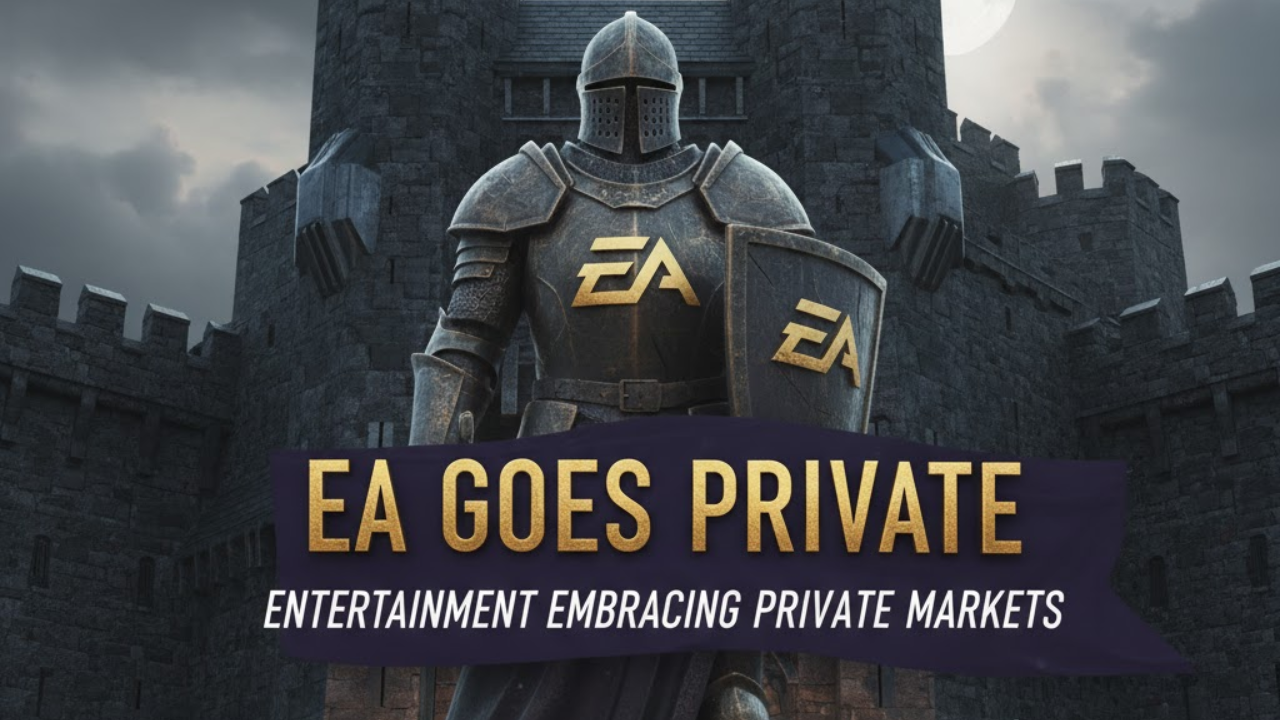
In September 2025, Electronic Arts (EA), one of the world’s leading video game publishers, announced it would be acquired via a $55 billion leveraged buyout by a consortium including Saudi Arabia’s Public Investment Fund (PIF), Silver Lake, and Affinity Partners. Once complete, EA will cease public trading and operate wholly under private ownership.
This move isn’t just about one company. It marks a turning point: entertainment and gaming are now among the sectors likely to move away from the public markets toward private capital. The transition reflects a broader shift in how media, content and IP are financed, governed, and scaled in a fast-changing digital era.
In this article, we explore the details of the EA deal, the motivations behind it, its implications for the gaming and entertainment industry, and what this trend means for investors and creators.
EA’s acquisition is structured as a leveraged buyout (LBO) valued at approximately $55 billion. The consortium backing the deal includes PIF, Silver Lake, and Affinity Partners. The transaction offers EA shareholders $210 per share, representing a 25% premium over the share price before deal announcement. The acquisition combines about $36 billion in equity investment with $20 billion in debt financing. Closing is projected in fiscal Q1 2027, pending regulatory and shareholder approvals.
EA has long operated under the pressures of public markets: quarterly earnings, investor scrutiny, volatility, and constrained flexibility. By going private, EA gains freedom to reorient its growth strategy, dedicate capital to long-cycle investments (e.g. next-gen game engines, cloud infrastructure, AI tools) and make bold moves without fear of short-term backlash.
Also, private ownership allows strategic alignment with long-term partners like PIF, which already has an existing stake and strategic interest in gaming and entertainment. The private structure may better suit EA’s need to evolve iteratively, particularly in a space where content lifecycles, platform ecosystems and investment cycles are increasingly long and capital-intensive.
Public media and entertainment firms face unpredictable demand, platform dependency, and rapid shifts in consumer tastes. Investor sentiment can swing wildly. Private ownership offers insulation from reactive markets and the ability to focus on long-term value.
Next-generation gaming, virtual worlds, and content platforms require heavy capital — for R&D, backend infrastructure, AI, and interoperability. Private equity or sovereign capital can better support such backloaded investments without pressure for immediate returns.
Entertainment value lies in IP—franchises, characters, expansive worlds. Private owners can retain tighter control over IP development, licensing, transformation and monetization strategies without public disclosure constraints.
Emerging models (subscriptions, microtransactions, NFT / blockchain-based content, cloud streaming) often undergo rapid prototyping. Private structures enable experimentation without immediate earnings pressure.
Sovereign investors and private funds are increasingly using entertainment as a strategic asset—tying content, media reach and soft power. The EA deal includes PIF, which aligns with that strategic dimension.
The EA transaction is likely to spark more take-private deals, mergers or consolidations in the creative and content sectors. Large public entertainment companies might exit markets or find it harder to compete with privately backed rivals. Gaming studios, publisher platforms and creative supply chains could become targets.
As marquee names leave public markets, retail investors lose exposure to flagship entertainment IP. Fewer pure-play public entertainment stocks may remain. Public markets may see a concentration of more tech-leaning, platform-related entertainment ventures.
Private firms are less obliged to disclose operational details, financials or internal strategy. That reduces transparency but also allows management to make strategic bets without public pressure. Governance models may lean heavier on investor oversight and board control rather than public accountability.
Smaller publishers or studios may need to partner with private capital or consortium models to scale. Some may become acquisition targets. Innovation hubs might align more with venture-backed or private-backed ecosystems.
The role of sovereign wealth funds and strategic investors in entertainment is becoming more visible. Content and gaming are part of culture and influence. Deals like EA's suggest states may increasingly view entertainment as part of soft power and global reach.
Leveraged deals carry debt loads that require consistent cash flow. Entertainment is cyclical — if a major title underperforms, debt service may stress the company.
Without public valuation, performance assessment depends on private rounds or exit events, which may create valuation opacity and investor uncertainty.
Investors often expect eventual exits (IPOs, secondary sales, strategic sales). That may impose time pressure on creative or long-horizon bets.
With investors like PIF involved, regulatory scrutiny around foreign ownership, content influence, censorship or political alignment may intensify.
Creative industries resist purely financial logic. Private investors will need to balance commercial returns with creative freedom, community expectations and cultural risks.
Consider whether remaining public is optimal. Evaluate hybrid models, strategic partnerships, or private capital infusion before full exits. Build flexibility in monetization, innovation and IP leverage.
Position yourself as attractive acquisition or partnership targets. Focus on IP strength, scalability, niche communities, and consistent franchises. Build relationships with private funds, not just public publishers.
Entertainment is an increasingly strategic target. But assess operational risk, cyclical trends and content pipelines carefully. Be wary of overpaying for IP hype without steady cash flow. Seek governance rights and creative alignment.
Ensure oversight of concentration in content, media influence, foreign capital in entertainment and ensure transparency in cultural sectors. Monitor national interest, censorship, localization, and content diversity.
The EA take-private deal could be a watershed moment. If replicated, we could see a gradual migration of media, gaming, content and storytelling firms into private ecosystems. In such a future:
The public markets may become less central for content businesses.
Entertainment platforms may blend with private tech conglomerates or sovereign-backed media groups.
Content communities might form around private-backed IP ecosystems, with tighter control and curation.
Creative autonomy may be shaped by investor-creator alignments rather than quarterly results.
Yet, new opportunities emerge: private funding could unlock more long-horizon, experimental content; markets could fund creative risk-taking; loyal fan economies and subscription models might thrive. The key shift is from public scrutiny to private strategic engines.
Disclaimer
This article is for informational and analytical purposes only and does not constitute investment, legal or financial advice. The content is based on publicly reported developments as of mid-October 2025. Stakeholders should perform due diligence and consult professional advisors before making decisions related to entertainment investments or corporate restructuring.










Anticipated Dates for UAE Eid Al Adha 2026 Unveiled by Astronomical Experts
Experts predict Eid Al Adha 2026 in the UAE to start on May 27, prompting early holiday planning amo

DAE Achieves Remarkable Growth in Q1 2026 With Record Revenue
Dubai Aerospace Enterprise announces impressive financial results for Q1 2026, reflecting a surge in

Price Increase for Sony PS5 in Southeast Asia Effective May 1
Sony announces a price increase for the PS5 across Southeast Asia starting May 1, 2026, impacting ga

Potential ‘Super El Niño’ in 2026: Understanding the Climate Risks
Could a Super El Niño emerge in 2026? Discover its implications and potential global climate impacts

Global Energy Crisis Intensifies: Markets React to Oil Supply Challenges
Markets are on edge as oil disruptions escalate, influencing prices and economic stability. Explore

Must-See Tourist Spots in London You Can't Overlook
Explore London's essential attractions, from royal landmarks to vibrant markets, ensuring an unforge




