Post by : Mina Rahman
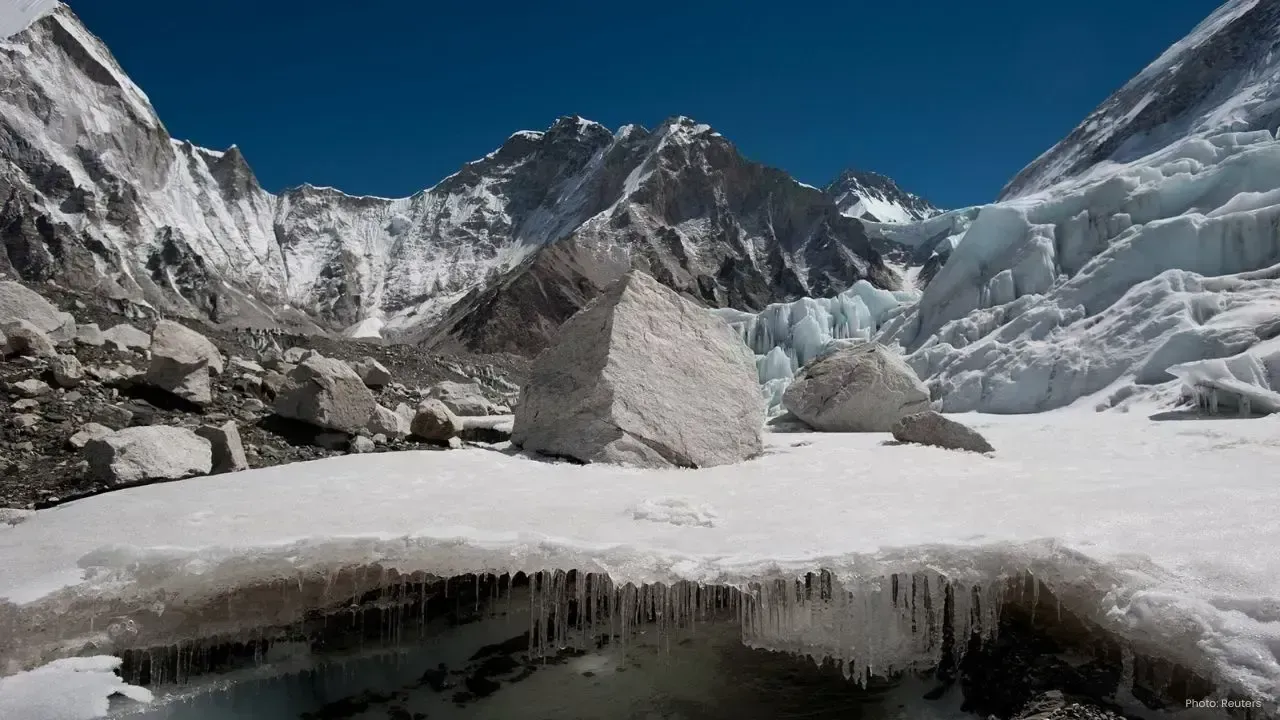
A significant decline in winter snowfall is being reported across the Himalayas, leaving many high peaks unexpectedly bare when they should typically be blanketed in white. Meteorological data indicates that over the last five years, snowfall in this region has consistently dipped below the long-term average established between 1980 and 2020.
The rising global temperatures are prompting the limited snowfall to melt at an accelerated rate. Additionally, areas at lower elevations are transitioning from snow to rain, a shift linked to climate change. This situation has now been termed a “snow drought” by scientists affecting extensive regions within the Himalayas.
The rapid melting of glaciers, exacerbated by the rising temperatures, poses serious concerns for India's Himalayan states and their neighbors. Experts warn that the ongoing decline in winter snowfall will worsen existing challenges. In addition to transforming the visual landscape, reduced snow and ice significantly affect millions who depend on these critical water sources and the delicate ecosystems they sustain.
Typically, the winter snowpack melts gradually during the spring months, replenishing rivers that supply drinking water, irrigation, and hydropower. A decrease in snowfall directly threatens this vital resource. Furthermore, as winter precipitation wanes, the risk of forest fires escalates due to increasingly dry conditions.
In addition, both glaciers and snow serve as natural protective mechanisms for the mountainous terrain. Their absence contributes to a rise in natural disasters such as landslides, rockfalls, glacial lake outburst floods, and debris flows.
Meteorologists are stressing that this trend is not an isolated event. The Indian Meteorological Department noted an alarming lack of rainfall or snowfall in northern India this past December. Predictions suggest that from January to March, regions including Uttarakhand, Himachal Pradesh, Jammu, Kashmir, and Ladakh may face precipitation reductions of up to 86% compared to the long-period average (LPA).
LPA reflects average rainfall and snowfall records spanning 30 to 50 years, helping to categorize present weather conditions as normal, excessive, or deficient. The LPA for northern India, calculated from 1971 to 2020, stood at 184.3 millimeters.
“This significant reduction in winter precipitation is observable across various datasets,” explained Kieran Hunt, a leading research fellow specializing in tropical meteorology at the University of Reading, UK. In his 2025 analysis covering the period from 1980 to 2021, he noted a noteworthy decrease in winter precipitation across the western and central Himalayan regions.
Leveraging ERA-5 reanalysis datasets, Hemant Singh, a research fellow at IIT Jammu, revealed that snowfall in the northwestern Himalayas has plummeted by 25% in the past five years compared to the average from 1980 to 2020.
Elsewhere, Nepal, which hosts the central Himalayas, has similarly witnessed drastic declines. “There has been virtually no precipitation since October, and this winter looks to remain predominantly dry. This trend has been persistent over the past five years,” commented Binod Pokharel, an associate professor at Tribhuvan University in Kathmandu.
While isolated areas may occasionally experience heavy snowfall, these events are rare and do not represent the steady, widespread snowfall that characterized previous decades, meteorologists noted.










Meta Unveils Subscription Plans for Instagram, Facebook, and WhatsApp
Meta introduces new subscription plans for users of Instagram, Facebook, and WhatsApp, featuring enh

Suvarna Joy on Education Leadership, Resilience, and Building Purpose Through Adversity in the UAE
Suvarna Joy shares her journey of education leadership, motherhood, faith, and resilience within the

Anticipated Dates for UAE Eid Al Adha 2026 Unveiled by Astronomical Experts
Experts predict Eid Al Adha 2026 in the UAE to start on May 27, prompting early holiday planning amo

DAE Achieves Remarkable Growth in Q1 2026 With Record Revenue
Dubai Aerospace Enterprise announces impressive financial results for Q1 2026, reflecting a surge in

Price Increase for Sony PS5 in Southeast Asia Effective May 1
Sony announces a price increase for the PS5 across Southeast Asia starting May 1, 2026, impacting ga

Potential ‘Super El Niño’ in 2026: Understanding the Climate Risks
Could a Super El Niño emerge in 2026? Discover its implications and potential global climate impacts




