Post by : Saif Nasser
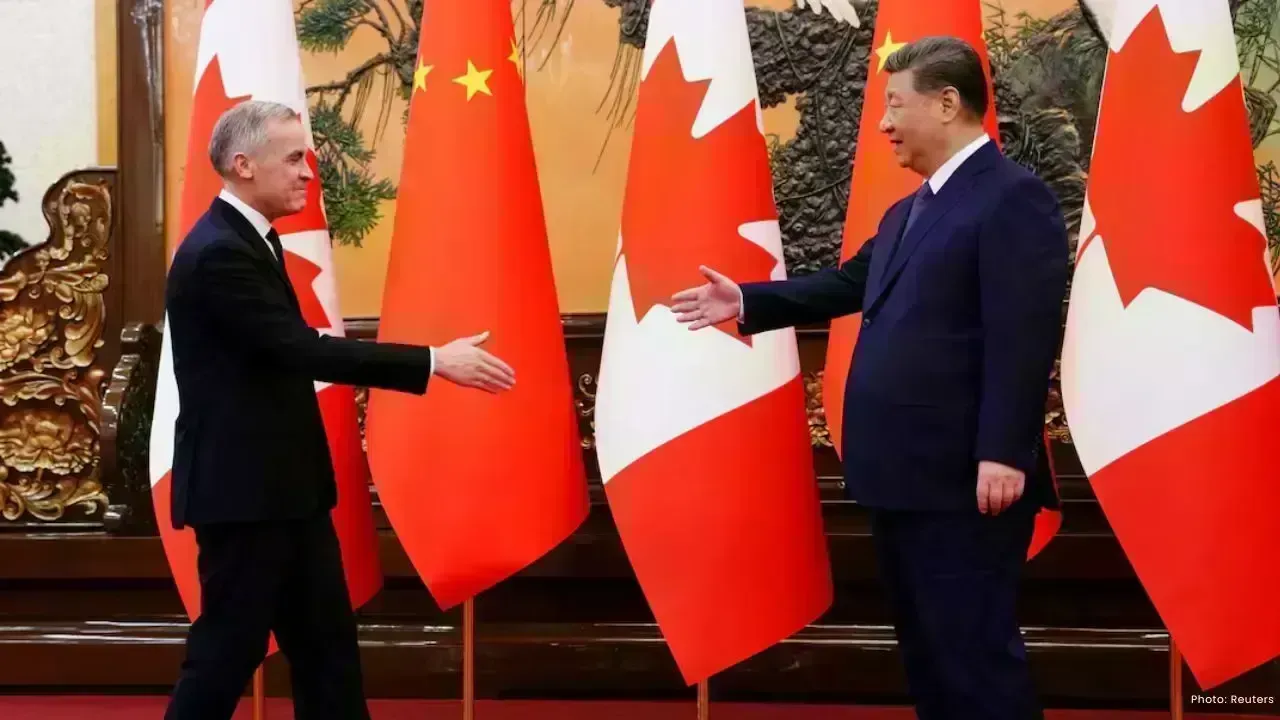
Canadian Prime Minister Mark Carney and Chinese President Xi Jinping have announced a new strategic partnership between Canada and China, a move that could bring “historic” gains for both nations. The announcement came during Carney’s visit to Beijing, the first by a Canadian prime minister since 2017, aimed at rebuilding ties with China, Canada’s second-largest trading partner after the United States.
Carney emphasized that the partnership is being launched at a time of “division” in the world. He highlighted key areas of focus, including agriculture, agri-food, energy, and finance, noting that these sectors could provide opportunities for immediate and sustained progress. He also expressed optimism that the partnership would strengthen economic and diplomatic ties between the two countries.
China, which has faced trade tensions with the United States under President Donald Trump, also welcomed the partnership. President Xi said he looked forward to working closely with Carney and expressed a shared sense of responsibility toward both nations and the global community.
The new partnership follows a period of economic uncertainty. Canada is seeking to diversify its trade and strengthen relations with China after Trump imposed tariffs on Canadian goods and suggested that Canada could become the United States’ 51st state. Similarly, China has faced tariffs on its exports from the U.S. and is now seeking cooperation with a Group of Seven nation in a traditionally U.S.-influenced sphere.
Analysts say that this rapprochement could subtly reshape the global balance, showing that U.S.-led economic decoupling from China is not universally accepted, even among close U.S. allies. However, experts note that Canada is unlikely to shift strategically away from the United States, given its deep integration with American security and intelligence networks.
Despite the positive outlook, some challenges remain. In 2024, Canada imposed tariffs on Chinese electric vehicles, citing unfair advantages due to state subsidies for Chinese manufacturers. China responded with tariffs on over $2.6 billion worth of Canadian farm and food products, including canola oil, canola meal, and canola seeds, which led to a 10.4% drop in Canada’s exports to China in 2025.
Experts say that overcoming these trade disputes will be key for the partnership to reach its full potential. If successful, the collaboration could boost trade, energy cooperation, and financial integration, benefiting businesses and consumers in both countries.
Overall, Carney’s visit signals a renewed commitment to constructive dialogue and pragmatic economic cooperation. It highlights a cautious but significant step toward stronger Canada-China relations, which could have lasting implications in a world marked by economic competition and shifting alliances.









The Impact of Consistent Small Investments on Wealth Building
Discover how investing small amounts regularly can positively transform your financial future over t

7.5 Magnitude Earthquake Strikes Japan, Tsunami Alerts Issued
Japan experiences a hefty 7.5 quake, prompting tsunami alerts and safety measures. Stay updated on a

Reopening of the Strait of Hormuz: New Regulations to Impact Global Trade
Iran reopens the strategic Strait of Hormuz with new regulations affecting oil transport and global

Top 10 Must-See Attractions in NYC for First-Time Explorers
Discover essential experiences for first-time visitors to NYC, including attractions, culture, and i

Starbucks Engages Boyu Capital for Major Chinese Expansion
Starbucks teams up with Boyu Capital, selling a majority stake to boost growth and adapt to the Chin

Three Individuals Charged in Massive Meth Trafficking Case in Malaysia
In Malaysia, a married couple and another suspect are charged with trafficking 510kg of meth, facing