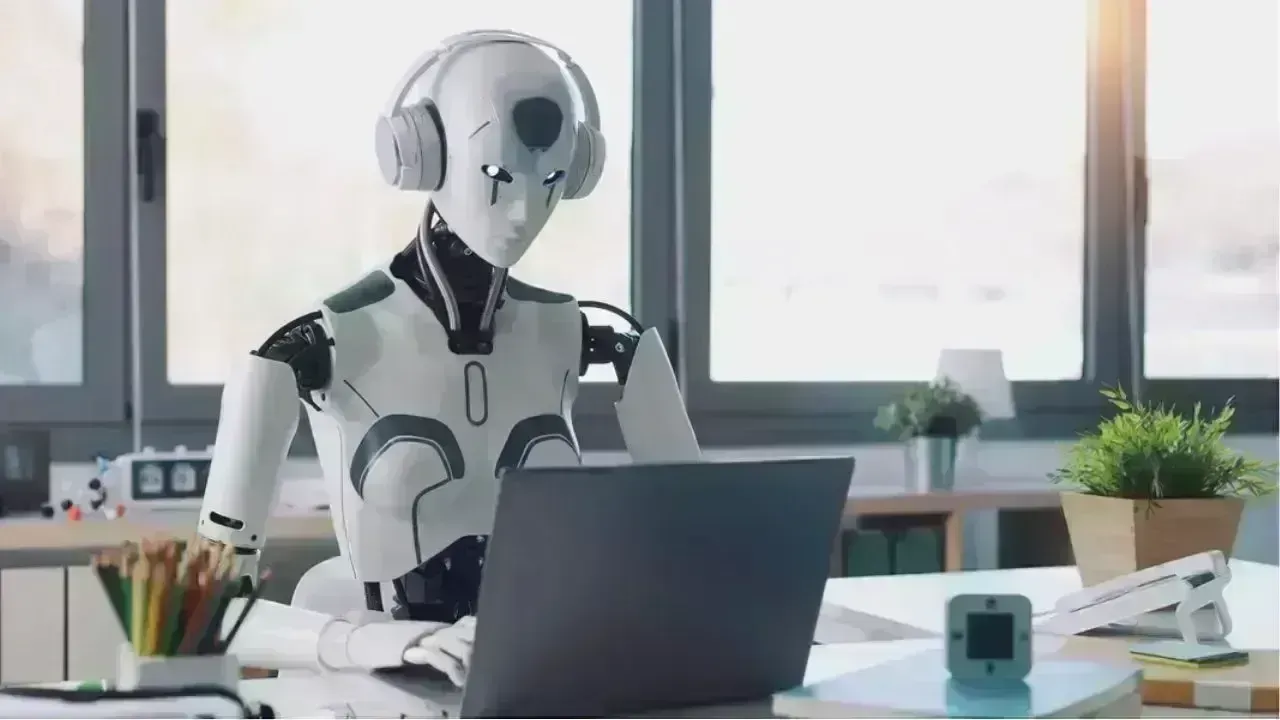
Post by : Anees Nasser
A pervasive unease now shadows many occupational environments. Employees still clock in, complete tasks, and engage in teamwork, yet a nagging concern lingers—how secure is my job's future? The implications of Artificial Intelligence have transcended science fiction, as it now handles a myriad of tasks like email responses, image creation, language translation, and customer service. What once sparked awe now breeds apprehension.
Unlike prior technological advancements that initially disrupted manufacturing jobs, this latest wave has directly infiltrated the office sphere. Job roles spanning accounting, writing, design, analysis, and administration are grappling with the possibility of algorithms outpacing their capabilities. This concern is hardly unfounded. Automation is steadily affecting hiring frameworks, leading to altered job descriptions and role integrations.
Yet, not every role faces dire risks. Certain professions remain fundamentally human, not due to the inefficacy of technology, but because the essence of humanity is intrinsically complex.
Artificial Intelligence excels in areas with clear instructions and predictable outcomes. In environments where tasks can be patterned, machines dominate. Conversely, roles necessitating comprehension of human emotions, nuanced behaviors, or unpredictable contexts present challenges for technology.
Common traits of easily automated tasks include: repetitive nature, fixed guidelines, structured information, and minimal emotional engagement. In contrast, jobs requiring creativity, judgment, emotional intelligence, and ethical considerations are more resistant to automation.
Recognizing this distinction can empower workers to pinpoint which roles are at greater risk and which are more likely to withstand the test of automation.
While technology permeates medicine, it doesn't dictate its course. AI can aid in detection, diagnosis, and data handling, yet the essential bond between patient and caregiver remains irreplaceable.
A physician's role transcends mere report evaluation. They provide counsel, interpret fears, communicate difficult realities, and tailor care to individual life scenarios. Similarly, nurses go beyond administering treatment; they notice emotional shifts, identify unspoken distress, and provide solace in ways no machine can.
Healthcare decisions are imbued with ethics, compassion, and responsibility. In critical moments, trust in human judgment remains paramount.
Teaching encompasses more than content delivery. It involves emotional engagement, motivation, mentorship, and insight into individual learning styles. Though AI can clarify concepts, it lacks the capacity to inspire, enforce discipline with understanding, or recognize emotional fluctuations that influence education.
Teachers can perceive a child's insecurity long before it manifests in test scores. They nurture self-doubt and challenge those with potential. Education is about shaping character, necessitating the human element.
While technology might be present in classrooms, it is the teachers who guide learning.
While AI can churn out content, the act of creation transcends mere output. Machines may generate images, music, or text based on historical patterns, but true human creativity emerges from emotions, experiences, and original insights.
Artists pull inspiration from love, pain, political landscapes, culture, and memories. Writers analyze society beyond the written word. Filmmakers elucidate narratives of identity and conflict. Designers create with emotional resonance, not merely functional requirements.
Machines may mimic styles; only humans can create them.
Creativity involves more than efficient assembly; it's about articulating the inexpressible.
Leadership cannot be substituted by software.
Leaders manage crises, inspire teams, navigate interpersonal conflicts, and accept accountability for failures. They make critical decisions amid stress, balancing constraints and diverse personalities. While technology can provide guidance, it cannot assume the role of a leader.
Management necessitates trust, not just directives. Teams are motivated by people, not protocols. Strategy demands vision, moral judgments, risk assessment, and experience.
Accountability cannot be automated.
When tough decisions arise, it’s human connection that prevails.
Mental health services hinge upon human interaction. Therapists go beyond just hearing spoken words; they decode silence, engaging with the subtleties of emotional nondisclosure. They attune to body language and tone.
No algorithm can substitute empathy, and no machine can truly care.
Clients do not seek simply solutions; they crave connection, validation, and understanding.
Healing from emotional turmoil cannot be coded.
It flourishes through human connection.
All these fields share a significant aspect: emotional intricacy.
They include:
Ethics
Trust
Creativity
Unpredictability
Responsibility
Human connection
AI struggles where results are dictated by culture, psychology, and experiences, not just logic and routine.
The roles that are most human are also the most secure.
No profession is entirely exempt from transformation.
Even professions with seemingly solid ground are evolving.
Doctors are utilizing AI systems. Educators are integrating digital tools. Creatives are leveraging technology. Leaders are embracing data analysis.
Yet, resilience does not equate to resisting technology.
It requires collaboration with it.
Employees skilled in AI adoptability will maintain their value.
Those who resist change become susceptible.
The future doesn’t diminish the workforce; it transforms it.
Flexibility is now essential for career survival.
Individuals should:
Embrace new tools
Familiarize with technology
Enhance communication skills
Cultivate emotional intelligence
Develop leadership capabilities
Nurture creativity
AI cannot surpass an individual committed to continuous learning.
Security in today's landscape derives from movement, not stability.
The more profound question becomes:
“Will I evolve more swiftly than technological advancements?”
Growth never halts.
Nor can careers.
Curiosity sustains relevance.
Fear of change leads to obsolescence.
While technology remains formidable, humans are irreplaceable.
Positions founded on emotion, ethics, creativity, and guidance will persist as machines lack a fundamental understanding of humanity.
AI may enhance.
It may speed up processes.
But it cannot supplant the core of human effort.
The future is not designed for the most proficient machines…
It is crafted for the most astute individuals collaborating with them.
DISCLAIMER
This article is for informational purposes only and does not offer career guidance or professional advice. Job trends can vary by region and industry. Readers are encouraged to seek advice from career counselors and industry experts for tailored guidance.









Anticipated Dates for UAE Eid Al Adha 2026 Unveiled by Astronomical Experts
Experts predict Eid Al Adha 2026 in the UAE to start on May 27, prompting early holiday planning amo

DAE Achieves Remarkable Growth in Q1 2026 With Record Revenue
Dubai Aerospace Enterprise announces impressive financial results for Q1 2026, reflecting a surge in

Price Increase for Sony PS5 in Southeast Asia Effective May 1
Sony announces a price increase for the PS5 across Southeast Asia starting May 1, 2026, impacting ga

Potential ‘Super El Niño’ in 2026: Understanding the Climate Risks
Could a Super El Niño emerge in 2026? Discover its implications and potential global climate impacts

Global Energy Crisis Intensifies: Markets React to Oil Supply Challenges
Markets are on edge as oil disruptions escalate, influencing prices and economic stability. Explore

Must-See Tourist Spots in London You Can't Overlook
Explore London's essential attractions, from royal landmarks to vibrant markets, ensuring an unforge




