Post by : Naveen Mittal
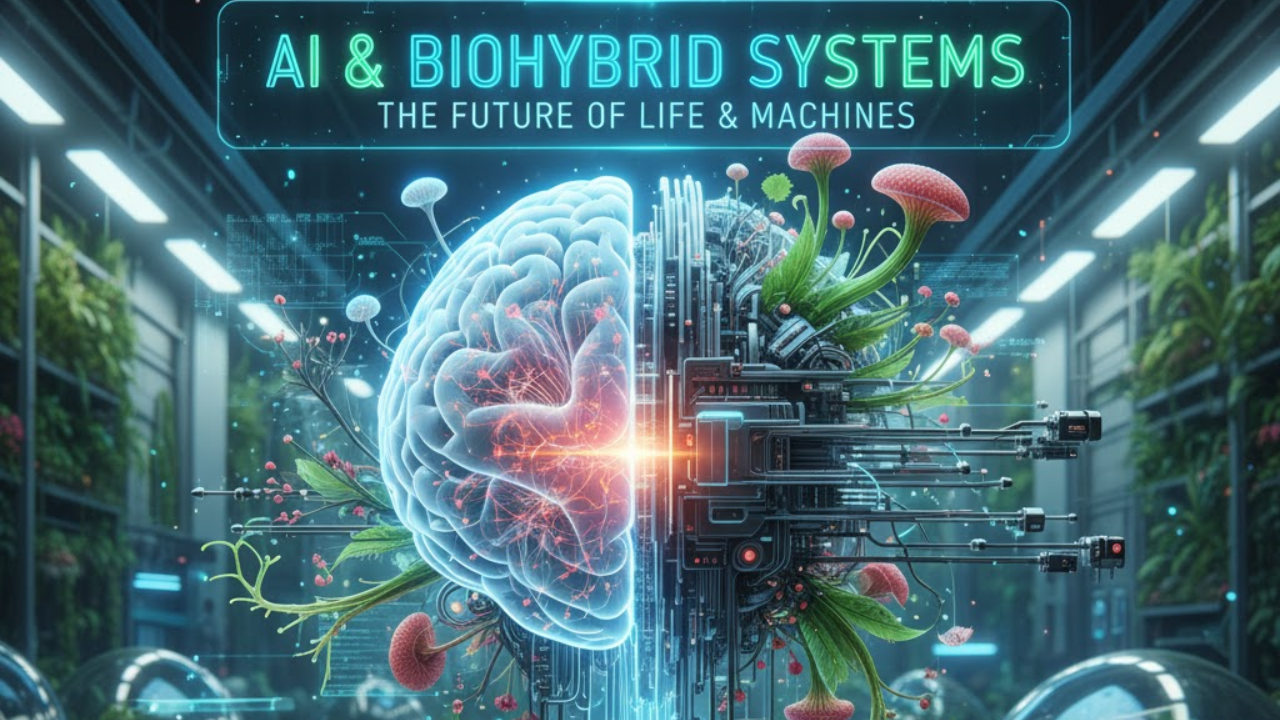
The line between living organisms and machines is blurring. Across labs from Tokyo to Boston, scientists are fusing biological intelligence with artificial systems, creating a new field of innovation known as biohybrid technology.
By combining AI, robotics, and cellular biology, researchers are building systems that can sense, adapt, and even heal — just like living organisms. From artificial hearts that beat on their own to robots powered by living muscle tissue, this union of biology and machine marks one of the most extraordinary frontiers in modern science.
A biohybrid system is a fusion of biological components (like cells, tissues, or DNA) with artificial structures (like sensors, circuits, or robotics).
The goal is not just to copy life — but to enhance and integrate it.
Artificial intelligence gives these biological systems the ability to learn and evolve, while biological materials give machines the flexibility, sensitivity, and energy efficiency that no purely mechanical system can match.
In 2025, breakthroughs in AI-powered biocomputing and synthetic biology are turning this science into reality.
Nowhere is this transformation more visible than in healthcare.
Engineers are using bioengineered tissues and AI-controlled sensors to build next-generation artificial organs — like smart hearts, kidneys, and lungs — that adjust their performance in real time.
For example, AI-driven pacemakers can predict irregular heart rhythms and adapt electrical impulses dynamically, while biohybrid kidneys use living membranes for natural filtration controlled by microprocessors.
Projects like Elon Musk’s Neuralink, Synchron, and BrainGate are pushing the limits of brain-computer communication. These implants translate neural signals into digital commands, allowing paralyzed patients to move robotic arms or control computers with thought alone.
AI algorithms learn from brain activity patterns, improving accuracy and adapting to each user’s neural network — merging cognition and computation in ways once imagined only in science fiction.
Using AI-driven biofabrication, scientists can grow replacement tissues using a patient’s own stem cells. 3D bioprinters — guided by deep learning models — precisely assemble cells into functioning tissues, drastically reducing organ transplant waiting lists.
In robotics, the integration of biology is producing machines that are more adaptive, autonomous, and efficient than ever before.
Unlike traditional metal-based machines, biohybrid robots use living muscle fibers as actuators — meaning they move using biological contractions rather than electric motors.
These soft robots can swim, crawl, or grasp objects with organic precision while consuming minimal energy.
At Harvard’s Wyss Institute, researchers created biohybrid jellyfish and stingray robots powered by rat heart cells that respond to light and electrical signals — demonstrating how living cells can drive machine behavior.
AI and nanotechnology are enabling prosthetic limbs that feel. Advanced bionic arms now use neural sensors and AI algorithms to decode brain signals, providing users with precise control and even a sense of touch.
Companies like Open Bionics and Össur are commercializing prosthetics that adapt to motion patterns, learn from daily use, and sync with the wearer’s nervous system.
Beyond medicine and robotics, researchers are exploring biological computing, where DNA or living cells act as processors.
Unlike silicon-based chips, biological processors can:
Store massive amounts of data in a tiny volume.
Perform parallel processing with high efficiency.
Self-repair and adapt to new environments.
In 2025, experiments with AI-assisted DNA computing have achieved early success in solving mathematical problems faster than traditional chips — hinting at a future where computers “think” using biology itself.
This could give rise to biocomputers capable of simulating human brain complexity with minimal energy, revolutionizing fields from drug discovery to climate modeling.
As with any boundary-breaking innovation, the rise of biohybrid systems brings tough ethical challenges:
How “alive” should machines be before they gain moral consideration?
Should human enhancement through AI implants be regulated like medicine — or personal choice?
What are the risks of creating bioengineered entities that could evolve beyond human control?
Organizations like the World Health Organization (WHO) and UNESCO are already drafting guidelines for ethical AI and biotechnology integration, aiming to prevent misuse while encouraging responsible innovation.
Still, the moral debate is just beginning — because the definition of “life” itself is being rewritten.
According to MarketsandMarkets, the biohybrid systems and AI-biotech market is expected to surpass $120 billion by 2032, driven by investments in:
Neural interfaces and prosthetics
AI-enabled medical devices
Biocomputing and nanorobotics
Synthetic tissue development
Major players like Siemens Healthineers, Neuralink, Boston Dynamics, and IBM Watson Health are leading this convergence of biology and AI, while universities are accelerating cross-disciplinary research between bioengineering, computer science, and neuroscience.
Picture this:
A robot powered by living cells explores deep oceans.
A synthetic heart learns and adapts to your body.
A prosthetic limb grows stronger the more you use it.
A microbe engineered with AI logic cleans up toxic waste autonomously.
This is not a fantasy — it’s the next phase of evolution, where intelligence, biology, and technology merge.
The future won’t just be artificial or organic — it will be bio-digital.
The fusion of AI and biology represents the most transformative shift since the dawn of computing.
Biohybrid systems are not merely machines that imitate life — they are machines that live, learn, and evolve.
As we step into this new era, humanity is no longer just creating tools — we are creating partners in evolution.










Anticipated Dates for UAE Eid Al Adha 2026 Unveiled by Astronomical Experts
Experts predict Eid Al Adha 2026 in the UAE to start on May 27, prompting early holiday planning amo

DAE Achieves Remarkable Growth in Q1 2026 With Record Revenue
Dubai Aerospace Enterprise announces impressive financial results for Q1 2026, reflecting a surge in

Price Increase for Sony PS5 in Southeast Asia Effective May 1
Sony announces a price increase for the PS5 across Southeast Asia starting May 1, 2026, impacting ga

Potential ‘Super El Niño’ in 2026: Understanding the Climate Risks
Could a Super El Niño emerge in 2026? Discover its implications and potential global climate impacts

Global Energy Crisis Intensifies: Markets React to Oil Supply Challenges
Markets are on edge as oil disruptions escalate, influencing prices and economic stability. Explore

Must-See Tourist Spots in London You Can't Overlook
Explore London's essential attractions, from royal landmarks to vibrant markets, ensuring an unforge




