Post by : Bianca Suleiman
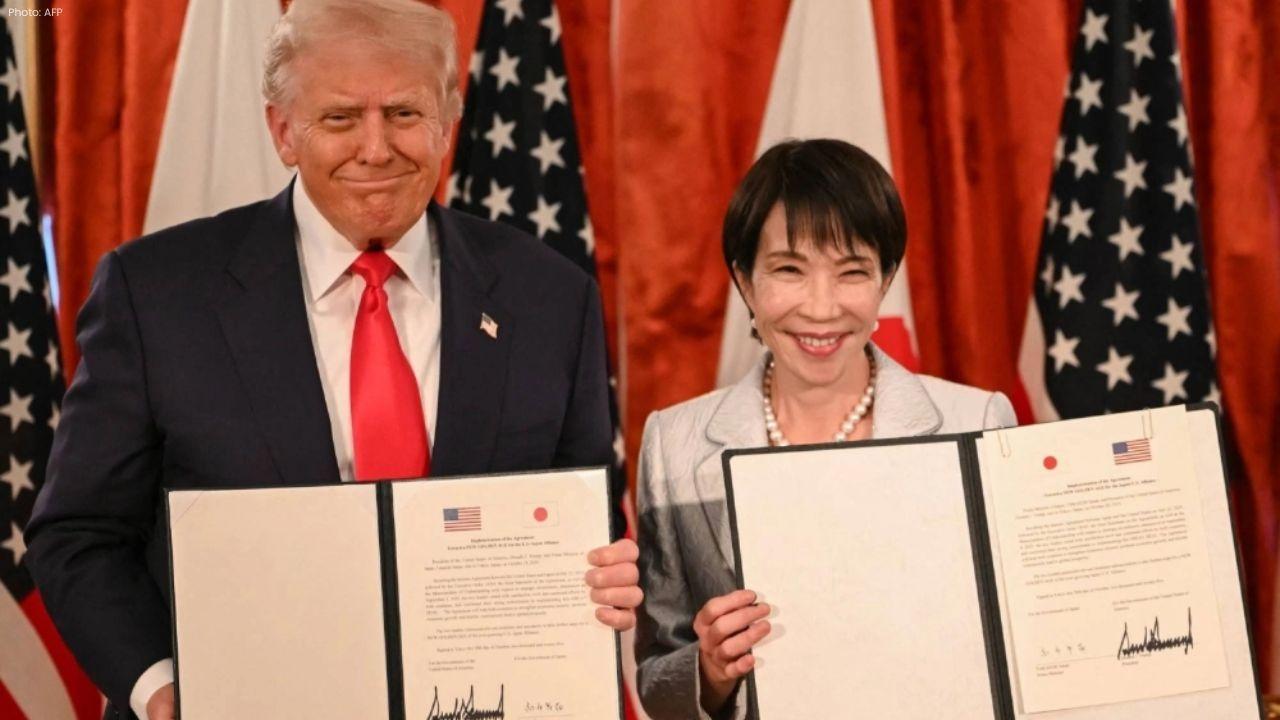
In a landmark move to reduce global dependence on China, U.S. President Donald Trump and Japanese Prime Minister Sanae Takaichi signed a framework agreement on rare earths at Tokyo’s Akasaka Palace on Tuesday. The signing, held under golden chandeliers and attended by senior aides, signals a strategic push to secure critical minerals vital for electronics and advanced technologies.
The accord outlines plans for both countries to coordinate investments, create fair and liquid markets for critical minerals, and provide financial support to selected projects over the next six months. Officials also hinted at possible complementary stockpiling arrangements and wider cooperation with international partners to strengthen supply chains.
China dominates over 90% of global rare earth processing, prompting concerns in Washington and Tokyo. While neither leader directly mentioned China, Beijing’s recent export curbs have added urgency to diversifying sources. The agreement comes ahead of a meeting between Trump and Chinese President Xi Jinping in South Korea, where discussions will focus on U.S. tariffs and rare earths export controls.
Currently, the U.S. and Myanmar account for 12% and 8% of rare earth extraction, while Malaysia and Vietnam contribute an additional 5% combined. The new U.S.-Japan framework aims to leverage these sources and reduce supply vulnerabilities.
Expanding Energy Cooperation
The partnership also extends into energy. Japan has pledged a $550 billion investment in the U.S., encompassing power generation and liquefied natural gas (LNG). With Russia’s Sakhalin-2 LNG project nearing contract expirations and Japan seeking diversification from Australia, U.S. LNG deals have become a strategic priority.
In recent months, Japan’s top buyers, JERA and Tokyo Gas, signed multi-million-ton agreements for U.S. LNG, with delivery timelines spanning the next decade. However, analysts note Japan still values proximity and cost efficiency, as Sakhalin-2 supplies reach Japan in days compared to longer shipping routes from the U.S. Gulf Coast and Alaska.
Industry observers suggest the agreement could reshape global rare earth markets while also influencing Japan’s long-term energy strategy, balancing affordability, security, and geopolitical considerations.







DAE Achieves Remarkable Growth in Q1 2026 With Record Revenue
Dubai Aerospace Enterprise announces impressive financial results for Q1 2026, reflecting a surge in

Price Increase for Sony PS5 in Southeast Asia Effective May 1
Sony announces a price increase for the PS5 across Southeast Asia starting May 1, 2026, impacting ga

Potential ‘Super El Niño’ in 2026: Understanding the Climate Risks
Could a Super El Niño emerge in 2026? Discover its implications and potential global climate impacts

Global Energy Crisis Intensifies: Markets React to Oil Supply Challenges
Markets are on edge as oil disruptions escalate, influencing prices and economic stability. Explore

Must-See Tourist Spots in London You Can't Overlook
Explore London's essential attractions, from royal landmarks to vibrant markets, ensuring an unforge

Ultimate Guide to Snagging Cheap Flights in 2026
Unlock the secrets to booking affordable flights in 2026 with insightful tips and strategies tailore




