Post by : Raina Nasser
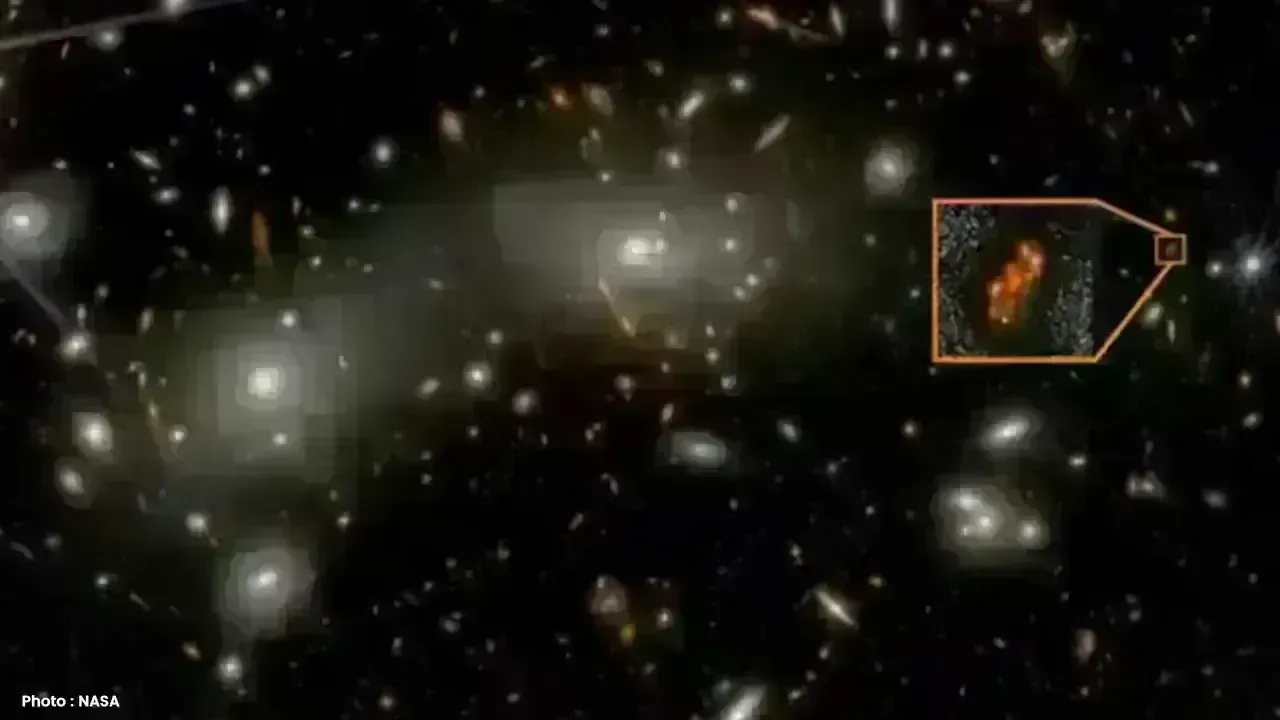
A groundbreaking discovery by astronomers in India is revolutionizing perceptions regarding the early Universe. Utilizing the advanced James Webb Space Telescope (JWST), the team has found a significant spiral galaxy from just 1.5 billion years after the Big Bang, a mere fraction of the Universe's current age of 13.8 billion years.
Led by researcher Rashi Jain, along with her supervisor Prof. Yogesh Wadadekar from the National Centre for Radio Astrophysics (NCRA-TIFR) in Pune, their findings were published in November in the European journal Astronomy and Astrophysics.
This newly named galaxy, Alaknanda, after a river in the Himalayas, has captivated scientists due to its unexpected spiral shape. Previously, galaxies from this early period were thought to be primarily small and chaotic. Alaknanda, however, exhibits a well-defined spiral structure that is strikingly similar to our own Milky Way, a rare occurrence for such an ancient galaxy.
Prof. Wadadekar noted the astonishing resemblance of this galaxy to the Milky Way, despite its formation in a time when the Universe was in its infancy. He emphasized that the existence of such a large disc with spiral arms emerging within only a few hundred million years is extraordinary on a cosmic scale.
With a diameter of approximately 30,000 light-years, Alaknanda is one-third the size of the Milky Way and boasts around 10 billion stars, producing new stars at a rate 20–30 times faster than our galaxy today.
Jain first detected this spiral galaxy earlier this year while analyzing data from JWST, among a survey of nearly 70,000 celestial objects. One particular object, showcasing a clear spiral formation, caught her attention. She described the galaxy’s classic “beads-on-a-string” structure, a pattern rarely witnessed in galaxies of the early Universe.
When she presented her findings to Prof. Wadadekar, he was initially in disbelief, as such a mature galaxy so soon after the Big Bang contradicts longstanding views about the rapid development of galaxies during the Universe’s early years, which are often characterized as chaotic and rudimentary.
While the cosmos hosts billions of galaxies, most early formations were predicted to be small, dim, and irregular. In contrast, Alaknanda stands as compelling evidence that the early Universe may have been more advanced and structured than previously assumed. The discoveries made by JWST have already highlighted numerous ancient galaxies, and Alaknanda reinforces the idea that complex structures could form significantly earlier than anticipated.
Since the galaxy's light has traversed 12 billion years to reach Earth, astronomers are essentially peering into the past. The current state of Alaknanda remains a mystery, as Prof. Wadadekar quipped, “To discern its present status, one would need to wait an additional 12 billion years.”
The research team plans to conduct follow-up observations with JWST or the ALMA observatory in Chile. They aim to unravel the processes that enabled such a colossal spiral galaxy to form its distinctive arms at such an early cosmic timeline. Investigating galaxies like Alaknanda could provide crucial insights into the history of the Universe and address significant questions regarding the evolution of galaxies.










BTS Tour Sparks Global Demand: Mexico Appeals for Additional Shows
BTS' comeback tour creates immense demand in Mexico, prompting President Sheinbaum to urge more conc

Former First Lady Exonerated Amidst Martial Law Controversies
The former First Lady was found not guilty on key charges, but prosecutors intend to appeal as inves

Kim Jong Un Aims to Enhance North Korea’s Nuclear Capabilities
Kim Jong Un is preparing to unveil significant enhancements in North Korea's nuclear and missile sys

Rybakina and Pegula Reach Australian Open Semifinals Following Major Upsets
Rybakina upsets Swiatek; Pegula defeats Anisimova. Both advance to the Australian Open semifinals, a

Trump Appeals for Calm After Federal Shooting Incident in Minnesota
In response to the fatal shooting of two citizens by federal agents, President Trump calls for calm

Malaysian Football Association's Executive Resigns Amid FIFA Sanctions
The Football Association of Malaysia's leadership resigns following FIFA sanctions related to player