Post by : Monika
On October 1, China marked its National Day with an unusual and bold move. Instead of limiting the celebration to Beijing or other cities, Chinese officials and sailors raised their red national flag in the waters near a disputed reef in the South China Sea. The reef is known internationally as Scarborough Shoal, but in China, it is called Huangyan Dao.
This action quickly drew protests from the Philippines, which also claims the shoal as part of its territory. The incident has once again put a spotlight on the ongoing tension in the South China Sea, one of the world’s most contested and strategic waterways.
What Happened at the Shoal
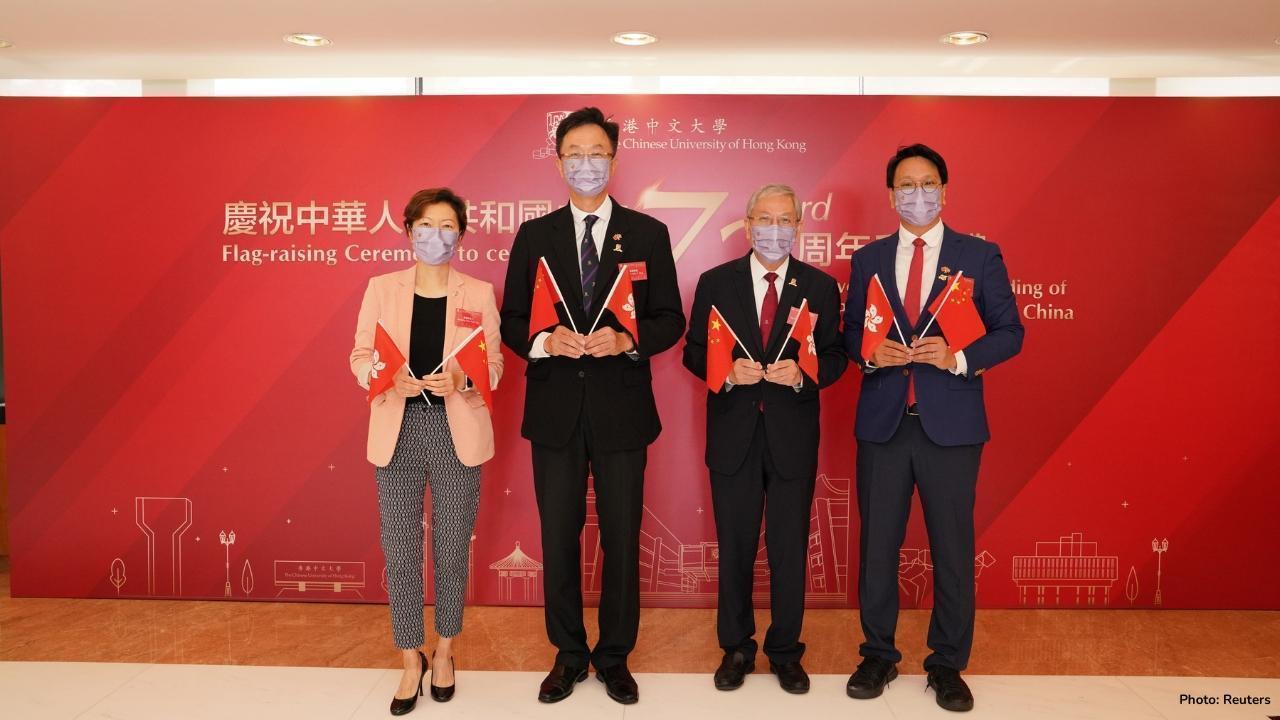
According to Chinese state media, the flag-raising ceremony was held at sea near the shoal. Sailors, coast guard officers, and officials reportedly stood on boats as the Chinese national anthem played. The ceremony marked the founding of the People’s Republic of China on October 1, 1949.
For Beijing, the act was meant to show patriotism and strengthen the government’s claim to waters it considers historically Chinese. But for Manila, it was an insult and a direct challenge to its sovereignty.
The Philippine government immediately expressed its opposition. Officials in Manila called the ceremony “provocative” and warned that China was once again ignoring international law.
Why the Shoal Matters
The Scarborough Shoal lies about 120 nautical miles west of the Philippines’ Luzon island. For decades, Filipino fishermen freely accessed the rich waters there, which are filled with fish and other sea life.
But since 2012, after a standoff between Chinese and Philippine ships, Beijing has controlled access to the area. Chinese coast guard vessels now patrol the waters, often blocking Filipino boats.
The shoal is not just about fishing. It sits in a strategic position in the South China Sea, close to major shipping routes. Whoever controls it has influence over trade and military movement in the region.
The Philippines’ Response
The Philippine Department of Foreign Affairs released a strong statement condemning China’s act. Officials said the shoal “is clearly part of the Philippines’ exclusive economic zone (EEZ)” under international law.
The Philippine government reminded the world of a 2016 ruling by an international tribunal in The Hague, which declared that China’s claim to most of the South China Sea had no legal basis. According to that decision, Scarborough Shoal lies within the Philippines’ EEZ.
Despite the ruling, China has never accepted it. Beijing insists that it has “historic rights” over the waters and features in the South China Sea.
A History of Tension
Scarborough Shoal has been a flashpoint for years.
2012 standoff: Philippine and Chinese vessels faced off for weeks, with neither side willing to withdraw. Eventually, China took control and has since prevented most Philippine boats from entering.
Fishermen disputes: Many Filipino fishermen say they have been harassed or driven away by Chinese coast guard vessels. Some reported that water cannons were used against them.
Military concerns: The Philippine government worries that China could one day build a permanent base or military facility on the shoal, as it has done on other reefs in the Spratly Islands.
The latest ceremony only adds to the growing list of confrontations.
China’s Position
Beijing says that Scarborough Shoal has been part of Chinese territory for centuries. Chinese officials argue that maps and historical records show fishermen from China used the area long before the Philippines existed as a nation.
For China, the National Day flag-raising was not a provocation but a “routine patriotic activity.” The state-run newspapers described it as a proud moment, showing China’s unity and strength.
However, China’s critics say that such acts are meant to gradually normalize its control and send a message: China will not back down, even when international law rules otherwise.
International Law and the 2016 Tribunal
In 2013, the Philippines brought its case to the Permanent Court of Arbitration in The Hague. After three years of study, the tribunal delivered a sweeping victory for Manila in July 2016.
Key points of the ruling included:
Despite the clarity of the ruling, China rejected it. Beijing said the court had “no jurisdiction” and insisted it would not accept or recognize the outcome. Since then, the dispute has remained unresolved.
A Symbolic Move on National Day
National Day is one of the most important holidays in China. It marks the founding of the People’s Republic by Mao Zedong in 1949. Usually, celebrations take place in Beijing’s Tiananmen Square, with military parades, cultural events, and public displays of patriotism.
By holding a ceremony at sea, China was making a symbolic point: the South China Sea is also part of its homeland. Analysts say the event was carefully chosen to send a political message both to its citizens and to foreign governments.
Regional and Global Impact
The South China Sea is not just a regional issue. Nearly $3 trillion worth of trade passes through its waters every year. The area is also believed to hold oil, gas, and other resources.
Other countries, including the United States, Japan, and Australia, have long voiced support for freedom of navigation in the sea. The U.S. Navy regularly conducts patrols near disputed reefs to challenge China’s claims.
With this latest ceremony, experts believe Washington and its allies may increase pressure on Beijing. Already, the U.S. has defense treaties with the Philippines, meaning that an attack on Philippine forces could trigger American involvement.
Voices from the Philippines
Local media in Manila reported anger and frustration among ordinary citizens. Many Filipinos see the shoal as rightfully theirs and feel helpless against China’s growing power.
Fishermen from coastal provinces like Zambales and Pangasinan say their livelihoods have suffered. One fisherman said, “Before, we could fish freely at the shoal. Now the Chinese chase us away. Our children go hungry.”
For them, the flag ceremony was not just politics — it was a reminder of daily struggles and lost income.
Possible Risks for China
Regional tension: Other Southeast Asian nations, like Vietnam and Malaysia, also have disputes with China in the South China Sea. They may feel more threatened after this bold display.
Some analysts say China may be overplaying its hand. While it gains short-term domestic approval, it risks uniting its neighbors and drawing greater U.S. attention.
Looking Ahead
The situation at Scarborough Shoal is unlikely to calm down soon. China has shown it will not back away from its claims, and the Philippines has vowed to defend its rights under international law.
In the coming weeks, observers expect more diplomatic protests, possibly joint naval patrols with the United States, and greater international scrutiny.
For now, the flag raised at sea on China’s National Day has become a powerful symbol — of pride for Beijing, but of pain and defiance for Manila.
\The National Day flag-raising ceremony near Scarborough Shoal was more than a patriotic celebration. It was a political statement about power, territory, and national pride. For China, it demonstrated control. For the Philippines, it represented another act of defiance against international law.
The incident underlines how fragile peace remains in the South China Sea. With fishermen losing access, military forces watching closely, and global trade routes at risk, the dispute over a small shoal has become a test of strength between nations.
Until both sides find a path to peaceful dialogue, every move — even raising a flag — will carry deep meaning and serious consequences.









DAE Achieves Remarkable Growth in Q1 2026 With Record Revenue
Dubai Aerospace Enterprise announces impressive financial results for Q1 2026, reflecting a surge in

Price Increase for Sony PS5 in Southeast Asia Effective May 1
Sony announces a price increase for the PS5 across Southeast Asia starting May 1, 2026, impacting ga

Potential ‘Super El Niño’ in 2026: Understanding the Climate Risks
Could a Super El Niño emerge in 2026? Discover its implications and potential global climate impacts

Global Energy Crisis Intensifies: Markets React to Oil Supply Challenges
Markets are on edge as oil disruptions escalate, influencing prices and economic stability. Explore

Must-See Tourist Spots in London You Can't Overlook
Explore London's essential attractions, from royal landmarks to vibrant markets, ensuring an unforge

Ultimate Guide to Snagging Cheap Flights in 2026
Unlock the secrets to booking affordable flights in 2026 with insightful tips and strategies tailore




