Post by : Shweta
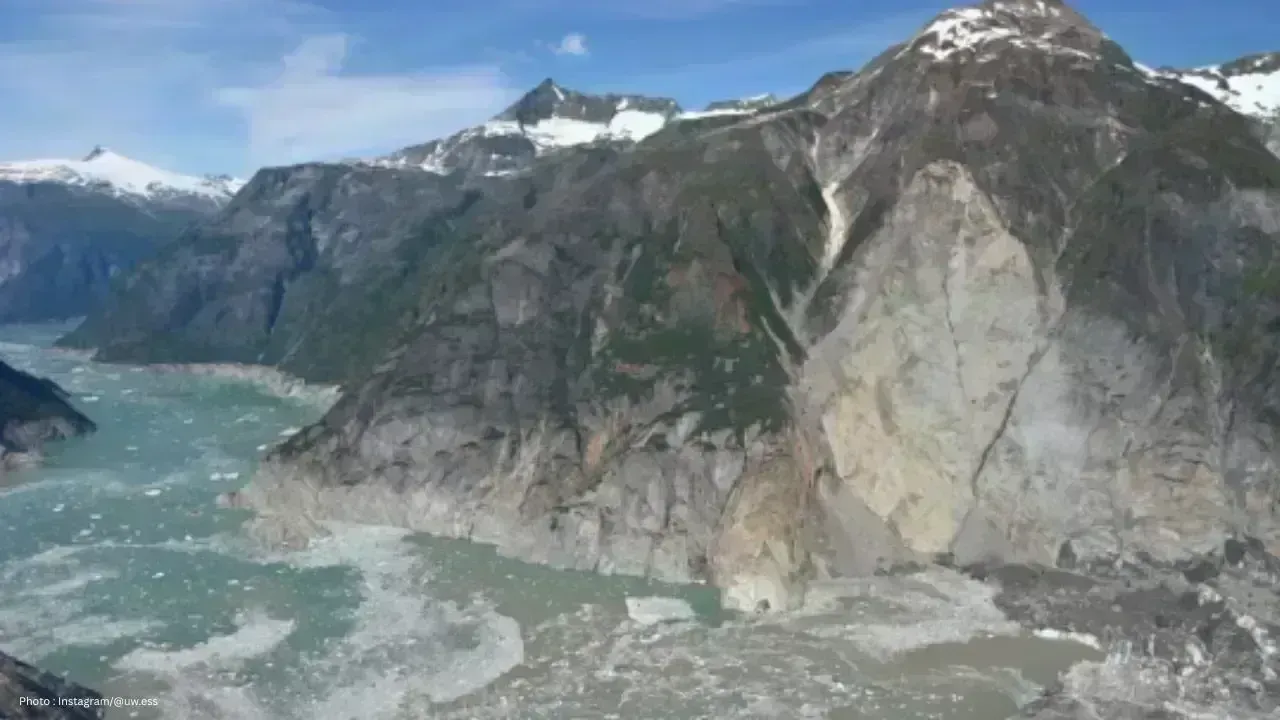
Recent satellite observations indicate that a colossal tsunami was generated following the collapse of a mountain in Alaska. This occurrence is noted as the second largest tsunami in history, with waves soaring up to nearly 200 meters due to millions of tons of rock plunging into a secluded fjord.
The event transpired in Dickson Fjord in eastern Greenland, triggered by the instability of mountains linked to the melting of glaciers. While it happened in an unpopulated vicinity, the magnitude of the collapse was significant enough for seismic sensors globally to register its vibrations. For several days, the tsunami oscillated within the narrow fjord.
International researchers reported that Earth-observing satellites captured intricate images and radar data that illustrated the movement of these giant waves through the fjord post-collapse. The role of satellite technology was pivotal, granting scientists a clearer understanding of the tsunami's scale and movement in a region challenging to access physically.
According to experts, the disaster unfolded due to prolonged warming, which weakened the mountain's structure. The melting glaciers beneath the mass diminished the support along the slope, leading to the catastrophic release of vast amounts of rock and ice into the fjord. This sudden descent displaced tremendous quantities of water, creating what is classified as a “mega-tsunami.”
Unlike traditional ocean tsunamis typically instigated by earthquakes, mega-tsunamis have distinct triggers like landslides or volcanic collapses that plunge rapidly into enclosed waters. The confinement within narrow fjords or bays allows these waves to swell to unprecedented heights and wreak havoc.
This event raises pressing concerns regarding climate change and its implications on Arctic environments. Researchers highlighted that increasing temperatures are accelerating glacier melt and destabilizing mountain infrastructures, potentially raising the risk of similar events in the future. The transformation in these remote Arctic regions is accelerating as loss of ice continues.
While there were no fatalities due to the isolated location of the event, experts emphasize the potential severity of climate-related geological phenomena. Continuous study of this collapse aims to provide insights into future landslides and mega-tsunamis in vulnerable areas globally.
Satellite agencies, along with climate scientists, are leveraging data from this event to enhance tsunami detection systems and risk assessment models. There is a common belief that advanced monitoring technologies could furnish earlier warnings for coastal communities that may face the threat of future landslide-driven tsunamis.
Describing the event as a significant demonstration of modern satellite capabilities, scientists noted its importance in real-time documentation of extreme natural disasters. The insights gathered are expected to inform ongoing research into climate change, Arctic geology, and the worldwide risks associated with tsunamis, as scholars continue to explore the long-term repercussions of rising temperatures on unstable mountain ecosystems.







Anticipated Dates for UAE Eid Al Adha 2026 Unveiled by Astronomical Experts
Experts predict Eid Al Adha 2026 in the UAE to start on May 27, prompting early holiday planning amo

DAE Achieves Remarkable Growth in Q1 2026 With Record Revenue
Dubai Aerospace Enterprise announces impressive financial results for Q1 2026, reflecting a surge in

Price Increase for Sony PS5 in Southeast Asia Effective May 1
Sony announces a price increase for the PS5 across Southeast Asia starting May 1, 2026, impacting ga

Potential ‘Super El Niño’ in 2026: Understanding the Climate Risks
Could a Super El Niño emerge in 2026? Discover its implications and potential global climate impacts

Global Energy Crisis Intensifies: Markets React to Oil Supply Challenges
Markets are on edge as oil disruptions escalate, influencing prices and economic stability. Explore

Must-See Tourist Spots in London You Can't Overlook
Explore London's essential attractions, from royal landmarks to vibrant markets, ensuring an unforge




